
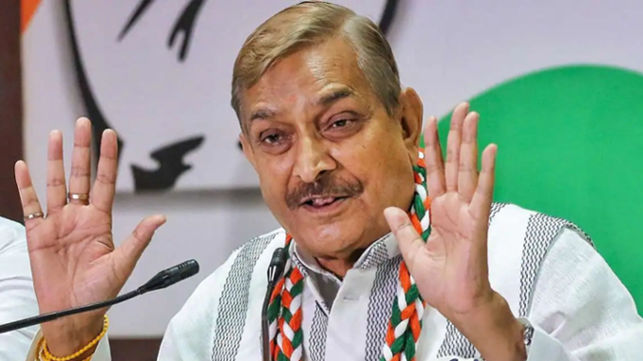

Congress MP Pramod Tiwari expressed his support for the Supreme Court’s recent directive to the Election Commission of India. On Wednesday, he welcomed the Court’s decision to stop the erasure or reloading of data during the verification process of Electronic Voting Machines (EVMs).
Tiwari’s Statement on the Issue
Tiwari stated, "I welcome the Supreme Court's observation on this. There is a dispute, and if you delete the data, how will the truth and facts come to light? It is necessary to leave it in the same state. The SC should call experts to examine what has happened and what possibilities exist; only then can the court arrive at a decision," he told reporters. Therefore, Tiwari emphasized the importance of transparency and accurate data handling.
Supreme Court’s Directive to the Election Commission
On Tuesday, the Supreme Court instructed the Election Commission to respond to petitions requesting the verification of burnt memory and symbol loading units in EVMs. This was in line with a previous ruling made by the Court. In addition, a special bench, led by Chief Justice Sanjiv Khanna and Justice Dipankar Datta, directed the Election Commission to refrain from erasing or reloading any data during the verification process. Consequently, the bench gave the Election Commission 15 days to submit a response and explain its procedures. The matter will be discussed again in the week of March 3.
Petitions and ADR’s Request
The petitions filed sought verification of the burnt memory and micro-controllers in the EVMs. In support of this, the Association for Democratic Reforms (ADR) filed a fresh application, arguing that the Election Commission’s current procedures did not comply with the Supreme Court’s 2024 judgment on the EVM-VVPAT case. Moreover, the ADR urged the Court to stop the Election Commission from clearing or deleting the contents of the burnt memory of EVMs, especially when verification requests are still pending.
Previous Supreme Court Ruling on Paper Ballots
Previously, in its April 26, 2024 ruling, the Supreme Court had rejected the call to revert to paper ballots. The Court explained that electronic devices were secure and played a crucial role in eliminating booth capturing and bogus voting. Nevertheless, the Court allowed unsuccessful candidates, who finished second or third in the election, to request the verification of micro-controller chips in 5 percent of EVMs per assembly constituency. These candidates could make this request in writing and pay a fee to the Election Commission.