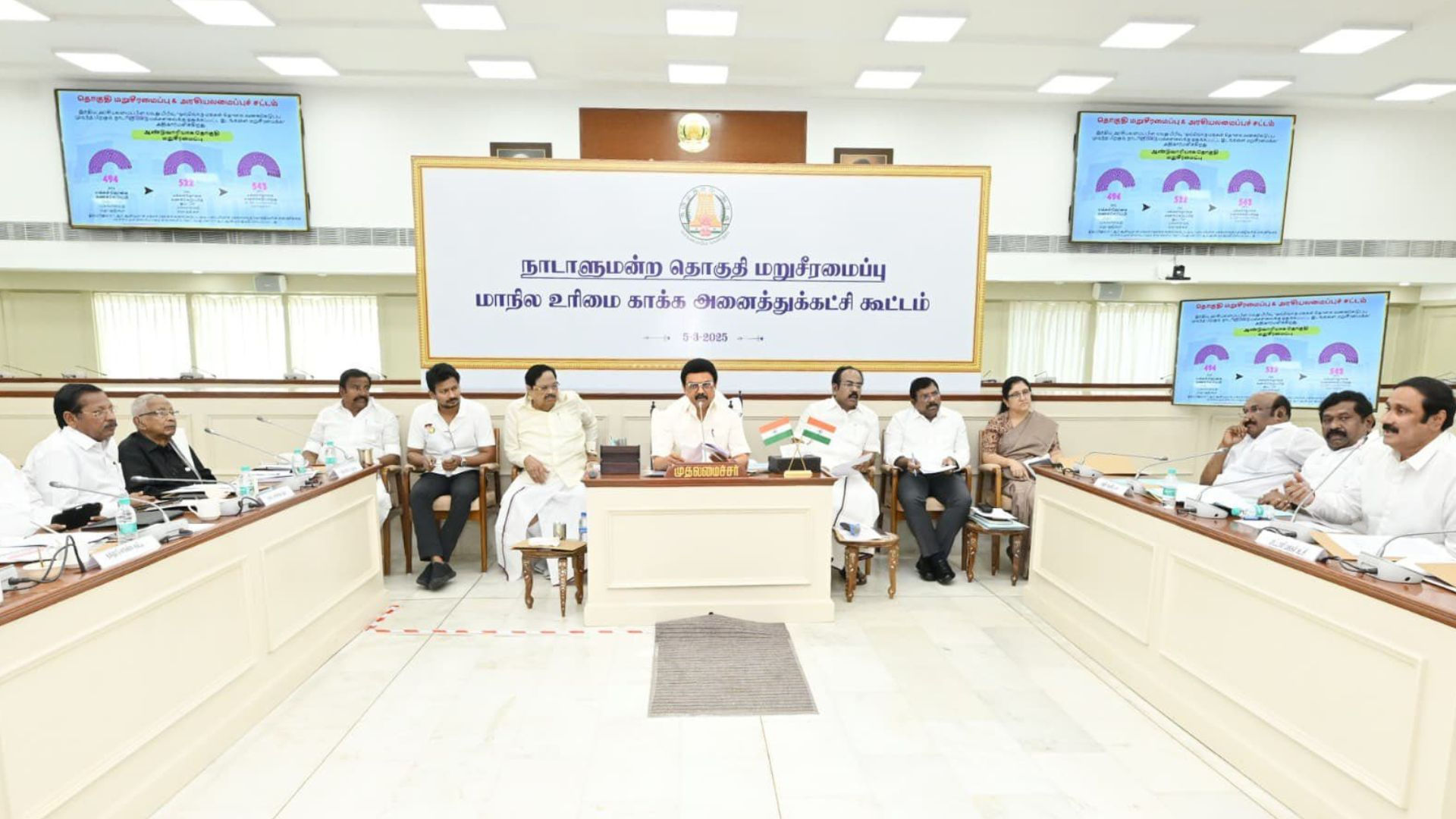
Tamil Nadu Chief Minister M.K. Stalin strongly opposes the proposed delimitation exercise, calling it a "blatant assault" on federalism. On Friday, he announced that he had written to several chief ministers and former leaders, raising concerns about the process. He believes it unfairly punishes states that have successfully controlled their population and ensured good governance.
Stalin's Strong Stand Against Delimitation
Stalin took to social media platform X to express his discontent. He stated, "The union government's plan for delimitation is a blatant assault on federalism, punishing states that ensured population control and good governance by stripping away our rightful voice in Parliament. We will not allow this democratic injustice."
He reached out to key leaders, including Kerala CM Pinarayi Vijayan, Karnataka CM Siddaramaiah, Telangana CM Revanth Reddy, Andhra Pradesh CM N. Chandrababu Naidu, West Bengal CM Mamata Banerjee, Punjab CM Bhagwant Mann, and Odisha CM Mohan Majhi. Additionally, he wrote to political party heads in Kerala, Andhra Pradesh, Telangana, Karnataka, West Bengal, Odisha, and Punjab. He urged them to unite against what he calls an "unfair exercise."
Understanding the Delimitation Exercise
Delimitation, originally scheduled for 2026, reallocates parliamentary seats based on population. This process could reduce representation for states with slower population growth.
Key Concerns Raised in Stalin’s Letter
In his letter, Stalin warned that the proposed exercise could weaken the political influence of states like Tamil Nadu, which have made significant efforts in population control. He noted that previous delimitation exercises took place in 1952, 1963, and 1973. However, the 42nd Amendment in 1976 halted them, freezing seat allocations until after the first census post-2000. In 2002, this freeze was extended until after the 2026 census.
Stalin argued that using post-2026 population data for delimitation would unfairly reduce parliamentary representation for states with effective population control policies. He also criticized the Central government for failing to provide clarity, calling their assurances vague and insufficient.
Implications of Delimitation
Stalin outlined two possible approaches for delimitation. The first involves redistributing the existing 543 parliamentary seats among the states. The second suggests increasing the total number of seats beyond 800. In both cases, he warned that states with successful population control policies would suffer losses if allocations rely on future census data.
"Tamil Nadu should not be penalized for effectively controlling population growth and upholding national development goals," he asserted.
He also accused the Union government of lacking transparency. He stated, "Despite the gravity of this issue, the Union Government has provided neither clarity nor any concrete commitment to address our concerns. Their representatives have vaguely stated that delimitation would follow a 'pro-rata' basis, without explaining the base used for such calculations."
He further questioned, "When the very foundation of our democracy is at stake, can we accept such vague assurances? When our States' futures hang in the balance, do we not deserve transparent dialogue?"
Call for Collective Action
To counter the proposed changes, Stalin urged other states to join the Joint Action Committee (JAC). He invited them to an inaugural meeting in Chennai on March 22 to formulate a collective strategy.
Amit Shah’s Response
Amid growing concerns, Union Home Minister Amit Shah sought to reassure Tamil Nadu and other southern states. He stated that they would receive a fair share of seats in the delimitation exercise. He also assured that if the number of seats increased, southern states would not be disproportionately affected.
However, Stalin remains steadfast in his opposition. He continues to push for a united front against what he sees as a threat to democratic representation for states with controlled population growth.