
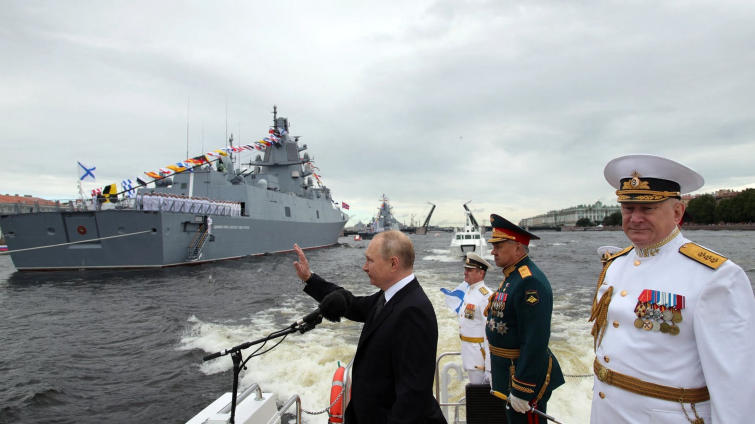

Russia reduced its annual Navy Day celebrations on Sunday because of growing fears over Ukrainian drone strikes. The Kremlin cancelled traditional warship parades usually held in cities like St. Petersburg, Kaliningrad, and Vladivostok. These parades are a key part of Russia’s Navy Day festivities.
Kremlin Cites Security as Top Priority
When reporters asked why the parade in St. Petersburg was cancelled, even though President Vladimir Putin visited the city, Kremlin spokesman Dmitry Peskov said, “It’s linked to the overall situation, security reasons, which are above all else.”
Massive Drone Attacks Hit Russia
The Russian Defence Ministry reported that air defence systems had destroyed 99 Ukrainian drones overnight. Later that day, another 51 drones were shot down near St. Petersburg. Local officials said drone fragments injured a woman in the Lomonosov area.
As a result of these attacks, St. Petersburg’s Pulkovo airport suspended dozens of flights early Sunday.
Putin Reviews Naval Exercises, Praises Crew
Despite the security concerns, President Putin visited the historic Admiralty headquarters in St. Petersburg. There, he reviewed results from the “July Storm” naval drills, which involved 150 ships from the Baltic to the Pacific.
Putin said the Russian Navy would receive more training and warships. He added, “the navy’s strike power and combat capability will rise to a qualitatively new level.”
He also visited the Admiral Grigorovich frigate at the Kronstadt naval base and praised the crew for stopping a Ukrainian drone attack earlier that day.
Ukraine’s Drone Campaign Forces Russia to Adapt
Russia’s decision to scale back Navy Day celebrations highlights how much Ukraine’s drone attacks are shaking the Kremlin’s confidence. In earlier strikes during the war—now entering its fourth year—Ukraine sank multiple Russian warships in the Black Sea. These hits severely weakened Moscow’s naval strength and forced Russia to move its fleet from Crimea to Novorossiysk.
On June 1, Ukraine launched a bold drone attack code-named “Spiderweb.” The operation targeted several Russian air bases used by long-range bombers, hitting locations from the Kola Peninsula to Siberia. Ukraine launched these drones from hidden trucks parked near the bases. The surprise attack damaged or destroyed many bombers that had carried out airstrikes on Ukraine. This move gave Kyiv a major morale boost, especially as it continues to defend a 1,000-kilometre (600-mile) front line with limited manpower and weapons.
Russia Responds With More Strikes
In response, Russia continued its own drone and missile attacks across Ukraine on Sunday. In Sumy, northeastern Ukraine, drones damaged civil infrastructure, an administrative building, and other sites. The regional military said three people were wounded.
In other parts of Sumy, two men died after stepping on a land mine, while a woman was injured by another drone strike.
Macron Backs Kyiv, Urges Peace Talks
French President Emmanuel Macron spoke with Ukrainian President Volodymyr Zelenskyy on Sunday. Later, Macron posted on X (formerly Twitter) that he reaffirmed France’s full support for Ukraine. He also said he would push for more pressure on Moscow to agree to a ceasefire. According to Macron, this truce should lead to “a solid and lasting peace, with full European involvement.”