
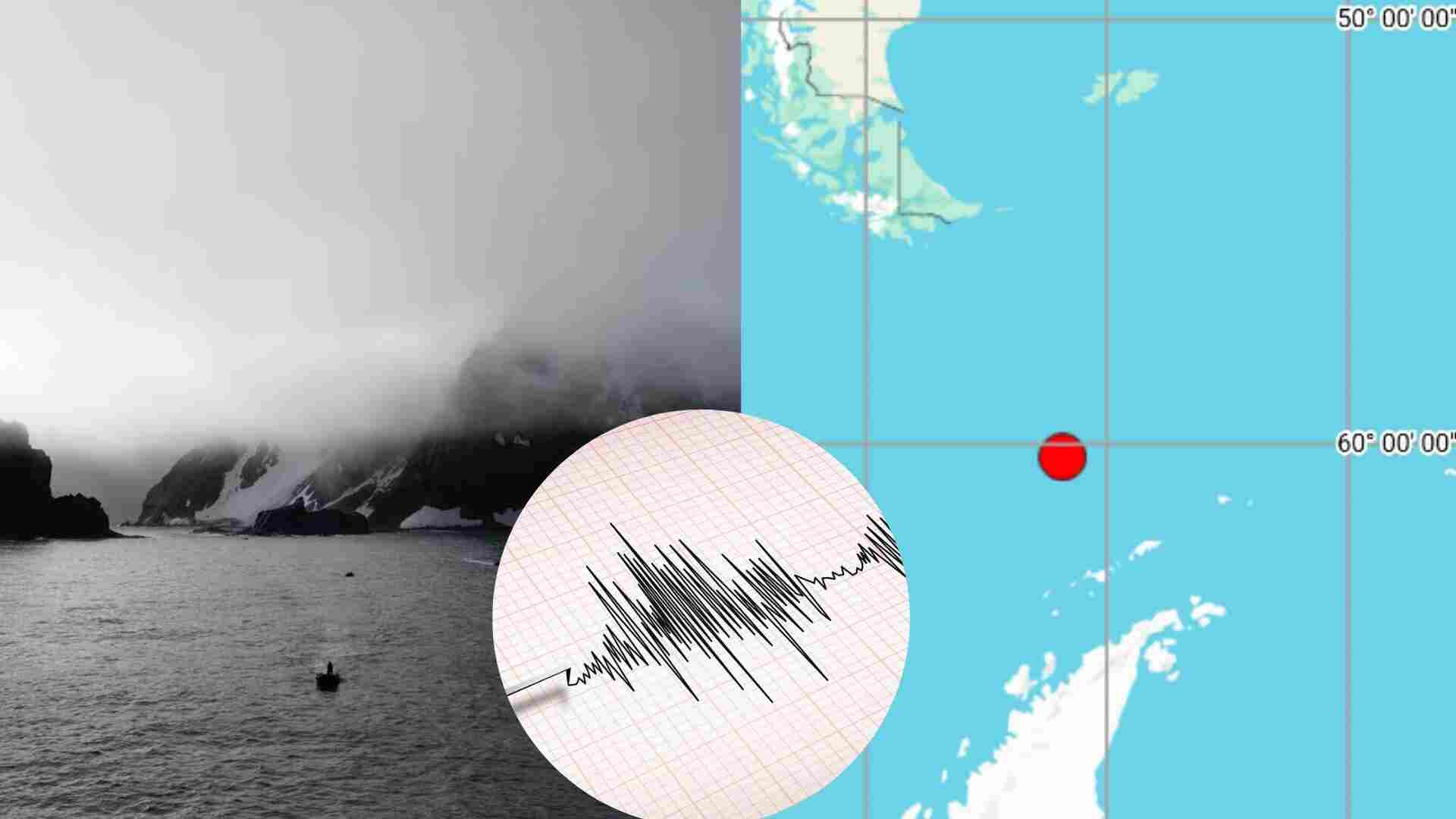

A strong earthquake hit the Drake Passage region on Thursday, according to the US Geological Survey (USGS). The agency first reported the quake at magnitude 8 but later downgraded it to 7.5.
The tremor struck at a shallow depth of 10.8 kilometers. The German Research Center for Geosciences estimated the magnitude slightly lower, at 7.1. Meanwhile, India’s National Center for Seismology (NCS) reported the quake at 7.4 with a depth of 36 kilometers at 7:46 am (IST).
EQ of M: 7.4, On: 22/08/2025 07:46:22 IST, Lat: 60.26 S, Long: 61.85 W, Depth: 36 Km, Location: Drake Passage.
— National Center for Seismology (@NCS_Earthquake) August 22, 2025
For more information Download the BhooKamp App https://t.co/5gCOtjdtw0 @DrJitendraSingh @OfficeOfDrJS @Ravi_MoES @Dr_Mishra1966 @ndmaindia pic.twitter.com/o5tQQ1wIa6
Tsunami Concerns
Although the US tsunami warning system did not issue an alert, the Pacific Tsunami Warning Center (PTWC) briefly sounded a warning for Chile. It said, “hazardous tsunami waves from the earthquake in Drake Passage are possible within the next three hours along some Chilean coasts.”
In response, Chile’s Navy Hydrographic and Oceanographic Service issued a precautionary notice for the country’s Antarctic territory.
The Drake Passage Explained
The Drake Passage is a vast stretch of water separating South America’s Cape Horn from the South Shetland Islands of Antarctica. It serves as a natural link between the southwestern Atlantic Ocean and the southeastern Pacific Ocean.
Context of Recent Quakes
This powerful tremor comes weeks after one of the strongest quakes ever recorded struck Russia’s Far East on July 30. That 8.8-magnitude quake triggered tsunami waves in Japan and Alaska and forced authorities across the Pacific, including Hawaii, North and Central America, and several islands toward New Zealand, to issue alerts.
Officials had then warned that the tsunami danger could last for more than a day.