
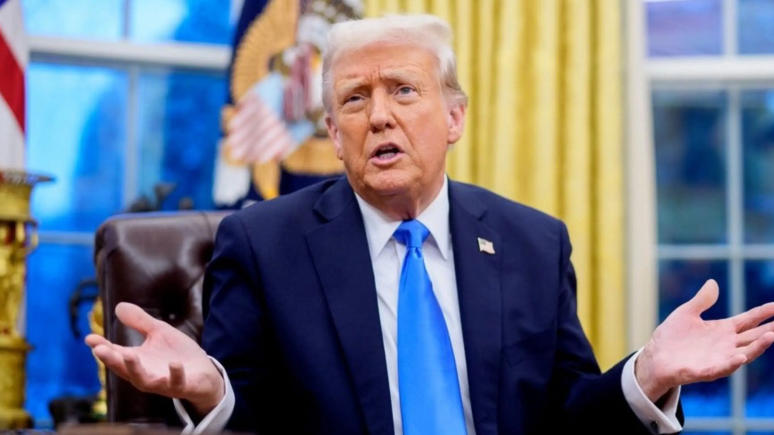

US President Donald Trump reacted strongly on Saturday after a US Appeals Court ruled most of his tariffs unlawful. Despite this setback, he said his tariff policy remains in place. Furthermore, he promised to take the case to the Supreme Court.
“ALL TARIFFS ARE STILL IN EFFECT! Today a Highly Partisan Appeals Court incorrectly said that our Tariffs should be removed, but they know the United States of America will win in the end,” Trump said.
Trump Warns of Economic Disaster
He also warned that removing tariffs would hurt the US economy. “If these Tariffs ever went away, it would be a total disaster for the Country. It would make us financially weak, and we have to be strong. The U.S.A. will no longer tolerate enormous Trade Deficits and unfair Tariffs and Non Tariff Trade Barriers imposed by other Countries, friend or foe, that undermine our Manufacturers, Farmers, and everyone else. If allowed to stand, this Decision would literally destroy the United States of America,” he said.
Moreover, Trump highlighted the benefits of tariffs for American workers and businesses.
“At the start of this Labor Day weekend, we should all remember that TARIFFS are the best tool to help our Workers, and support Companies that produce great MADE IN AMERICA products. For many years, Tariffs were allowed to be used against us by our uncaring and unwise Politicians. Now, with the help of the United States Supreme Court, we will use them to the benefit of our Nation, and Make America Rich, Strong, and Powerful Again! Thank you for your attention to this matter.”
Court Rules Trump Exceeded Authority
Meanwhile, the US Court of Appeals in Washington, DC, ruled that Trump overstepped his powers. He had imposed tariffs under emergency powers laws.
“The statute bestows significant authority on the President to undertake a number of actions in response to a declared national emergency, but none of these actions explicitly include the power to impose tariffs, duties, or the like, or the power to tax,” the court said, according to Reuters.
Tariffs Affected
As a result, the court struck down Trump’s “reciprocal” tariffs introduced in April during the trade war. It also invalidated a separate set of February tariffs targeting China, Canada, and Mexico. However, tariffs on steel and aluminum under different laws remain in effect.
Trump had justified the tariffs using the International Emergency Economic Powers Act (IEEPA), a 1977 law usually applied for sanctions or freezing assets. Importantly, he became the first US president to use IEEPA for tariffs.
Legal Challenges and Constitutional Concerns
Furthermore, the court noted, “It seems unlikely that Congress intended, in enacting IEEPA, to depart from its past practice and grant the President unlimited authority to impose tariffs.”
The ruling followed two lawsuits—one filed by five small US businesses, and another by 12 Democratic-led states. Both argued that IEEPA does not give the president authority to impose tariffs. They stressed that the Constitution assigns Congress—not the president—the power to impose taxes and tariffs. Additionally, any delegation of such authority must be clear and limited.