
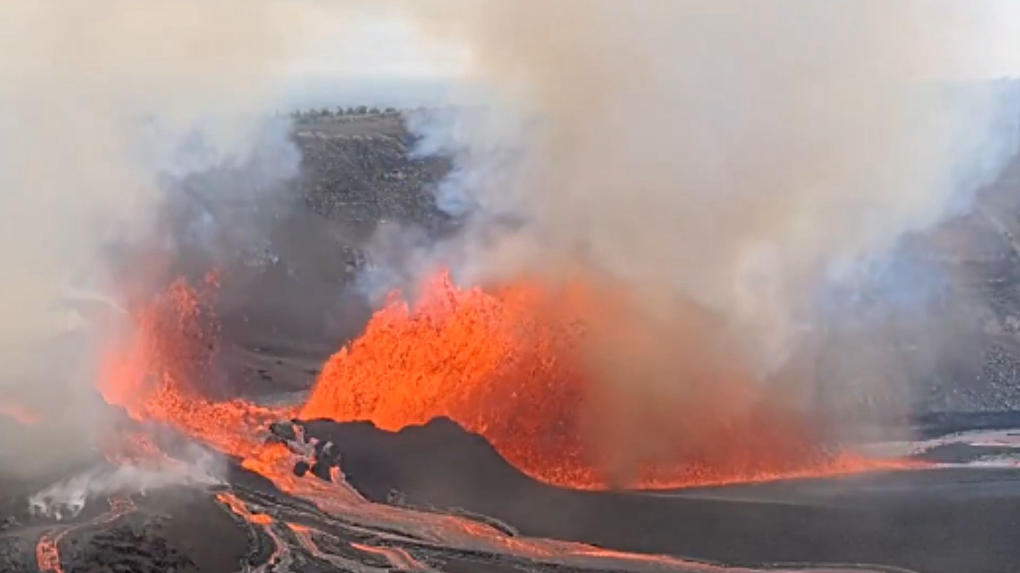

Hawaii’s Kilauea volcano erupted early Tuesday, once again putting on a spectacular show of nature’s force. The US Geological Survey (USGS) reported that fountains of molten lava soared 330 feet (100 meters) into the air.
Moreover, dramatic footage released by USGS captured bright orange lava shooting skyward, while thick clouds of smoke rose above the crater.
This marked the 32nd eruption since December, when the volcano’s latest activity began. Importantly, officials confirmed that all the lava stayed contained within Halemaumau Crater inside Hawaii Volcanoes National Park, meaning no homes or buildings were at risk.
We know you've heard of a volcano...but how about a volnado?
— USGS Volcanoes🌋 (@USGSVolcanoes) September 3, 2025
This afternoon, during episode 32 fountaining at Kīlauea the V3 live camera (https://t.co/tCc5xGmMcO) caught this whirlwind kicking up loose ash deposits along the active fountain and flow within Halemaʻumaʻu crater. pic.twitter.com/wCwhZgoFV8
Activity Spreads to Multiple Vents
At first, the eruption began just after midnight, when lava emerged from the north vent of the crater. Then, by 6:35 a.m., the vent started spewing powerful fountains of lava.
As the morning progressed, two more vents erupted — one to the south and another in the middle — intensifying the volcanic activity. Furthermore, a video released by USGS showed molten rock flowing rapidly, with glowing deposits forming around the active vents.
Magma Build-Up Driving the Eruption
According to scientists, Halemaumau Crater has been receiving magma directly from deep underground at a rate of five cubic yards (3.8 cubic meters) per second.
Explaining the process, Ken Hon, head of the Hawaiian Volcano Observatory, said the magma first fills a lower chamber, which builds up intense pressure. Eventually, it pushes into an upper chamber and then bursts to the surface through cracks, creating the fiery display seen above ground.
Previous Eruptions Reached Even Greater Heights
Since December, Kilauea has erupted repeatedly, and at times, lava fountains have soared more than 1,000 feet (300 meters) into the sky. Consequently, these eruptions have created spectacular natural displays, attracting scientists and tourists alike.
Volcano’s Location and Viewing Options
Kilauea is one of the most active volcanoes in the world. It sits on Hawaii Island, roughly 200 miles (320 kilometers) south of Honolulu, which is located on Oahu.
Additionally, visitors can safely watch the eruption from designated viewing points within the national park. For those unable to visit, USGS offers a live stream showing real-time footage of the volcano from three different camera angles.
Lava Remains Contained and Communities Safe
Authorities emphasized that lava remains fully contained within the crater. Therefore, there is no immediate danger to nearby communities. However, scientists continue to closely monitor Kilauea, since its activity can change without warning.
As a result, the volcano remains a powerful reminder of nature’s force, captivating observers with its dramatic eruptions and fiery displays.