
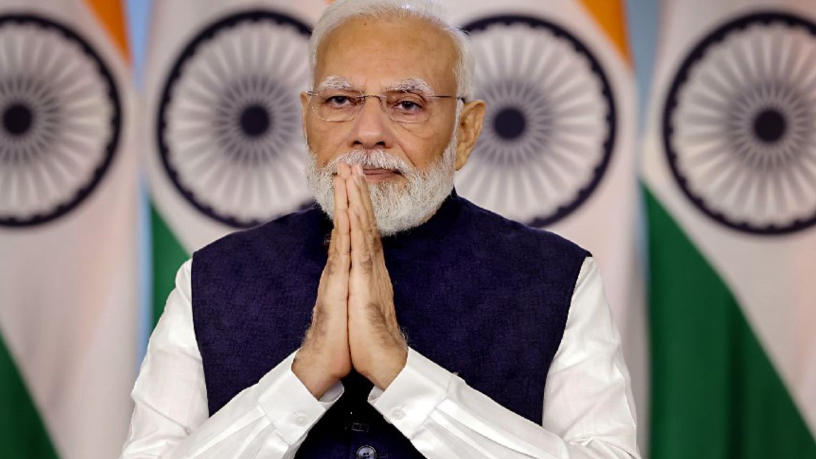

Narendra Modi is a visionary leader who has taken India to the global stage in 11 years. He is not just a name or a political leader; he is now the heartbeat of crores of Indians. Today, he turns 75 — an age when most people retire. But he continues to work day and night to make India a world leader.
Narendra Modi delivered his first Independence Day speech from the Red Fort on August 15, 2014. He wore a white kurta and a bright orange-and-green Rajasthani safa.
In that speech, he described himself as an “outsider to Delhi.” Modi said, “I have been quite isolated from the elite class of this place but during the last two months while being an outsider, I had an insider view and I was astonished. It seemed as if dozens of separate governments are running at the same time in one main government. It appears that everyone has their own fiefdom. I could observe disunity and conflict among them.”
From the very beginning, Modi made it clear he wanted to unify governance and simplify decision-making. Over the next 11 years, he streamlined welfare schemes, pushed legal reforms, and strengthened India’s position globally.
Transforming Political Communication
Soon after taking office, Modi introduced a new style of political communication.
A senior BJP leader explained, “After he became the PM, one big change was visible in political communication. He changed the way the PM communicated with the people from online to offline. And there was no need for intermediaries…he reached out directly to the masses and he spoke to all sections of society.”
As a result, Modi connected with citizens without middlemen, building trust and strengthening his bond with the public.
Strengthening the BJP and NDA
Immediately after 2014, Modi began organizing BJP workers nationwide. He directed them to promote government programs like Swachh Bharat Mission and ensure every household benefited from welfare schemes.
A BJP functionary said, “There was a clear directive that party workers had to pull their weight. Even in states where the BJP was considered an outsider, the workers were asked to show up and work to expand the party’s base and that’s how the BJP had grown to be the world’s largest party.”
Consequently, BJP’s growth skyrocketed. BJP president JP Nadda stated, “The Modi-led NDA is responsible and responsive. We are the largest political party in the world with 14 crore members. NDA governments in 20 states, BJP governments in 13 states. We have 240 MPs, around 1,500 MLAs, and more than 170 MLCs.”
Even when key allies like TDP, JD(U), AIADMK, SAD, and Shiv Sena left the NDA, Modi restructured the coalition. Eventually, most returned, with only the SAD staying out.
Furthermore, Modi delivered on core promises, including building the Ram Temple in Ayodhya and scrapping Article 370 in Jammu and Kashmir.
Expanding BJP’s Base Nationwide
Over the years, Modi focused on marginalized groups and regional expansion.
For the first time, BJP formed governments in Assam, Jammu & Kashmir, and Andhra Pradesh. Modi repeatedly emphasized that the poor, youth, women, and farmers were India’s four biggest castes. By doing so, he united a broad coalition of Hindu voters.
Former MP Rakesh Sinha remarked, “Modi unapologetically freed India from colonial legacies and hangovers. His leadership is a unique combination of ideas of development and cultural unfoldment. We can confidently say that he redefined the idea of India.”
Similarly, BJP made unprecedented gains in the Northeast. A party leader highlighted, “He’s made multiple visits to the Northeast, more than any PM. He ensured that development funds turned into real infrastructure on the ground.”
Since 2014, BJP has won three straight Lok Sabha elections and now governs seven Northeastern states.
Economic Growth and Reforms
At the start of Modi’s tenure, India was part of the Fragile Five economies. Today, it is the fourth-largest economy and is expected to rise to third place soon.
Union Minister Gajendra Singh Shekhawat explained Modi’s approach. “The PM follows a different philosophy and work ethic. He says when you draft a policy, put yourself in the place of the poorest of the poor and then roll it out. He has always said there is a need to eliminate the layers, increase efficiency and connect with the people.”
To achieve this, Modi introduced major reforms:
-
Digital India to expand online services.
-
Jan Dhan Yojana for financial inclusion.
-
Collateral-free loans for women and youth.
-
Goods and Services Tax (GST) launched in 2017.
-
Merging railway and Union Budgets for efficiency.
-
Make in India to boost manufacturing.
-
Heavy investment in roads, railways, and airports.
As a result, India witnessed massive growth:
-
Digital payments hit 222 billion in 2024-25.
-
Over 100 unicorn companies emerged.
-
Extreme poverty significantly reduced.
-
Inflation brought under control.
Redefining Foreign Policy
From the beginning, Modi reshaped India’s foreign policy strategy.
In 2014, he invited SAARC leaders to his oath ceremony, signaling a regional focus. He declared that any terror attack on India would be treated as an act of war.
A BJP leader said, “There was a misconception that being non-aligned means India should not speak out. The PM has been firm that India’s interests are paramount and the government will do what it takes to secure them.”
During the Covid-19 pandemic, Modi launched Vaccine Maitri to share vaccines globally. He also ordered Operation Sindoor, showing that terror bases in Pakistan and Pakistan Occupied Kashmir would face a strong response.
Additionally, Modi personally monitored evacuations during crises in Yemen, Afghanistan, and Ukraine. He also pushed for tough trade deals, including agreements with the United States.
Sinha observed, “Modi is the first leader from the developing world who made his legitimate and decisive place in world politics.”
Improving Welfare and Daily Life
At the same time, Modi focused on ease of living and welfare schemes.
Former Himachal Pradesh CM Jairam Thakur recalled how Modi sped up the Atal Tunnel project connecting Manali and Keylong. Despite Covid-19 restrictions, Modi insisted on inaugurating the tunnel in October 2020 before winter closures.
According to an RSS leader, Modi’s personal experiences shaped his policies. “When he spoke about the need for clean fuel, it was because he had seen his mother struggle in the kitchen. Similarly, having seen the poor struggle for health care, education, and earning opportunities fuelled his pro-people policies and welfare schemes.”
Key welfare achievements include:
-
Ujjwala Yojana – free LPG connections to poor households.
-
Jan Dhan Yojana – 550.2 million bank accounts opened.
-
Ayushman Bharat – 36 crore people covered under health insurance.
-
PM Awas Yojana – 91.50 lakh houses built.
Consequently, Modi created a large base of direct beneficiaries, or labharthis, who strongly support his leadership.
Strengthening Defence and Security
Under Modi’s leadership, defence spending rose sharply. He encouraged local production of military equipment by raising FDI in defence from 26% to 49%.
India acquired Rafale fighter jets and commissioned its first indigenous aircraft carrier, INS Vikrant.
A BJP leader noted, “While he’s stressing on Atmanirbarta in all sectors including defence, he is a leader who has taken the initiative of addressing their demands, from ensuring the roll out of One Rank, One Pension to spending time with the soldiers.”
Since 2014, Modi has celebrated Diwali with soldiers every year, starting at Siachen Base Camp. Recently, he oversaw Operation Sindoor, targeting terror bases in Pakistan.
Standing Firm for Farmers
Meanwhile, Modi stood strong for farmers amid global trade challenges.
At the MS Swaminathan Centenary International Conference, he declared, “I am aware that at a personal level I will have to pay a heavy price, but I am prepared for it. India is ready for its farmers, fishermen and cattle-rearers. We have been consistently working towards increasing the income of farmers, reducing the expenditure on farming and creating new sources of income.”
Modi’s Legacy
Over the last 11 years, Modi has modernized governance, expanded welfare, strengthened India’s economy, and elevated its global role.
His journey from an RSS pracharak to Prime Minister reflects a deep understanding of India’s struggles.
Ultimately, Modi’s leadership has reshaped India’s future, leaving behind a legacy of bold reforms, decisive policies, and a direct connection with the people.