
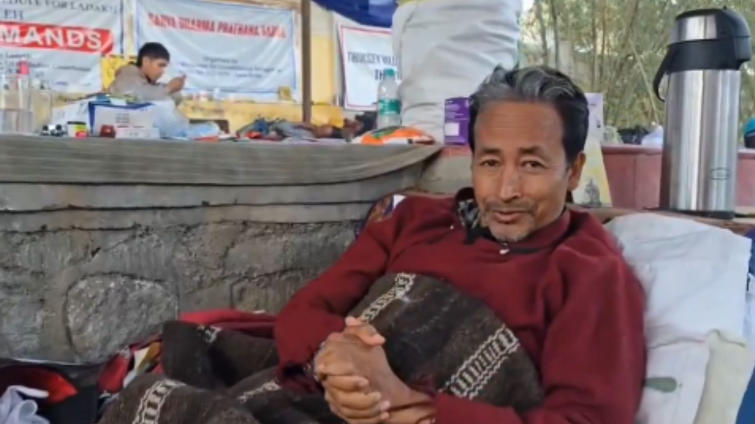

Ladakh is slowly returning to normal after protests turned violent, leaving four people dead and around 70 injured. Authorities reported no violent incidents since 4 pm on Wednesday, September 24, signaling a fragile calm across the region.
Meanwhile, the Union government blamed climate activist Sonam Wangchuk for provoking the demonstrations. Officials claimed that his speeches encouraged people to act violently.
Government Blames Wangchuk
The Ministry of Home Affairs (MHA) said Wangchuk misled people by referencing Arab Spring-style protests and Gen-Z demonstrations in Nepal. According to the ministry, his words directly triggered the mob to vandalize government offices and BJP headquarters.
The MHA stated, “On 24th September, around 11.30 am, a mob instigated by his (Wangchuk’s) provocative speeches left the venue of the hunger strike and attacked a political party office as well as Government office of the CEC Leh.”
Additionally, the government criticized Wangchuk for leaving without attempting to calm the crowd. “Amidst these violent developments, he broke his fast and left for his village in an ambulance without making serious efforts to control the situation,” the statement read.
Scale of Violence
Officials described Wednesday’s unrest as the most violent in recent years. Protesters set fire to vehicles and buildings, targeting the BJP office and the Hill Council. Consequently, police and paramilitary forces used teargas to restore order. Authorities also imposed a curfew and banned gatherings of more than five people.
The MHA traced the unrest back to Wangchuk’s hunger strike, which began 10 days earlier. He demanded statehood for Ladakh and its inclusion in the Sixth Schedule of the Constitution, which grants special autonomy to tribal areas. The ministry noted that dialogue with the Union government was already underway but added that some politically motivated individuals tried to sabotage the process.
Wangchuk Responds
Wangchuk has not directly responded to the government’s claims. However, he condemned the violence, saying his “message of peaceful path failed.”
He said, “On the 15th day of our strike, I am pained to say that several incidents of violence, arson and vandalism took place in Leh today. Two people on strike had to be hospitalised yesterday. This sparked outrage. A bandh was announced today, and thousands of youngsters hit the streets.”
Moreover, he described the unrest as a “kind of a Gen-Z revolution” and added, “They have been jobless for five years. This is a recipe for social unrest. There is no democratic platform here.”
Wangchuk’s Background
Wangchuk is a prominent activist and innovator in Ladakh. From 1993 to 2005, he founded and edited Ladakh’s only print magazine, Ladags Melong. In addition, he designed low-cost mud houses that remain warm in freezing temperatures and created ice stupas to store water for farmers during late spring.
In 2020, after the India-China clashes in the Galwan Valley, he urged Indians to boycott Chinese products with the slogan, “Cheen ko jawaab… Sena degi bullet se, Nagrik dengey wallet se.” Later, in March 2024, he undertook a 21-day hunger strike to remind the government to protect Ladakh’s environment and tribal culture. Thousands joined him.
Furthermore, in September 2025, he began the “Delhi Chalo Padyatra,” a foot march from Leh to Delhi, urging the central government to resume discussions about Ladakh’s future.
GOOD EARLY MORNING...
— Sonam Wangchuk (@Wangchuk66) September 24, 2024
From #ClimateMarch #PadYatra.
Yatra starts at 4.45 am to avoid the effects of sweltering heat of the plains on high Himalayan people pic.twitter.com/wMuFB5GyYA