
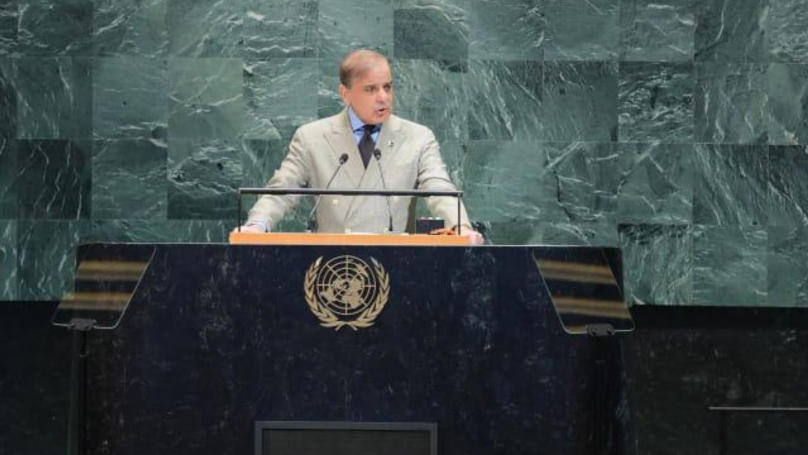

Pakistan Prime Minister Shehbaz Sharif on Friday warned India that any breach of the Indus Waters Treaty would be treated as an “act of war.” Moreover, he credited US President Donald Trump for brokering a ceasefire earlier this year — a claim that New Delhi has repeatedly denied.
Sharif made these remarks while addressing the 80th United Nations General Assembly in New York, where he focused on rising tensions between the two countries.
Sharif Warns of “Act of War”
Shehbaz Sharif accused India of escalating tensions by suspending the Indus Waters Treaty, which governs the sharing of six rivers.
“Any violation of the Indus Waters Treaty represents an act of war,” Sharif declared. Furthermore, he called India’s move a “serious provocation.”
He stressed that Pakistan’s foreign policy is built on “peace, mutual respect and cooperation.” Therefore, he urged both nations to resolve disputes through “dialogue and diplomacy.”
Sharif Claims “Unprovoked Aggression”
Sharif then accused India of launching attacks in May. “In May this year, my country confronted unprovoked aggression from the eastern front,” he said. “Our response was in accordance with self-defence. We sent them back in humiliation.” He also alleged that “India attacked our cities and targeted our citizens.”
However, India has strongly disputed these claims.
India Responded to Pahalgam Attack
In contrast, India stated that it launched Operation Sindoor after the Pahalgam terror attack, which killed 26 civilians. The operation involved air and missile strikes targeting terrorist bases in Pakistan and Pakistan-occupied Kashmir (PoK).
According to New Delhi, the action was a measured counter-terrorism response, not aggression. Subsequently, India suspended its participation in the Indus Waters Treaty. Moreover, it insisted that this was a sovereign move aimed at holding Pakistan accountable for cross-border terrorism.
Trump’s Role in Ceasefire
Sharif credited Trump with preventing the May conflict from escalating into a larger confrontation. “The ceasefire was facilitated by President Trump. Who would have lived to tell what happened,” Sharif said.
He even added, “We nominated President Trump for the Nobel Prize.”
However, India has consistently rejected Trump’s claim. Instead, it asserted that the ceasefire was reached through direct talks between the military commanders of both countries, without any third-party mediation.
Sharif Faces Tough Questions
Earlier in the day, as Sharif entered the UN headquarters, ANI reporters confronted him with sharp questions. One reporter asked, “When are you going to stop cross-border terrorism?”
Sharif replied, “We are defeating cross-border terrorism. We are defeating them.” Then, when the reporter said, “India is defeating you, Pakistan Prime Minister,” Sharif chose to remain silent and walked away without answering.
Growing Tensions
As a result of these developments, relations between India and Pakistan have deteriorated further. While Sharif portrayed Pakistan as a victim, India maintained that its actions target terrorists, not civilians. Consequently, the standoff has deepened mistrust and raised fears of a potential escalation in the region.