
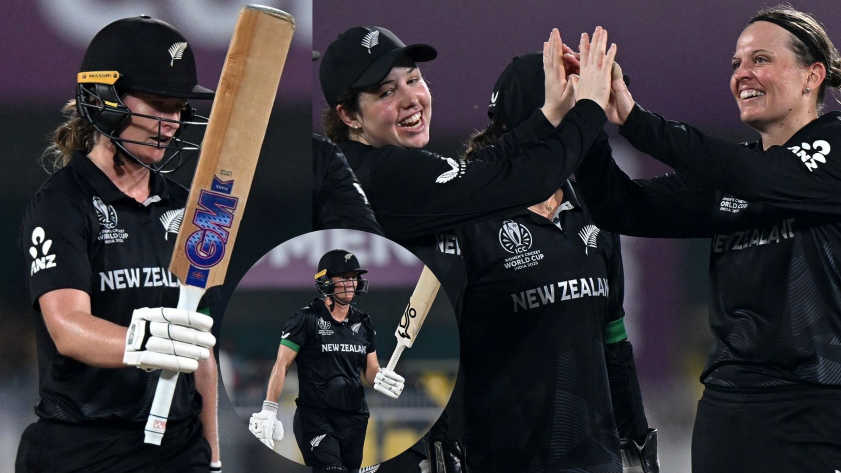

New Zealand crushed Bangladesh by 100 runs in the 11th match of the ICC Women's ODI World Cup 2025 in Guwahati. Bangladesh, at one stage, had reduced New Zealand to 38/3. It was a good opportunity for Bangladesh Women as leg-spinner Rabeya Khan bowled sharply on the Guwahati pitch, creating early pressure. However, the momentum slipped away, and New Zealand posted 227 for 9 with the help of composed innings from Sophie Devine and Brooke Halliday. Rabeya Khatun (3/30 in 10 overs) led the bowling attack for Bangladesh.
While chasing, Bangladesh Women were bowled out for 127 runs in 39.5 overs. Fahima Khatun (34) was the top scorer for Bangladesh, while Rabeya Khan and Nahida Akter showed little resistance against the New Zealand bowlers. Jess Kerr (3/21 in 8 overs) and Lea Tahuhu (3/22 in 6 overs) did the major damage to Bangladesh.
Devine Anchors New Zealand’s Middle Order
Sophie Devine, who had shown resilience in previous games, stood firm once again. She abandoned her usual flair to play patiently and grind out a crucial half-century. Battling the heat and the tricky pitch, Devine’s 50 was perhaps more valuable than her century against Australia in Indore last week.
Supporting Devine, Brooke Halliday added creativity and aggression when needed. She countered Bangladesh’s spin by sweeping intelligently and taking calculated risks. Together, Devine and Halliday built a 112-run partnership across 166 balls. Halliday top-scored with 69 before falling to a top-edge while attempting a slog sweep. Devine also departed in the same over while trying to clear cow corner after hitting two sixes off Nishita Akter.
Late contributions from Maddy Green, Lea Tahuhu, and Isabella Gaze added 49 runs, pushing New Zealand’s total and securing momentum at the halfway point. The team scored 74 runs off the last ten overs.
Bangladesh’s Top Order Fails to Deliver
Bangladesh’s best chance to challenge New Zealand came in the powerplay. However, their top order struggled against the swing and seam of Jess Kerr and Rosemary Mair. They barely played attacking shots, quickly losing three wickets for 22 runs. Sobhana Mostary, their half-centurion against England, fell for 2 to a leading edge off Kerr.
Even when Bangladesh tried spin, New Zealand prioritized pace. Jess Kerr and Rosemary Mair bowled impressive opening spells, and Lea Tahuhu used subtle changes in length and seam movement to pick key wickets. Tahuhu’s deliveries accounted for Sumaiya Akter caught at cover and Shorna Akter lbw. Bangladesh fell to 33 for 6, signaling the inevitability of collapse.
Lower-Order Resistance and Final Collapse
Fahima Khatun and Rabeya Khan resisted with an 44-run partnership for the eighth wicket. Fahima’s reprieve, when Isabella Gaze dropped a routine catch, allowed her to extend her innings. Fahima eventually fell for 34 after facing 80 balls. Bangladesh was bowled out for 127 in 39.5 overs.
Brief Scorecard
Despite the win, New Zealand will need to address their top-order struggles ahead of the Colombo fixtures. Suzie Bates scored 29 off 33, her first runs in the tournament, while Amelia Kerr and Georgia Plimmer again failed to accelerate in the powerplay. For now, Sophie Devine continues to lead by example, but New Zealand will rely on their top order to contribute more in the upcoming games, especially against challenging spin attacks.
The World Cup has exposed the struggles of less-experienced teams to maintain dominance over long periods. Bangladesh, in particular, has faced this challenge three times so far. While they started strong against Pakistan, they could not match the strength of teams like England and New Zealand. Stay tuned with JUSZNEWS for regular updates!