
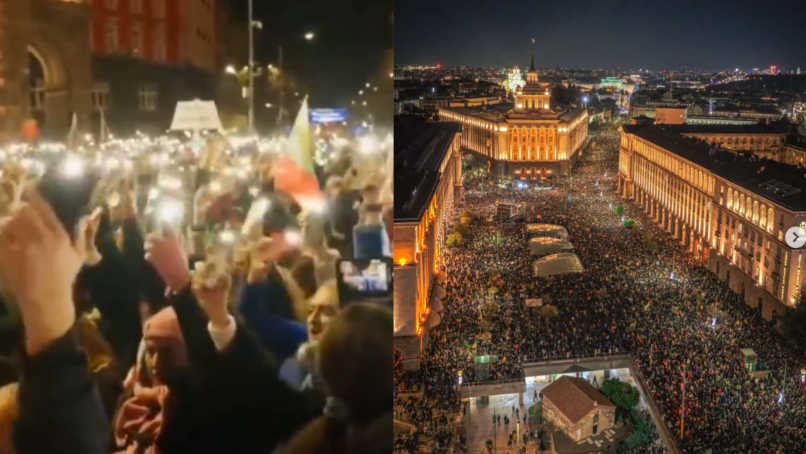

The Bulgarian government pulled back its controversial 2026 draft budget after tens of thousands of people filled the streets in Sofia and other major cities. According to Fox News, most of the protesters were young people from Generation Z. They accused the government of hiding deep corruption and ignoring public anger.
At the same time, business groups and opposition parties also raised strong objections. They warned that the proposed budget would hurt the economy at a critical moment, just before Bulgaria is expected to join the Eurozone in early 2026.
“Gen Z took to the streets because they want to stay in Bulgaria, but they want a renewed, different, corruption-free Bulgaria,” Daniel Lorer, a member of Bulgaria’s parliament, told Fox News. “They want reforms. The government refused to listen. The budget it proposed simply extended all its previous policies, funded through higher taxes, social security contributions and more debt,” Lorer added.
The protests grew each day. As pressure increased, the government found it harder to defend the draft plan.
Prime minister steps back and promises change
Prime Minister Rosen Zhelyazkov finally reacted to the growing unrest. He announced that the most controversial parts of the budget, including higher taxes and increased social security contributions, would be dropped. He also said the government would prepare a new proposal that reflects the demands raised by the protesters.
“The government saw what the citizens who protested had to say…I support these people who protest for more rights, more democracy, more justice. We believe that the protest is not so much political, but more of a social, human side, in search of more dialogue, more tolerance, and more harmony in social relations,” Zhelyazkov said at a press conference.
He went on to recognise the energy of young people in the demonstrations.
“This is a visible protest of young people, young people who are looking for their place in the future of Bulgaria, which we are obliged to hear, and we are obliged to do what is necessary to secure the funds that the country has,” Zhelyazkov furthered.
His words marked a shift in tone. Instead of confrontation, the government now promises consultation and revision.
Tension rises as some protests turn violent
Although most protesters remained peaceful, some violence did break out. A group of masked individuals attacked offices linked to the ruling party in Sofia. Police stepped in and clashes followed in a few areas.
The unrest also raised wider concerns about political instability in Eastern Europe. Analysts pointed out that countries near Russia often face external influence and interference, especially during moments of internal tension.
“Russia is always glad to stir unrest. Anything that upsets the democratic process in any EU country is welcome, and even more so in Eastern Europe, their former sphere of influence,” Lorer said.
This warning added an international dimension to what began as a domestic budget dispute.
President sides with opposition
Amid the growing crisis, Bulgarian President Rumen Radev spoke out against the draft budget. He supported the opposition and even called for the government’s resignation and early elections.
It is important to note that the Bulgarian president mostly plays a ceremonial role. However, his comments increased political pressure on the prime minister and added to uncertainty inside the government.
Even so, the administration chose to withdraw the draft budget instead of dissolving parliament for now.