
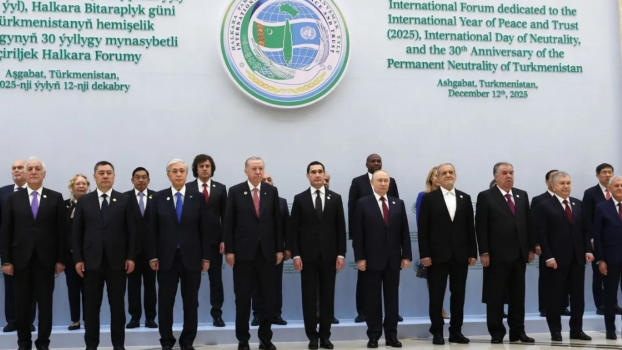

Turkmenistan, one of the world’s most closed nations, is hosting a rare international summit on Friday as leaders from Russia, Turkey, and Iran arrive to mark the Central Asian state’s 30 years of official neutrality. Russian President Vladimir Putin, Turkish President Recep Tayyip Erdogan, and Iranian President Masoud Pezeshkian are among the key invitees.
The country’s foreign policy is built on the principle of “permanent neutrality.” This status has shaped Turkmenistan’s identity and contributed to its isolation from the rest of the world.
A Political Dynasty Dominates Turkmenistan
Turkmenistan has had only three presidents since its independence in 1991. Saparmurat Niyazov ruled first. He declared himself “president for life” and adopted the title “father of the Turkmen.”
In 2006, the Berdymukhamedov family took control. Gurbanguly Berdymukhamedov ran the country for years before handing power to his son, Serdar, in 2022. In practice, both continue to govern together. Gurbanguly still wields enormous influence and remains central to a state-sponsored personality cult.
The government calls him the “leader of the Turkmen nation” and Arkadag, meaning hero-protector. He built a new city named Arkadag for at least $5 billion and installed several golden statues of himself. State media routinely praise Serdar as well.
Neutrality Fuels the Country’s Isolation
Turkmenistan is often compared to North Korea because of its secrecy and tight control over information. Since the UN endorsed its “permanent neutrality” in 1995, the government has used this status to avoid joining alliances and to justify its isolationist approach.
A 100-metre Neutrality Monument, topped by a golden statue of Niyazov, stands in Ashgabat as a symbol of this policy.
Before the summit, President Serdar Berdymukhamedov released another book celebrating neutrality, calling it a “precious gift for the Turkmen people.”
Turkmenistan maintains its closest ties with China, Russia, Iran, and Turkey due to natural gas exports. Its engagement with Western nations remains limited. Amnesty International says the country is “effectively closed to international human rights NGOs, UN special mechanisms and independent media.” Reporters Without Borders notes that information is heavily restricted and designed only to glorify the government.
Huge Gas Reserves, Severe Water Shortages
Turkmenistan holds the world’s fourth-largest natural gas reserves. However, water remains scarce, and climate change is expected to worsen shortages. The Karakum desert covers most of the country. Cotton farming, a major industry, also consumes vast amounts of water, increasing pressure on the region.
The ‘Gateway to Hell’ Continues to Burn
One of Turkmenistan’s most famous landmarks is the Darvaza gas crater, known as the “Gateway to Hell.” This enormous fire has been burning since 1971, when Soviet scientists accidentally ignited a natural gas field. Despite repeated promises to close it, authorities have not succeeded. The country is also the world’s largest emitter of methane, according to the International Energy Agency.
Horses and Dogs Treated as Sacred
Turkmenistan treats two native animals as national treasures: the Akhal-Teke horse and the Alabai dog. Former president Gurbanguly Berdymukhamedov ordered several statues of both animals across the country and designated holidays in their honor. He even wrote a song celebrating his favorite horse.
The Berdymukhamedov family often gifts these animals to foreign leaders and is frequently filmed cuddling them in public.