
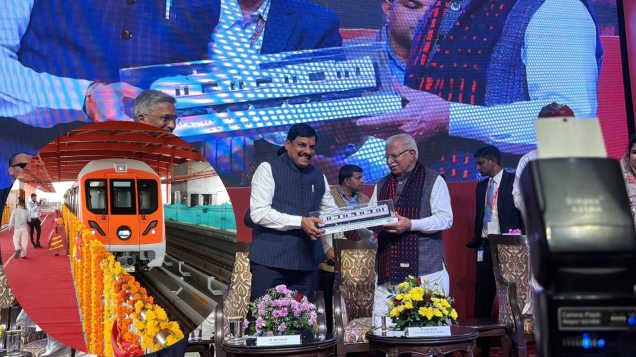

Bhopal entered now into a new era of urban transport on Saturday with the launch of its first-ever metro service. The milestone places the Madhya Pradesh capital among India’s growing list of cities with modern rail-based public transport.
The inauguration took place at 5 pm at Subhash Nagar Metro Station. Chief Minister Mohan Yadav and Union Housing and Urban Affairs Minister Manohar Lal Khattar flagged off the first train.
For commuters, regular metro services will begin on December 21 from 9 am.
Chief Minister Dr Mohan Yadav inaugurated the Bhopal Metro passenger service by pressing a remote button. This historic initiative will connect the state capital Bhopal with a modern, safe, and fast public transport system, giving a fresh boost to the city’s development.
मुख्यमंत्री डॉ. मोहन यादव ने रिमोट का बटन दबाकर भोपाल मेट्रो यात्री सेवा का शुभारंभ किया।
— Bhopal Metro Rail (@OfficialMPMetro) December 20, 2025
यह ऐतिहासिक पहल राजधानी भोपाल को आधुनिक, सुरक्षित और तेज़ सार्वजनिक परिवहन से जोड़ते हुए विकास की नई रफ्तार देगी। 🚇✨#BhopalMetro #MPM pic.twitter.com/J51E5ZuqtV
First step in a larger metro network
The launch marked the opening of the priority stretch of the Orange Line. This is the first operational section of the 30.8-km Bhopal Metro project.
The metro aims to reduce traffic congestion, improve travel reliability, and provide a cleaner and safer alternative to busy city roads. With Bhopal’s population rising and road traffic increasing, officials see this corridor as the beginning of a long-awaited transformation in daily travel.
Size and structure of the Bhopal Metro project
The Bhopal Metro network covers 30.8 km and runs across two main corridors. Both corridors share a common depot at Subhash Nagar.
The project connects major residential areas, business districts, and transport hubs. It allows smoother east–west and north–south movement across the city.
The two corridors are:
-
Orange Line: 16.74 km from Karond to AIIMS
-
Blue Line: 14.16 km from Bhadbhada to Ratnagiri
Priority corridor opens first
The first section to open is a nearly 7-km priority stretch of the Orange Line between Subhash Nagar and AIIMS. This route includes eight elevated stations:
Subhash Nagar, Kendriya Vidyalaya, DB Mall, MP Nagar, Rani Kamalapati Station, DRM Office, Alkapuri, and AIIMS.
Authorities built this corridor at a cost of Rs 2,225 crore. It forms part of the overall Rs 10,033-crore metro project. Since the route passes through busy areas such as MP Nagar, it is expected to significantly ease daily commuting in central Bhopal.
Train frequency and travel time
Public operations will start at 9 am on December 21. The metro will run 17 trips each day.
Nine trips will operate from AIIMS to Subhash Nagar, while eight trips will run in the opposite direction.
The first train from AIIMS will depart at 9 am and reach Subhash Nagar in about 40 minutes. The last train from AIIMS will leave at 5 pm and arrive at 6:25 pm. One full round trip will take roughly 75 minutes.
Between stations, the metro will take around two to three minutes. Trains will halt for about two minutes at each station to allow passengers to board and exit.
Ticket prices for Bhopal Metro
The metro fare structure follows three slabs:
-
Up to two stations: Rs 20
-
Three to five stations: Rs 30
-
Six to eight stations: Rs 40
The minimum fare is higher than in several other Indian metro cities, where entry fares start at Rs 10 to Rs 15. Once the full Orange Line becomes operational, the maximum fare will remain between Rs 40 and Rs 70, depending on distance.
Features of the metro trains
The three-coach metro trains come equipped with modern and passenger-friendly systems.
Key features include stainless steel, rust-free coaches, face-to-face seating, wide standing space, automatic doors, and platform screen doors. The trains also offer digital route maps, LED displays, mobile charging points, and full air-conditioning.
Each train can carry around 980 passengers, with about 330 passengers per coach, including standing space. Two coaches include dedicated wheelchair spaces along with a long-stop request button for easier access.
The first and third coaches serve as driving units, allowing trains to reverse direction from either end. The project will eventually receive 81 coaches to form 27 trains. Eight trains are already available.
Although the system supports future driverless operations, trains will operate with drivers for now. Emergency intercom buttons allow passengers to contact the driver, who can alert emergency teams at the next station if required.
Safety and accessibility at stations
All eight stations on the priority corridor include strong safety and accessibility features. These include CCTV surveillance, fire-fighting systems, lifts, escalators, Braille signage, tactile tiles for visually impaired passengers, audio announcements, and digital information displays.
Passenger movement from entry to exit remains simple and well marked. Platform screen doors open about 10 seconds after a train arrives. Train doors and platform gates operate together.
For passengers with disabilities, the extended stop option provides extra time for safe boarding and exit.
Why the metro launch matters for Bhopal
The Bhopal Metro represents a major shift in the city’s approach to mobility and public transport. The project aims to reduce traffic congestion, cut pollution, and provide faster and more dependable travel. It also seeks to improve access to jobs, education, and healthcare.
The metro project was first proposed in 2009, with the detailed report ordered in 2011. However, progress remained slow, and authorities awarded the first major construction contract only in 2018. Although Bhopal and Indore metro projects started around the same time, Indore became operational about seven months earlier.
With the launch of the priority corridor, Bhopal has finally entered the operational phase. As work continues on the remaining Orange and Blue Line stretches, the full network is expected to offer a cleaner, smoother, and more reliable transport system for the city.