
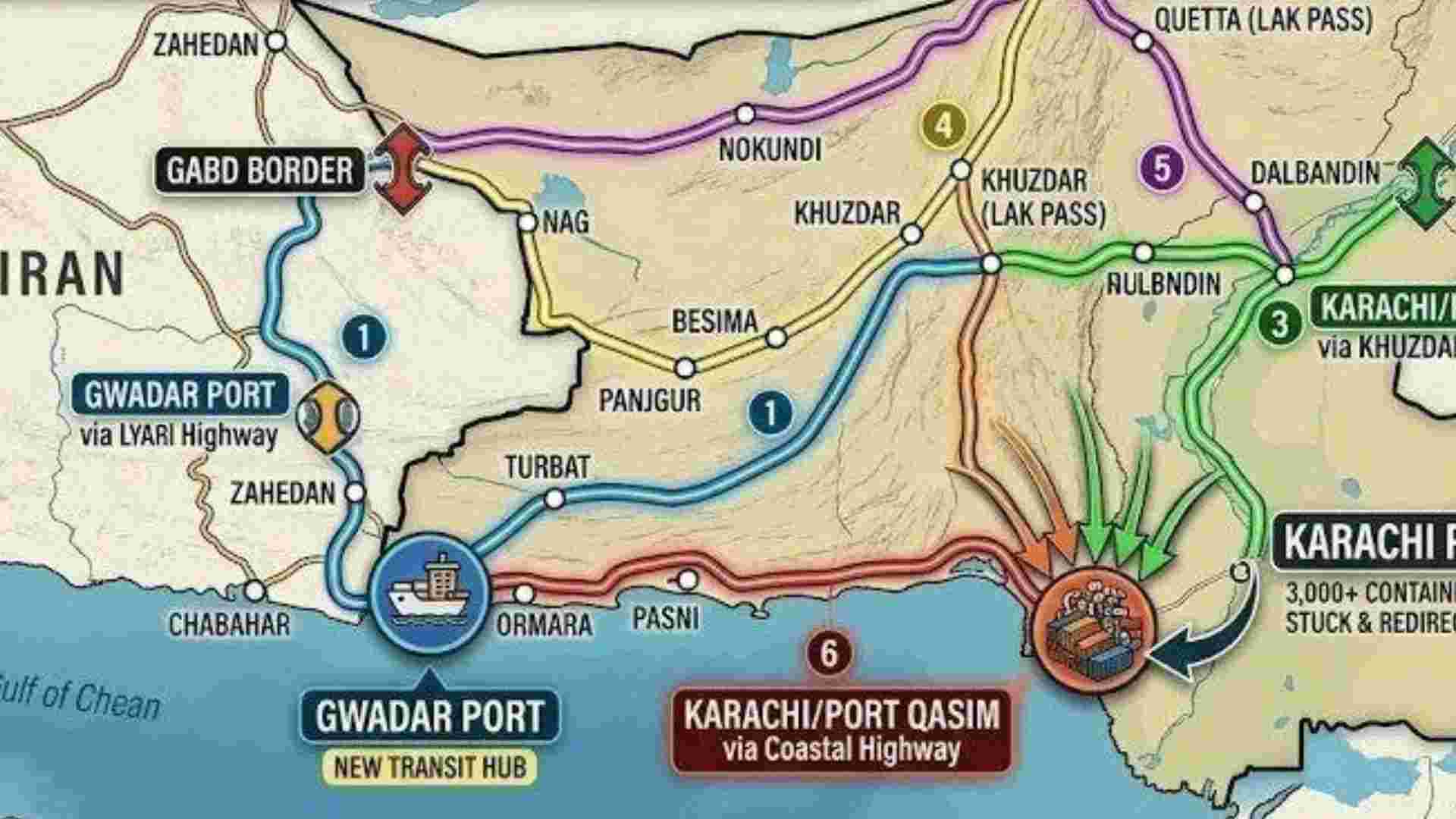

Pakistan has taken a strong step to handle disrupted maritime trade in the Persian Gulf. It has officially opened six land transit routes for goods heading to Iran.
The Ministry of Commerce announced this move under the “Transit of Goods through Territory of Pakistan Order 2026.” The government acted after a prolonged naval standoff in the Strait of Hormuz disrupted shipping activity.
As a result, thousands of containers meant for Iran got stuck at Pakistani ports.
Ports Face Heavy Congestion
The order came into effect on April 25. It mainly aims to reduce congestion at Karachi Port and Port Qasim.
At present, more than 3,000 containers bound for Iran remain stranded. The US naval blockade of Iranian ports and the closure of the Strait of Hormuz caused these delays.
Pakistan Creates Six Land Trade Corridors
To solve this problem, Pakistan has built a land bridge connecting its ports to the Iranian border. These routes now allow goods, especially from third countries, to reach Iran without relying on sea transport.
The six routes include:
- Gwadar to Gabd — the fastest and shortest route
- Karachi/Port Qasim – Lyari – Ormara – Pasni – Gabd
- Karachi/Port Qasim – Khuzdar – Dalbandin – Taftan
- Gwadar – Turbat – Panjgur – Quetta – Taftan
- Gwadar – Lyari – Khuzdar – Quetta – Taftan
- Karachi/Port Qasim – Gwadar – Gabd
Notably, the Gwadar–Gabd route will significantly cut travel time. Officials estimate it will reduce transit time by up to 87 per cent. For instance, transport to the Iranian border may drop from 18 hours to just three hours. Therefore, traders will likely see lower logistics costs.
Tensions Force Shift from Sea to Land
Meanwhile, the situation in the Strait of Hormuz remains unstable. Since late February 2026, tensions between the US and Iran have disrupted this key waterway.
Normally, the Strait handles about 20 per cent of global oil supply. However, repeated closures have affected trade.
On April 18, Iran completely shut the Strait. It also warned that any vessel trying to pass would be treated as “cooperating with the enemy.” This move came in response to the ongoing US blockade.
As a result, shipping costs have surged, and sea routes have become unreliable. Consequently, land routes through Balochistan now serve as the only practical option for trade with Iran.
Government Introduces Strict Controls
At the same time, Pakistan has enforced strict rules to prevent misuse of these routes. Traders must provide encashable bank guarantees equal to the import duties. This step ensures compliance with regulations.
In addition, the policy allows “cross-stuffing.” This means officials can transfer goods from shipping containers into trucks or other land vehicles. The Federal Board of Revenue (FBR) will supervise this process closely. Moreover, the system applies mainly to goods from third countries passing through Pakistan to Iran.
Opportunity Comes with Security Concerns
On one hand, the Gwadar Port Authority has welcomed the move. Officials see this crisis as a chance to strengthen Gwadar’s role as a regional trade hub.
On the other hand, security remains a concern. Many routes pass through remote parts of Balochistan. Therefore, authorities have increased patrols in these areas due to rising regional tensions.