
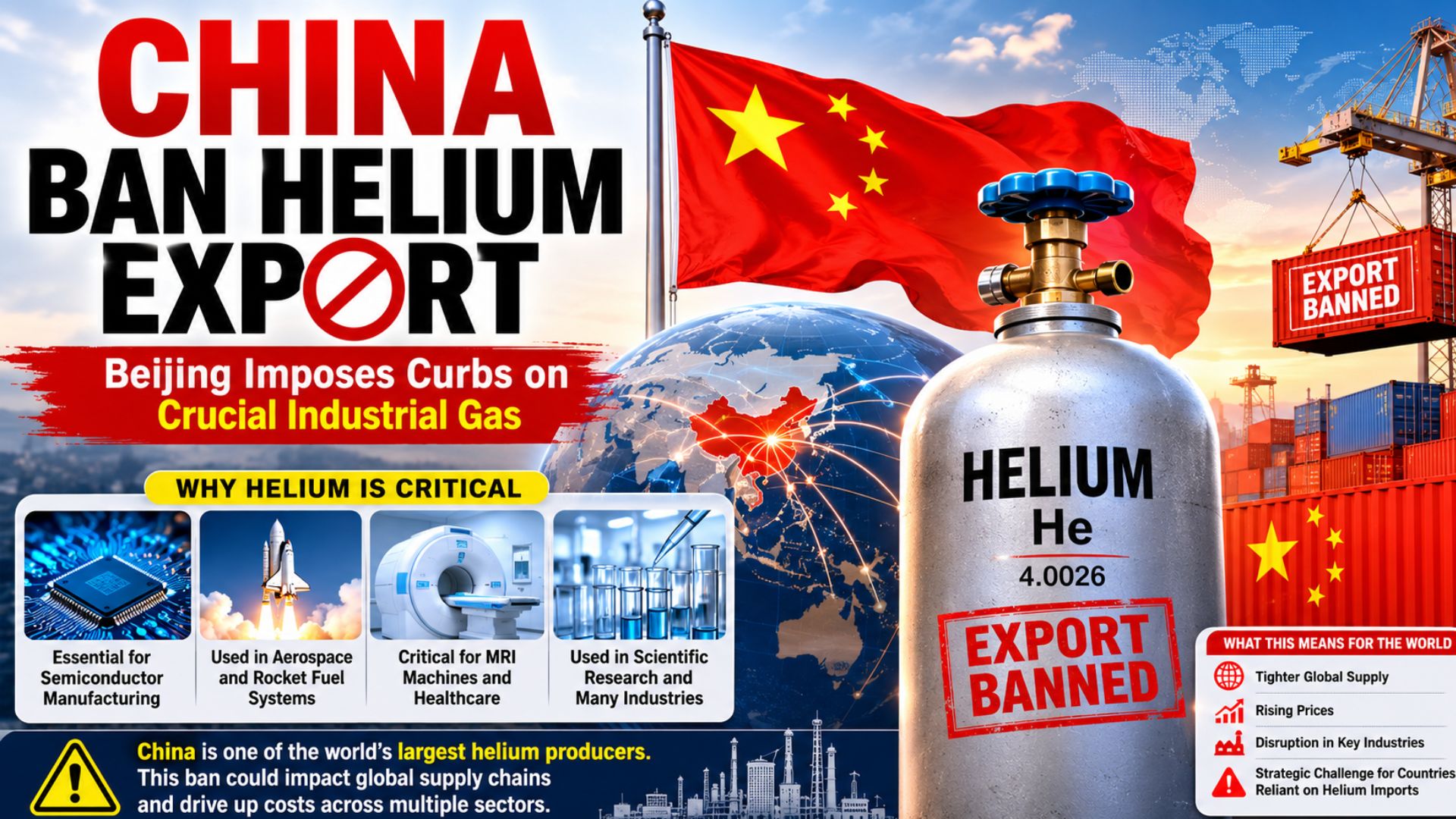

China on Friday announced a temporary suspension of helium exports as it seeks to protect domestic supplies of the critical gas. The decision comes as the ongoing conflict involving Iran continues to disrupt global helium availability and tighten international supplies. The export restriction took effect immediately after a joint announcement by China's Ministry of Commerce and the General Administration of Customs. Although the authorities confirmed the suspension, they did not explain the reason behind the move or say how long the restrictions would remain in force.
Helium Supplies Face Growing Pressure
Helium plays a vital role in several high-tech and medical industries. It is widely used in semiconductor manufacturing and is essential for cooling MRI scanners in hospitals and healthcare facilities.
Global helium supplies have come under increasing pressure since fighting involving Iran escalated in late February. The supply disruption has led to a sharp rise in helium prices worldwide.
China Depends Heavily on Imported Helium
Despite its large industrial base, China produces only a small portion of the helium it needs. Industry estimates suggest the country meets only around 15% of its domestic helium demand through local production. The remaining supply comes mainly from imports.
Qatar remains China's biggest helium supplier and is responsible for nearly one-third of global helium production, according to research referenced by consultancy Trivium China. This dependence on overseas supplies has made China more vulnerable to disruptions in the global market.
Move Aimed at Protecting Domestic Industries
Analysts believe Beijing introduced the temporary export ban to safeguard local industries rather than for geopolitical reasons. Gary Ng, senior economist at French bank Natixis, told Reuters that helium has become increasingly scarce in the global market.
According to him, China is prioritising supplies for industries that rely heavily on helium, particularly semiconductor manufacturers. He added that the restrictions are mainly intended to strengthen supply security rather than serve political objectives.
Semiconductor and AI Push Influences Policy
The latest decision also supports China's broader strategy to strengthen its semiconductor and artificial intelligence industries. As technological competition with the United States continues to grow, Beijing has been working to improve the resilience of its domestic technology supply chains. Ensuring stable access to critical industrial materials such as helium is considered an important part of that strategy.
Uncertainty Over Global Supply Recovery
Experts say it remains difficult to predict when the international helium market will return to normal. Cameron Johnson, senior partner at Shanghai-based consultancy Tidalwave Solutions, said the export suspension indicates that Chinese authorities believe current helium supplies are not sufficient to meet domestic demand.
While economists expect the overall global impact to remain relatively limited because China is not a major helium exporter, the restrictions could further tighten an already strained international market.
With global supplies already under pressure, the temporary suspension is likely to add further uncertainty for industries that depend on helium until supply conditions improve.