
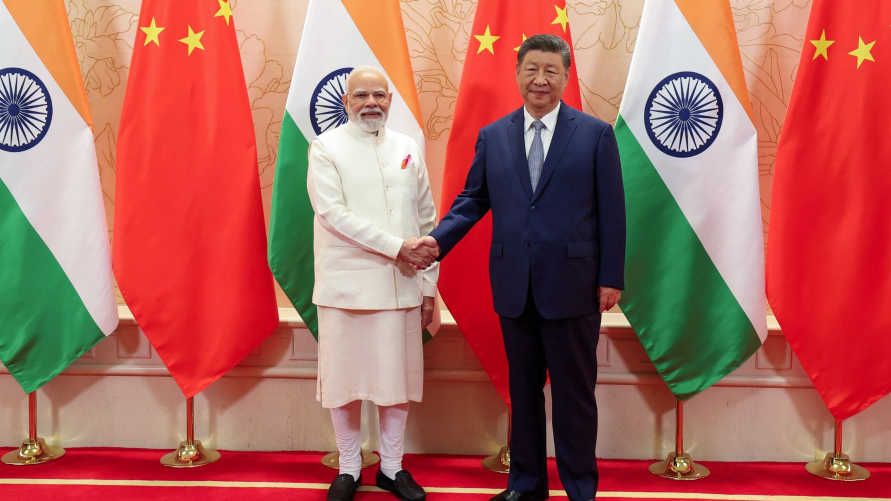

Prime Minister Narendra Modi held talks with Chinese President Xi Jinping on Sunday during the Shanghai Cooperation Organisation (SCO) summit in Tianjin. This was Modi’s first visit to China in over seven years, a move that comes amid improving ties after years of strained relations.
The meeting took place against the backdrop of US President Donald Trump’s tough trade-tariff policies and his criticism of India’s oil imports from Russia. Following the talks, Modi remarked that India-China relations “should not be seen through a third country lens,” hinting at external pressures, especially from Washington.
Expanding Common Ground
According to a statement from India’s Ministry of External Affairs (MEA), both leaders “deemed it necessary to expand common ground on bilateral, regional, and global issues and challenges, like terrorism and fair trade in multilateral platforms.” The statement highlighted that the two Asian neighbors place high importance on “strategic autonomy.”
They also emphasized that “differences should not turn into disputes,” a message that has often been repeated in India-China dialogues.
Acknowledging Economic Role
Modi and Xi recognized the weight of their economies in stabilizing global trade. They also spoke about pursuing “a fair, reasonable, and mutually acceptable resolution of the boundary question,” reflecting a cautious but hopeful approach to the long-standing border issue.
The MEA noted, “Both leaders welcomed the positive momentum and steady progress in bilateral relations since their last meeting in Kazan (Russia) in October 2024. They reaffirmed that the two countries were development partners and not rivals, and that their differences should not turn into disputes.”
Border and People-to-People Ties
On the sensitive border matter, PM Modi “underlined the importance of peace and tranquility” in frontier regions, stressing that stable conditions are vital for bilateral ties. The statement referred to “the successful disengagement last year” which has kept the peace since then.
The two sides also welcomed improvements in people-to-people ties. These included the resumption of direct flights, relaxed visa measures, and the restart of the Kailash Manasarovar Yatra, which had been on hold.
A Call for Multipolar World
Both leaders reaffirmed that strong India-China relations are key to shaping a balanced world order. The MEA said, “A stable relationship and cooperation between India and China and their 2.8 billion peoples on the basis of mutual respect, mutual interest and mutual sensitivity are necessary for the growth and development of the two countries, as well as for a multipolar world and a multi-polar Asia befitting the trends of the 21st century.”
Future Engagements
PM Modi invited President Xi to attend the BRICS Summit in 2026, which India will host. Xi expressed gratitude and assured China’s support for India’s presidency of the grouping.
Modi also met Cai Qi, member of the Standing Committee of the Politburo of the Communist Party of China, and sought his cooperation to advance the shared vision of the two leaders.
Role of the SCO
The SCO summit provided the backdrop for this dialogue. Originally created to counter US influence in Central Asia, the SCO has expanded over the years. Its full membership now includes Russia, Belarus, China, India, Iran, Kazakhstan, Kyrgyzstan, Pakistan, Tajikistan, and Uzbekistan. India and Pakistan joined in 2017, followed by Iran in 2023 and Belarus in 2024.