
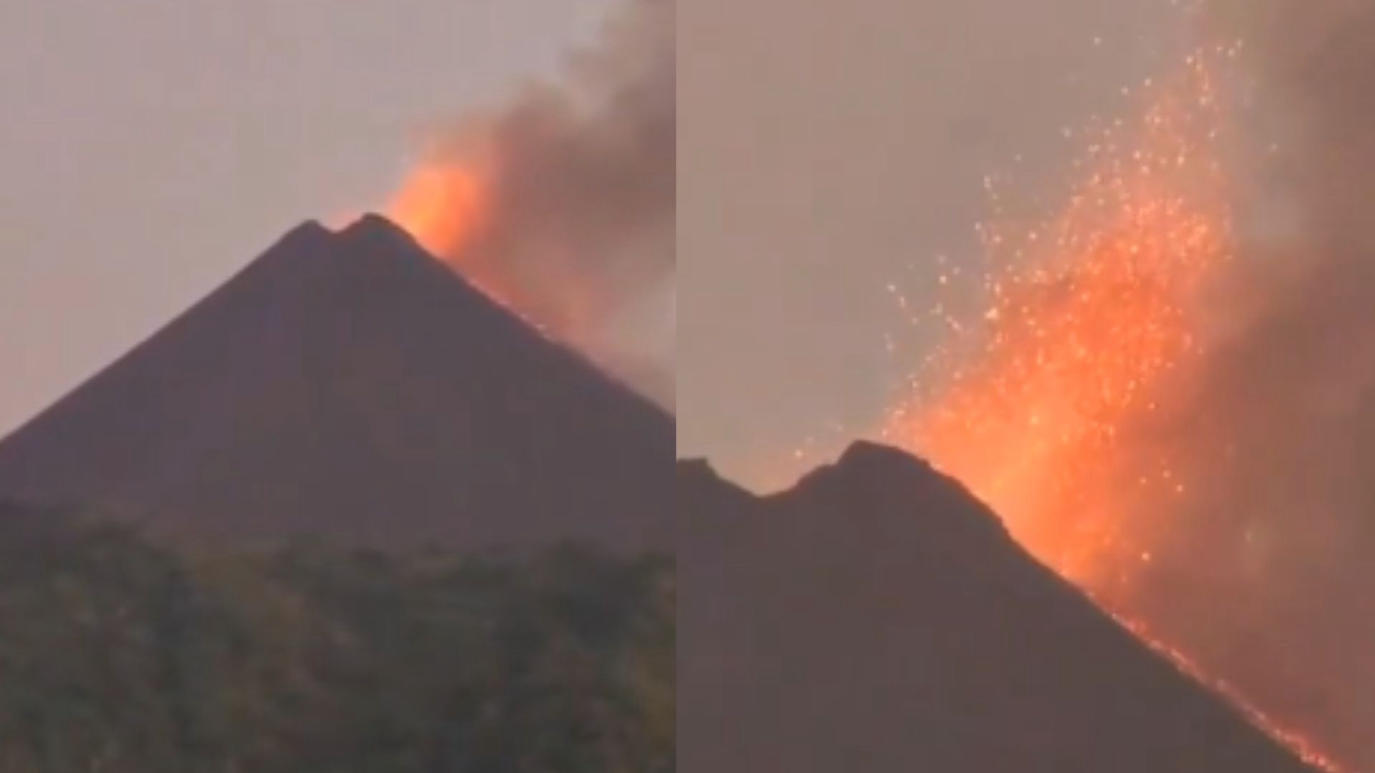

India’s only active volcano erupted on September 20 on Barren Island in the Andaman Sea. The eruption happened just two days after an earthquake struck the region. Since the island is remote and uninhabited, no destruction or loss of life was reported.
Earthquake Led to the Eruption
Scientists believe the recent earthquake directly triggered the eruption. O P Mishra, Director of the National Centre for Seismology, explained that the quake disturbed the magma chamber beneath the volcano. Consequently, this disturbance caused what he described as a “pre-mature magmatic eruption.”
“The earthquake shaking intensity within the magma chamber of the Barren Island volcano triggered this month’s eruption,” Mishra told TOI.
Furthermore, Barren Island is almost circular and 3.2 kilometres in diameter. The volcano rises two kilometres from the sea floor and has an average height of 300 metres above sea level.
-#India’s only Active volcano 'Barren Island,' Andaman & Nicobar got activated on 20 Sep'25
— Insightful Geopolitics (@InsightGL) September 22, 2025
-Video by #IndianNavy warship on patrol pic.twitter.com/RJmMArzrJq
Connection to the Fault Line
The region lies on a major fault line, the same one that caused the December 2004 tsunami. Mishra pointed out that this fault runs very close to the volcano and aligns with the location of the recent earthquake.
He explained, “Andaman-Nicobar Island is located in the subduction complex consisting of the down-going Indian plate intruding into the mantle of the overriding Sunda Plate where continuous earthquakes of moderate to strong strengths occur, along with micro seismicity in the area.”
As a result, the area remains highly prone to frequent seismic activity.
History of Eruptions
This eruption marked the fourth since 1991. Although the volcano has been active for years, its eruptions have been sporadic and relatively mild.
Moreover, lava activity occurs when seismic energy from moderate or strong earthquakes forces magma upward. The magma then rises through volcanic vents and escapes to the surface, leading to an eruption.
No Immediate Threat to Nearby Areas
Fortunately, there is no immediate danger to nearby islands or coastal regions. However, scientists continue to closely monitor the area.
Given its active fault line and past disasters, including the catastrophic 2004 tsunami, experts consider the region a high-risk zone for future earthquakes and volcanic activity.