
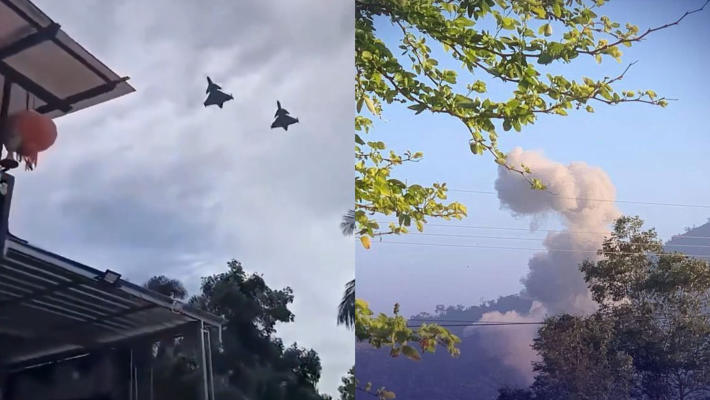

Thailand carried out airstrikes on Cambodia on Monday. As a result, fighting resumed between the two neighbouring countries. This sudden escalation raised doubts about the peace initiative proposed by US President Donald Trump just two months ago.
Both sides blamed each other for the latest violence. The accusations followed weeks of relative calm after a ceasefire had ended earlier clashes along the disputed border.
Thailand says it responded to an earlier attack
A Thai military official said the airstrikes were a counterattack. He stated that Cambodian forces had struck first on Monday morning. During that initial attack, one Thai soldier died and two others suffered injuries, according to CNN.
Thai Maj. Gen. Winthai Suvaree explained the target of the operation. He said, “The target was at Cambodia’s arms supporting positions in the area of Chong An Ma Pass, because those targets had used artillery and mortar launchers to attack the Thai side at Anupong Base, resulting in one soldier killed and two soldiers injured.”
According to the Thai army, Cambodian forces began firing toward the Thai border at around 3 a.m. local time.
Cambodia blames Thailand for triggering the violence
In a separate statement, the Cambodian army denied starting the conflict. Instead, it accused Thailand of attacking first at around 5:04 a.m. local time.
The Cambodian side also criticised Thailand’s recent actions, saying, “It should be noted that this attack occurred after the Thai forces engaged in numerous provocative actions for many days.”
Because of the rising tension, Thailand evacuated a large number of civilians from border areas. Around 70 per cent of residents living in these towns have now been moved to safer locations.
Civilian impact reported during evacuation
The Thai government confirmed that one civilian died during the evacuation process. Officials explained that the death occurred due to a “pre-existing medical condition” and not from direct fighting.
Still, the renewed violence has increased fear among people living along the frontier.
Background of the earlier conflict
The two countries already experienced a deadly border clash in July this year. That five-day conflict killed dozens of people. In addition, about 200,000 people were forced to flee their homes on both sides of the border.
After the violence in July, Thailand and Cambodia agreed to an initial ceasefire on July 28. This came after Trump spoke with leaders from both countries.
Later, in October, the two sides signed a broader ceasefire agreement in Kuala Lumpur. Trump and Malaysian Prime Minister Anwar Ibrahim witnessed the signing ceremony.
Now, with fresh fighting breaking out, the future of that peace effort looks uncertain.