
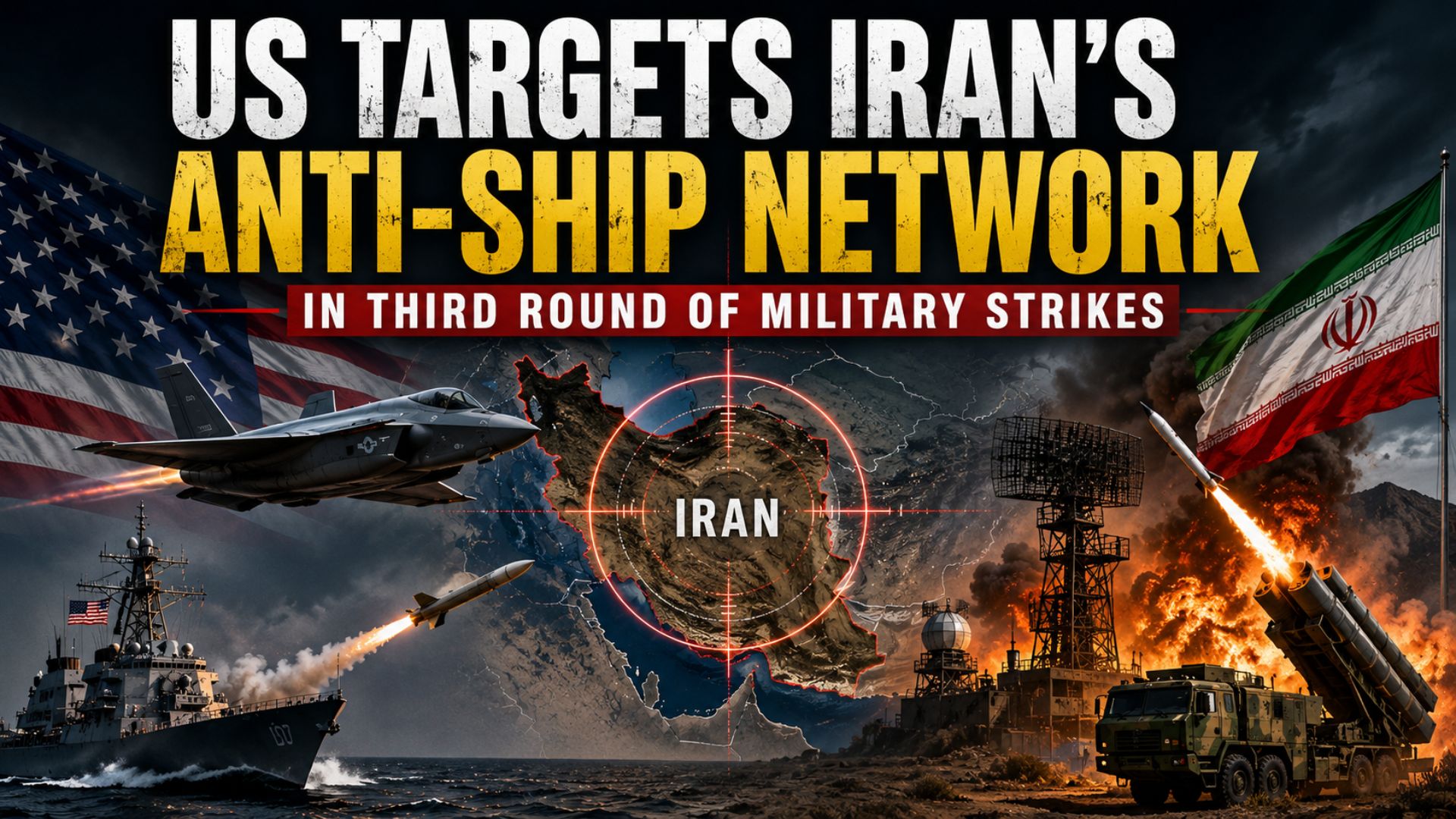

The United States carried out a third wave of military strikes against Iran on Sunday, just hours after Tehran announced that it was closing the Strait of Hormuz again following an incident involving a commercial ship. The latest military action marks another major escalation in the growing conflict between Washington and Tehran. It also puts further pressure on the fragile ceasefire agreement reached between the two countries last month.
Explosions reported across southern Iran
Several explosions were reported in southern Iran after the US launched its latest military operation on Saturday. Iranian media said blasts were heard in Bandar Abbas, Sirik and Chabahar. According to the US Central Command (CENTCOM), the strikes began at 7.15 pm Washington time (2315 GMT).
The US military said President Donald Trump authorised the operation after Iran’s Islamic Revolutionary Guard Corps (IRGC) “blatantly attacked” a Cyprus-flagged container ship travelling through the Strait of Hormuz.
Following the strikes, US Defence Secretary Pete Hegseth delivered a strong warning to Iran. “Iran made a poor choice. Now they pay,” Hegseth said. CENTCOM said the operation was aimed at imposing a “heavy cost” on Iran by weakening its ability to attack civilian sailors and commercial ships passing through the strategic waterway.
Earlier, Iran announced that the Strait of Hormuz would remain closed after one vessel travelling through what it described as an “unauthorised route" was fired upon with warning shots. The United States had already warned that any new attacks on commercial shipping would lead to a military response.
US targets Iran’s anti-ship military network
According to Axios, citing a US official, the latest strikes focused on several parts of Iran’s anti-ship military infrastructure. The reported targets included,
- Air surveillance radar systems
- Missile and drone storage facilities
- Missile and drone launch sites
- Surface surveillance radars
- Surface-to-air missile launchers
US officials said the operation was designed to damage every major part of Iran’s anti-ship capability. The strikes targeted systems used to detect ships, facilities storing missiles and drones, launch platforms used to fire those weapons, and air defence systems protecting the sites.
The latest military action is the third round of US strikes this week. It follows the IRGC’s reported attack on a commercial vessel and Iran’s decision to close the Strait of Hormuz.
Multiple locations hit during operation
Reports said the strike zone stretched from Asaluyeh to Bushehr, while unconfirmed reports suggested that Iranian air defence systems were also active over Tehran. At least 10 powerful explosions were reported in Bandar-e-Jask.
US strikes also reportedly hit Asaluyeh, the onshore centre of the South Pars gas field, one of Iran’s most valuable energy facilities. Additional strikes were reported in Bushehr.
The attacks came shortly after the IRGC Navy targeted a commercial vessel, declared the Strait of Hormuz closed and challenged Washington to respond. US officials had previously warned Iran against attacking commercial shipping. “If they keep on shooting at ships… we’re going to hit ’em back," US officials had said before launching the latest operation.
Strait of Hormuz remains the main flashpoint
The latest confrontation began after Iran announced that it was once again closing the Strait of Hormuz following the incident involving a commercial vessel. The Strait of Hormuz is one of the world's busiest maritime trade routes and plays a vital role in global oil and natural gas supplies.
Senior US officials have previously said that talks aimed at strengthening last month’s ceasefire agreement cannot move forward unless the waterway remains safe for international shipping. Washington had also expected Iran to publicly confirm that commercial vessels could continue using the route safely. Instead, Tehran declared that the strait would remain closed until further notice.
Diplomatic efforts continue despite military escalation
Although tensions have intensified, diplomatic negotiations are still underway. According to reports, Iranian Foreign Minister Abbas Araghchi is returning to Iran with a proposal from Oman that aims to manage shipping through the Strait of Hormuz.
The reported proposal suggests dividing the waterway into two separate shipping corridors. Under the plan, the southern route would remain open for international vessels, while ships using the northern corridor would need approval from Iran. Reports also said that no toll would be charged for using the route. The proposal reflects ongoing efforts to reduce tensions even as both countries continue balancing military operations with diplomatic negotiations.