
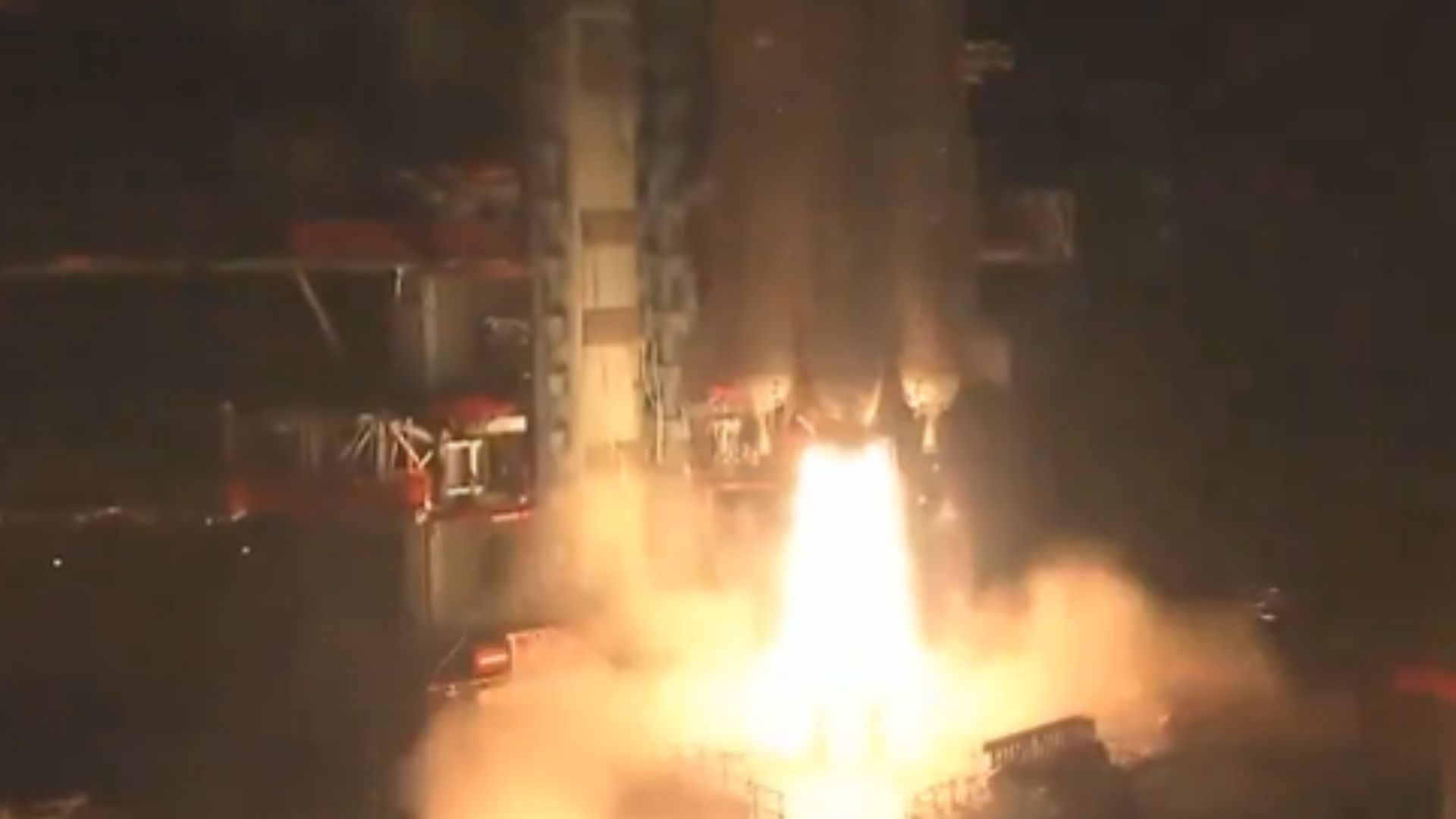

The Indian Space Research Organisation (ISRO) has successfully launched its second-generation navigation satellite, NVS-03, aboard the GSLV-F18 rocket. The successful mission has restored India's indigenous Navigation with Indian Constellation (NavIC) system to its minimum operational configuration of four satellites.
ISRO Chairman V Narayanan said the mission achieved another important milestone by recording the shortest turnaround time between two consecutive GSLV launches. He also announced plans to strengthen India's navigation network further by launching two additional satellites in the coming months.
The 50-metre-tall GSLV-F18 rocket lifted off at 11:51 pm on Friday from the second launch pad at the Satish Dhawan Space Centre in Sriharikota. The launch followed a 24-hour countdown.
After approximately 18 minutes of flight, the rocket successfully placed the NVS-03 satellite into its designated Geosynchronous Transfer Orbit (GTO). All three stages of the launch vehicle performed as expected, including its complex cryogenic upper stage.
Weighing 2,240 kg, the NVS-03 satellite will use its onboard propulsion system to reach its final geosynchronous orbital position at 32.5 degrees East.
The satellite carries an indigenously developed Rubidium atomic clock and will transmit navigation signals across the L1, L5 and S frequency bands. These capabilities will improve India's regional positioning, navigation and timing services.
🚨 Liftoff of GSLV-F18 carrying NVS-03 at 11:51 PM IST from Second Launch Pad, SHAR!
— ISRO Spaceflight (@ISROSpaceflight) October 30, 2026
ISRO's rescue mission for NavIC is now underway 🚀#ISRO | #GSLVF18 pic.twitter.com/MizXSaUe4R
ISRO Restores NavIC to Minimum Operational Configuration
The successful deployment of NVS-03 has brought India's NavIC navigation constellation back to its minimum operational strength of four satellites. Addressing the achievement, ISRO Chairman V Narayanan said three navigation satellites, including NVS-01, were already operational before the latest launch. The addition of NVS-03 has restored the required four-satellite configuration. "NavIC ((Navigation with Indian Constellation) is a strategic national asset which provides independent access to Position, Navigation, Timing services, and it is also used for civilian applications like real time tracking of trains, vehicles, shipping vessels," he said. Narayanan highlighted that NavIC plays an important role in India's efforts to develop the 'one nation, one time' system. He added that one of the country's indigenous atomic clocks had already been placed in orbit.NavIC Supports Real-Time Tracking of Trains, Vehicles and Fishing Vessels
The second-generation navigation satellite will support several civilian applications alongside its strategic importance. According to Narayanan, NavIC is already being used to monitor around 10,400 locomotives and 64,000 fishing vessels in real time. In addition, approximately 15 lakh tracking devices have been installed in vehicles across the country. ISRO is also working to expand the tracking network for fishing vessels under the Pradhan Mantri Matsya Sampada Yojana. The space agency aims to increase the number of fishing vessels tracked through NavIC to one lakh within the next six months.NavIC Services on Mobile Phones Await Full Satellite Constellation
Narayanan also addressed the availability of NavIC navigation services on ordinary civilian mobile phones. He said mobile phone users would be able to access these services once ISRO completes the full seven-satellite constellation. The planned expansion is expected to improve the availability and reliability of India's independent satellite navigation services.ISRO Explains Decision to Keep Three Pyro Valves Open
During a press conference on Saturday, Narayanan revealed an important technical decision taken before the NVS-03 launch. He said ISRO deliberately launched the satellite with three pyro valves already open to improve mission reliability and prevent a repeat of the technical problem encountered during the previous NVS-02 mission. The decision followed extensive vibration and shock tests. A national-level committee chaired by former ISRO chairman Kiran Kumar reviewed and validated the approach before the launch. Pyro valves are essential components of a spacecraft's propulsion system. They control the flow of propellants required for engine operations and orbital manoeuvres.Previous NVS-02 Mission Failed Due to Pyro Valve Problem
The technical decision was linked to the failure of the NVS-02 mission, which ISRO launched in 2025. The satellite could not reach its intended orbit because the drive signal failed to reach the pyro valve connected to the oxidiser line of the engine responsible for raising the satellite's orbit. A high-level investigation panel examined the failure and concluded that "the drive signal did not reach the pyro valve of the oxidiser line of the engine meant for orbit raising." In February 2026, ISRO released the panel's findings and identified the most likely cause as a loss of electrical contact. According to the investigation, at least one contact in each of the main and redundant connector paths had become disengaged, preventing the required signal from reaching the pyro valve. ISRO subsequently incorporated the lessons from the earlier failure into the NVS-03 mission to avoid a similar problem.GSLV-F18 Achieves High Accuracy During Satellite Orbit Injection
Narayanan also highlighted the precision achieved by the GSLV-F18 rocket while placing NVS-03 into its designated transfer orbit. He said the launch vehicle performed exceptionally well and achieved orbital parameters close to the planned figures. "Against (the planned) perigee (point when it is closest to the Earth) of 170.36 km; we have got 170.31 kilometres," Narayanan said. "Against (the planned) Apogee (point farthest away from the Earth) of 37,247 kilometres, we achieved 38,080 kilometres," he noted. "This is one of the best accuracy of any of the launch vehicles in the world we can think of," he added. The ISRO chairman confirmed that all launch vehicle systems performed according to expectations. He also congratulated the scientists, industrial partners and academic institutions involved in the mission.ISRO Records Fastest 56-Day Turnaround Between GSLV Missions
The NVS-03 launch also established a new operational milestone for ISRO's GSLV programme. Narayanan said the mission was completed with a turnaround period of just 56 days between two successive GSLV launches. "The NVS-03 satellite mission has been accomplished with the least turnaround time of 56 days between successive GSLV missions," he said. He also highlighted the contribution of India's private industrial sector to the mission. According to the ISRO chief, almost 80 per cent of the budget had been "pumped into the Indian industries." The achievement reflects the growing involvement of domestic industries in India's space programme.ISRO Plans NVS-04 and NVS-05 Launches to Strengthen NavIC
Following the restoration of NavIC's minimum operational configuration, ISRO has outlined its next steps to expand the satellite network. The space agency plans to launch NVS-04 within five months and NVS-05 within 10 months. Both satellites will further strengthen the navigation constellation and improve the availability of positioning and timing services across the region. The planned launches are part of India's broader efforts to maintain an independent satellite navigation network and reduce dependence on foreign navigation systems.EOS-05 Satellite Sends Outstanding Data to ISRO
Narayanan also provided an update on another recent space mission. He said the EOS-05 geo-imaging satellite, which was launched in September, was functioning properly. ISRO has been receiving "outstanding" data from the satellite. The satellite's performance has added to the agency's recent achievements in strengthening India's space-based capabilities.ISRO Targets Five More Launches in Current Financial Year
Looking ahead, ISRO has an ambitious launch schedule for the remaining part of the current financial year. Narayanan said the space agency plans to conduct five additional launches. These missions will include G1, the first uncrewed flight under India's Gaganyaan human spaceflight programme, along with small satellite launches. The upcoming missions are expected to advance India's satellite capabilities and bring the country closer to its human spaceflight objectives.PM Modi Congratulates ISRO on Successful NVS-03 Mission
Prime Minister Narendra Modi congratulated ISRO scientists and engineers following the successful GSLV-F18 launch. He described the mission as an important development in strengthening India's indigenous satellite navigation capabilities. "Congratulations to our scientists and engineers at ISRO on the successful launch of GSLV-F18 carrying NVS-03. This mission marks an important step in strengthening NavIC, our indigenous satellite navigation system," he said in a post on X. Modi said the satellite's improved capabilities would support India's efforts to achieve self-reliance in critical technologies and provide better navigation services to people. He also praised the dedication and innovation of India's space scientists, saying their achievements continued to make the country proud. Congratulations to our scientists and engineers at ISRO on the successful launch of GSLV-F18 carrying NVS-03.
This mission marks an important step in strengthening NavIC, our indigenous satellite navigation system. Equipped with enhanced capabilities, NVS-03 will further our pursuit of self-reliance in critical technologies and support navigation services that benefit our people. The dedication and ingenuity of our space scientists continue to make our nation proud. @isro — Narendra Modi (@narendramodi) October 31, 2026