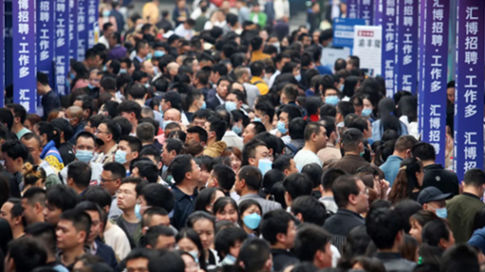
In China, many young people with high-level education are being forced to take jobs far beneath their qualifications. This has become a troubling trend as the country’s economy struggles. Stories of graduates with degrees in fields like physics, environmental planning, and philosophy working as handymen, cleaners, and delivery drivers highlight the widening gap between education and available job opportunities.
The Struggles of Highly Educated Youth
Take 25-year-old Sun Zhan as an example. He holds a master’s degree in finance but now works as a waiter in Nanjing. “My dream job was in investment banking,” Sun shared with the BBC. Despite months of searching for a job in his field, he settled for work in a hot pot restaurant. His family has been critical of his decision, wishing he had pursued a more traditional public service career instead.
Rising Youth Unemployment
China’s economy is burdened by a property crisis and weak domestic demand, making it difficult to create enough jobs for the millions of graduates each year. In fact, youth unemployment hit a record high of 21.3% in June 2022, leading the government to halt the publication of unemployment data. This rising unemployment rate reflects the larger economic challenges the country is facing.
A Reality Many Graduates Face
Like Sun, many graduates are faced with the difficult reality of taking jobs far below their qualifications. Furthermore, these individuals often face societal and familial pressure to find more suitable employment. Despite these challenges, Sun remains optimistic. He hopes that, by learning the restaurant business, he can one day open his own establishment. “If I run a successful business, my family’s opinion will change,” he said.
Economic Reforms and the Need for Change
This issue highlights the broader economic challenges facing China, underscoring the urgent need for structural reforms. To meet the aspirations of its educated youth, the government must address the disconnect between education and employment opportunities.
Government’s Financial Relief Efforts
Last month, the Chinese government urged local officials to provide more financial relief, especially before major holidays. As the country’s economic troubles are expected to extend into 2025, authorities are hoping that these efforts will offer some relief to citizens. Meanwhile, the World Bank has reported that China’s poverty reduction has slowed in 2024 and will likely continue to decelerate due to weaker economic growth projections in the coming years.
Focus on Household Consumption for Economic Recovery
Economists suggest that tepid household consumption is a major obstacle to economic recovery. According to analysts, reviving household demand will be essential for a successful recovery in the upcoming year. Policymakers have committed to focusing on this issue in hopes of stimulating growth.
Increased Interest in Civil Service Jobs
In 2024, a record 3.4 million young Chinese people applied for the civil service exam. This surge in applicants, which increased by over 400,000 from the previous year, reflects the rising demand for stable government jobs. As the private sector continues to struggle, many disillusioned young people see the civil service as a reliable option, even though local governments are facing financial difficulties.
Rising Demand for Stability
This shift towards government jobs shows the growing desire for stability among Chinese youth, particularly as they face limited job opportunities in the private sector. In fact, the number of applicants for the civil service exam has tripled since 2014, signaling that many young people are seeking job security as the private sector weakens due to economic slowdown.
The Strain on Local Governments
While civil service jobs are increasingly in demand, local governments are struggling to meet the rising demand. Wage arrears are widespread and remain a significant challenge. As a result, some officials may resort to corrupt practices, such as accepting bribes or increasing fines for citizens, to make up for their lack of income.
Calls for Reform in China’s State Sector
For years, there have been calls for reform in China’s state sector. Despite efforts to downsize, the number of civil servants has increased from 6.9 million in 2010 to 8 million today. Additionally, around 31 million public sector employees, such as teachers and healthcare workers, have fewer employment protections.
Quiet Cuts and the Struggle for Stability
Since 2020, many Chinese provinces have quietly reduced public sector jobs, primarily through hiring freezes and natural attrition. Despite these cuts, the government is still grappling with how to handle the large number of civil servants and public sector employees.
The Challenge of Social Stability
A professor from a top Chinese university, speaking anonymously, explained that wage arrears are a “systematic and universal” issue across the country. He warned that these issues could contribute to growing corruption. He further emphasized that the most pressing issue for the Chinese government is social stability, which may lead to an expansion of civil service hiring rather than addressing the need for institutional reform.
“The most pressing issue now is social stability,” the professor said. “Therefore the lesser of two evils will cause the expansion of civil service hiring and the neglect of institutional reform.”