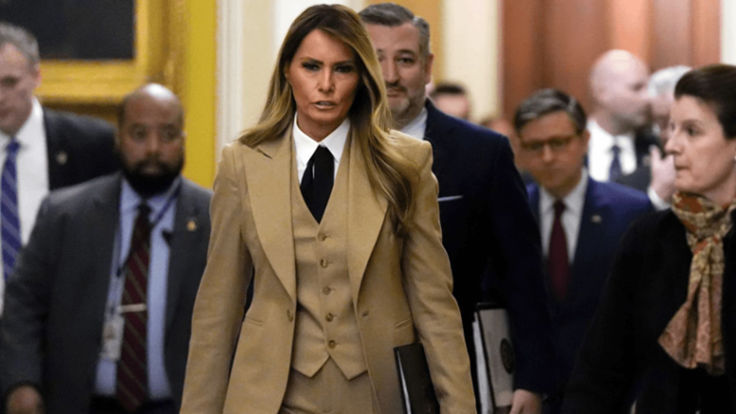
US First Lady Melania Trump made her first solo public appearance on Capitol Hill. She urged lawmakers to support the 'Take It Down' bill. This marked her first major solo engagement in US President Donald Trump’s second term. Therefore, she attended a congressional hearing to advocate for the bill, which has bipartisan support in the Senate but still awaits House approval.
What Is the 'Take It Down' Act?
The bill aims to make "revenge porn" a federal crime and protect victims from deepfake pornography. It seeks stricter laws against the non-consensual distribution of sexual images, including AI-generated content. As a result, if passed, the bill would criminalize posting intimate images without consent and require tech companies to remove such content within 48 hours.
Senator Ted Cruz introduced the bill, and the Senate recently approved it. His office stated that the law would criminalize the publication of non-consensual intimate imagery (NCII), including AI-generated deepfake pornography. Furthermore, social media platforms would also be required to remove such content when victims report it.
The Rise of AI-Generated Exploitation
AI-generated explicit images have affected many people, including celebrities like Taylor Swift and Representative Alexandria Ocasio-Cortez. In addition, young girls have also been targeted. One of them, 15-year-old Elliston Berry from Texas, joined
Melania Trump on Capitol Hill. The First Lady shared Berry’s story. Strangers superimposed Berry’s face onto explicit content without her consent. Although her family contacted social media companies, their pleas were ignored. Consequently, the fake images spread globally.
The bill proposes strict penalties for offenders. Specifically, it would make it a federal crime to knowingly publish or threaten to publish intimate images without consent. Additionally, it requires social media companies to remove such images within 48 hours and prevent their reappearance.
The Threat of Revenge Porn and Deepfake Technology
WebMD defines revenge porn as digital abuse where explicit images are shared without the depicted person’s consent. Offenders often use it for blackmail or humiliation. Some images come from private exchanges, while others are manipulated using AI to create fake but harmful content.
Meanwhile, deepfake pornography is a growing problem. AI creates realistic but fabricated explicit images. Digital harassment lawyer Carrie Goldberg noted that while deepfake images may contain small flaws, they look convincing and cause severe harm.
Melania Trump’s Urgent Call for Action
During the discussion, Melania Trump expressed deep concern over victims’ suffering, especially teenagers. She called the situation "heartbreaking" and stressed the need to protect young people online.
“This toxic environment can be severely damaging. We must prioritize their well-being by equipping them with the support and tools necessary to navigate this hostile digital landscape,” she said.
Furthermore, she emphasized that every young person deserves a safe online space, free from exploitation and harm.
Support from Lawmakers and Tech Companies
Senator Ted Cruz, who hosted the discussion, praised Melania’s leadership. He said her support would help push the bill forward. The bill was inspired by Elliston Berry and her mother, who struggled for nearly a year to get Snapchat to remove an AI-generated explicit image of Berry when she was 14.
On Capitol Hill, Berry and other victims shared their experiences. Additionally, tech giant Meta, the parent company of Facebook and Instagram, has expressed support for the bill.
However, Melania criticized the lack of participation from Democratic lawmakers. Only California Representative Ro Khanna attended the discussion. She expected more Democrats to join the effort.
“I must admit, however, I expected to see more Democrat leaders with us here today to address this serious issue,” she said. “Surely as adults, we can prioritize America’s children ahead of partisan politics.”
Next Steps
Melania Trump hopes the discussion will raise awareness about the dangers of non-consensual image sharing. Therefore, she urged lawmakers to pass the 'Take It Down' Act. Senator Cruz emphasized that the bill would empower victims and force technology companies to act quickly in removing harmful content.
In conclusion, the bill is a crucial step in fighting AI-generated exploitation and protecting online safety, especially for young people.