
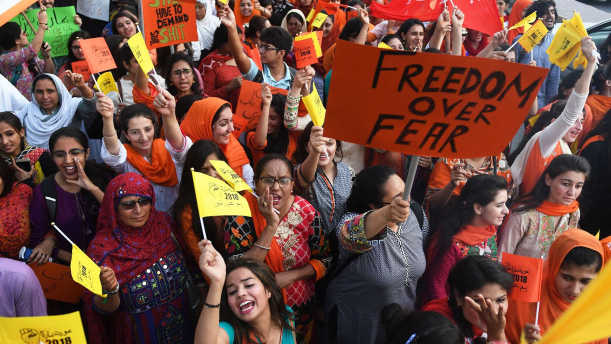

Pakistan remains a deeply conservative country, especially in its treatment of women. According to the 2023 National Report on The Status of Women in Pakistan, published by the United Nations, the situation is alarming. Shockingly, 50% of women experience physical abuse, while 90% suffer mental and verbal mistreatment from men.
Nevertheless, a strong women’s rights movement continues to fight back. Known as Aurat March, this annual demonstration takes place in multiple cities across Pakistan. It demands accountability for violence against women and supports those facing harassment at home and in the workplace. Every year in March, women flood the streets, holding powerful signs and making their voices heard.
A Movement of Resilience
The first Aurat March happened on March 8, 2018, in Karachi. Women’s collectives organized it alongside the global #MeToo movement. Soon after, in 2019, Lahore joined in. Gradually, the movement spread across the country, including the capital, Islamabad.
In 2023, Karachi organizers scheduled the march on a Sunday instead of March 8. Their goal was to accommodate working women who couldn’t attend on a weekday. Similarly, this year, different cities have planned marches on separate dates for the same reason. However, despite government resistance, the Islamabad march will proceed on March 8.
To clarify their approach, organizers released a statement titled “2025: The Year of the Aurat March Caravan.” They emphasized that while traditions matter, Aurat March focuses on challenging societal norms and creating space for feminist voices. As the statement read, “For the first time, the marches in Lahore, Multan, Karachi, and Mirpurkhas will take place on newer dates but with the same passion.”
Defying Restrictions
On Friday, Islamabad’s Aurat March organizers made a bold announcement. They declared they would move forward with their demonstration, regardless of official approval.
According to Pakistani news outlet Dawn, the event will start at the National Press Club and continue toward D-Chowk.
“We will have our show outside the National Press Club as per previous years and will try to march towards D-Chowk to mark the occasion [of International Women’s Day],” said rights activist Dr. Farzana Bari. Notably, she revealed that the group had applied for permission months ago.
However, Islamabad’s administration has not issued a No-Objection Certificate (NOC) yet. In response, Bari also wrote to Prime Minister Shehbaz Sharif, urging him to direct officials to grant permission. So far, she has received no reply.
Government Pushback
Instead of granting approval, officials urged organizers to postpone the march. They cited the holy month of Ramazan as the reason.
Despite this, Bari explained that the group had already reassured authorities. They confirmed the event would take place respectfully, without music or unnecessary celebrations.
Meanwhile, Aurat March organizers posted an open letter on Instagram, appealing directly to the prime minister. The letter stated, “In the past, our organizers have faced brutalization at the hands of religious fundamentalist groups, police, and the Islamabad administration. This sends a negative message to the international community regarding the status of women’s rights in Pakistan.”
Rather than addressing their concerns, Islamabad’s traffic police announced roadblocks at Express Chowk and Serena Hotel. Officials cited the “ongoing law and order situation” as the reason.
Impact and Change
Despite facing resistance, Aurat March has sparked crucial discussions about women’s rights in Pakistan. Activists argue that these demonstrations bring issues like consent, bodily autonomy, and sexual rights into public discourse. In a deeply conservative society, these conversations remain rare.
For instance, a Karachi organizer told Dawn, “Effecting legislation will take time, but we believe that providing a platform for these issues will affect the consciousness of the public.”
One major victory has been the fight against the “two-finger test” used on victims of sexual assault. Thanks to awareness raised by Aurat March and feminist-led petitions, the courts eventually banned the practice.
Similarly, activists believe that Aurat March has encouraged more women to speak out. “It is hard to imagine the #MeToo cases brought forward by educational institutions in 2020 happening 10 years ago. The Aurat March makes us believe in our ability to resist,” said an Islamabad volunteer. She further noted that increasing public pressure influenced policies like the Anti-Rape Ordinance, even though it still has flaws.
A Platform for Change
Regardless of opposition, Aurat March has given Pakistani women a platform to speak up. In a country where discussions on women’s rights have long been suppressed, this movement continues to challenge the status quo. Year after year, it reminds society that silence is no longer an option.