Two days of intense clashes in Syria have killed over 1,000 people, according to a war monitoring group. Fighting erupted between Syrian security forces and loyalists of former President Bashar Assad, followed by brutal revenge attacks. This marks one of the deadliest incidents in Syria’s 14-year-long civil war.
Escalating Violence and Worsening Crisis
The Syrian Observatory for Human Rights reported that gunmen executed 745 civilians, mostly at close range. Additionally, 125 government security personnel and 148 fighters from Assad-affiliated armed groups died. The violence left many areas in Latakia without power or drinking water, worsening the humanitarian crisis.
Clashes broke out on Thursday, posing a major challenge to Syria’s new government. Just three months after insurgents overthrew Assad’s regime, instability has intensified.
Government Responds, Dismissing Responsibility
Authorities said they retaliated against attacks by remnants of Assad’s forces. However, they denied responsibility for the widespread bloodshed, attributing it to "individual actions."
Sectarian Retaliation: Sunnis Target Alawites
On Friday, Sunni Muslim gunmen supporting the government launched violent revenge attacks on members of Assad’s Alawite sect. This significantly weakened Hayat Tahrir al-Sham, the group that played a key role in Assad’s overthrow. Alawites had long formed the backbone of Assad’s support base.
Eyewitnesses described horrific scenes in Alawite villages. Gunmen executed men in the streets and at their doorsteps. They looted homes before setting them on fire. Two residents from Syria’s coastal region, hiding for safety, told The Associated Press (AP) that thousands of people had fled to nearby mountains. Fearing retaliation, they requested anonymity.
Baniyas in Chaos
Baniyas, one of the hardest-hit towns, saw bodies left uncollected in the streets, homes, and on rooftops. A resident said gunmen prevented people from retrieving the bodies of five neighbors executed on Friday.
Ali Sheha, a 57-year-old resident, fled with his family and neighbors as the violence intensified. He estimated that at least 20 of his neighbors and colleagues were killed, many inside their homes or workplaces.
Sheha called the killings "revenge attacks" against the Alawite minority for Assad’s government’s crimes. Other witnesses claimed foreign fighters and militants from nearby villages took part in the attacks.
"It was very, very bad. Bodies were on the streets," Sheha said, speaking by phone from 20 kilometers (12 miles) away. He described how gunmen gathered just 100 meters from his apartment building, shooting randomly at homes and civilians. In one case, they demanded identification from residents to confirm their religion and sect before executing them. The attackers also looted homes, stole vehicles, and set buildings ablaze.
Rising Death Toll Amid Massacres
Rami Abdurrahman, head of the Syrian Observatory for Human Rights, confirmed that revenge killings stopped early Saturday.
"This was one of the largest massacres in the Syrian conflict," he stated, referring to the targeted killings of Alawite civilians.
Previously, the Observatory reported over 600 deaths, but the number has now surpassed 1,000. The government has not released official figures.
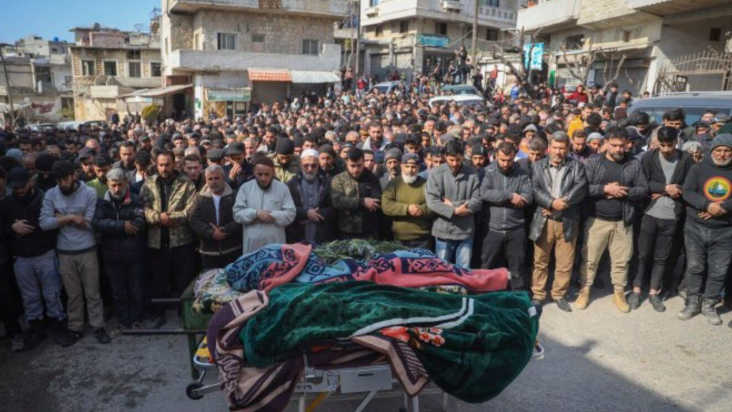
On Saturday afternoon, mourners gathered in Al-Janoudiya, a northwestern village, to bury four Syrian security officers killed in the clashes.
Government Retakes Territory
Syria’s state news agency quoted a Defense Ministry official who claimed that government forces had recaptured most areas from Assad loyalists. Authorities also closed all roads leading to the coastal region “to prevent further violations and gradually restore stability.”
On Saturday morning, residents of Tuwaym buried 31 people killed in Friday’s revenge attacks. The victims included nine children and four women. Residents shared photos with AP, showing bodies wrapped in white cloth before burial in a mass grave.
Fleeing to Lebanon for Safety
Lebanese legislator Haidar Nasser, who represents the Alawite sect in parliament, reported that many people were fleeing Syria for refuge in Lebanon. However, he did not have exact figures.
Nasser added that some Alawites sought shelter at the Russian airbase in Hmeimim. He urged the international community to step in and protect Alawites, emphasizing that they are Syrian citizens loyal to their country. He also noted that since Assad’s fall, many Alawites lost their jobs, and some former soldiers who reconciled with the new government were killed.
Uncertain Future
With thousands displaced and communities devastated, Syria’s future remains uncertain. The cycle of violence and revenge continues to tear the country apart, leaving innocent civilians trapped in the chaos. As government forces regain control, the challenge of rebuilding shattered communities and restoring stability remains immense.