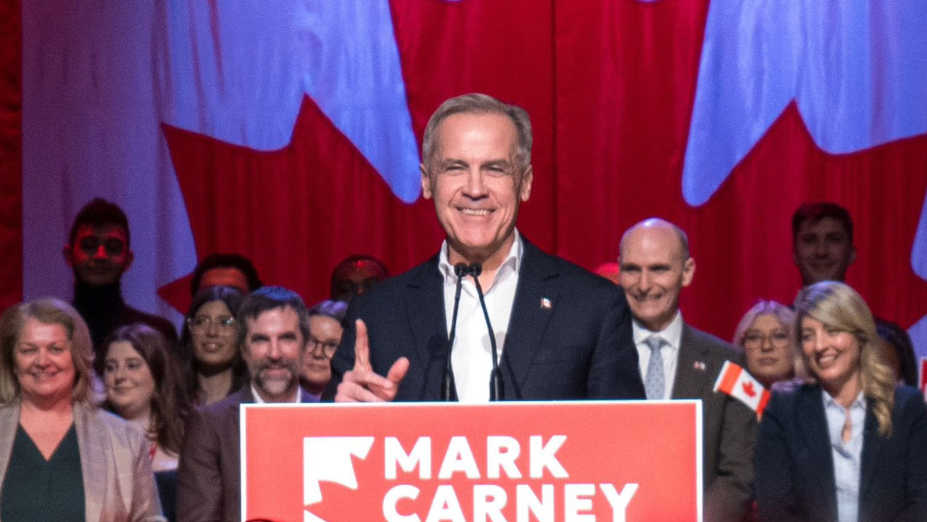
Canada has a new leader. Mark Carney, a former central banker, won the Liberal Party leadership and will soon become the Prime Minister. His victory comes at a crucial time, as US President Donald Trump escalates a trade war and makes annexation threats against Canada.
At 59 years old, Carney replaces Justin Trudeau, who resigned in January. However, Trudeau will remain in office until Carney officially takes over in the coming days. Carney won by a landslide, securing 85.9% of the votes, which highlights the strong support he has within his party.
Carney Takes a Firm Stand Against Trump
From the start, Carney made it clear that he will not tolerate Trump’s aggressive trade policies.
“There is someone who is trying to weaken our economy,” Carney said. “Donald Trump, as we know, has put unjustified tariffs on what we build, on what we sell, and how we make a living. He’s attacking Canadian families, workers, and businesses, and we cannot let him succeed, and we won’t.”
Furthermore, he promised to maintain retaliatory tariffs until the U.S. treats Canada with respect.
“We didn’t ask for this fight. But Canadians are always ready when someone else drops the gloves,” he said. “The Americans, they should make no mistake, in trade, as in hockey, Canada will win.”
Carney’s Strong Background in Crisis Management
Carney is no stranger to handling economic challenges. Previously, he served as the Governor of the Bank of Canada, where he played a key role in stabilizing the economy during the 2008 financial crisis. Later, in 2013, he became the first non-British governor of the Bank of England. Notably, Canada recovered faster than most countries under his leadership, earning him international respect.
Growing Canadian Backlash Against Trump
Meanwhile, Trump’s trade war and annexation threats have sparked strong reactions in Canada. As a result, many Canadians have begun expressing their frustration in different ways:
Crowds boo the U.S. national anthem at NHL and NBA games.
Many boycott American products and cancel trips to the U.S..
Due to this surge in nationalism, the Liberal Party’s popularity has been rising. Consequently, their chances of winning the upcoming parliamentary election have also improved.
Carney Defends Canada’s Sovereignty
In addition to addressing trade concerns, Carney emphasized the importance of protecting Canada’s independence.
“The Americans want our resources, our water, our land, our country. Think about it. If they succeeded, they would destroy our way of life,” he said. “In America, health care is big business. In Canada, it is a right.”
Similarly, he pointed out the cultural differences between the two nations.
“America is a melting pot. Canada is a mosaic,” he said. “America is not Canada. And Canada will never, ever be a part of America in any way, shape, or form.”
Canada-U.S. Relations Take Center Stage in the Election
For decades, Canada and the U.S. maintained a stable relationship. However, due to Trump’s aggressive stance, this election will now focus on who can best navigate U.S.-Canada relations.
At the same time, Carney urged Canadians to stay united.
“These are dark days, dark days brought on by a country we can no longer trust,” he said. “We are getting over the shock, but let us never forget the lessons. We have to look after ourselves, and we have to look out for each other. We need to pull together in the tough days ahead.”
Trump’s Trade Policies Create Economic Uncertainty
At first,
Trump announced a 25% tariff on Canadian and Mexican goods. However, he later postponed it for a month due to widespread backlash. Despite this delay, he still threatens new tariffs on steel, aluminum, dairy, and other key exports, raising concerns of a prolonged trade war.
Carney’s Path to Leadership
Since announcing his candidacy in January, Carney has gained strong support from Cabinet ministers and Parliament members. Thanks to his economics expertise and Wall Street experience, he has positioned himself as a capable leader, despite lacking political experience.
Before entering politics, Carney worked 13 years in London, Tokyo, New York, and Toronto. In 2003, he became Deputy Governor of the Bank of Canada. Later, in 2020, he took on an international role as the United Nations’ special envoy for climate action and finance.
A New Political Era for Canada
Carney’s main rival, Chrystia Freeland, received just 8% of the vote. Following a public dispute with Trudeau, she resigned from his administration, which weakened her campaign.
Looking ahead, Carney is expected to call an election soon. If he does not, opposition parties could force one with a no-confidence vote later this month.
Overall, Canada is entering a critical political moment. The upcoming election will likely determine the country’s future direction for years to come.