
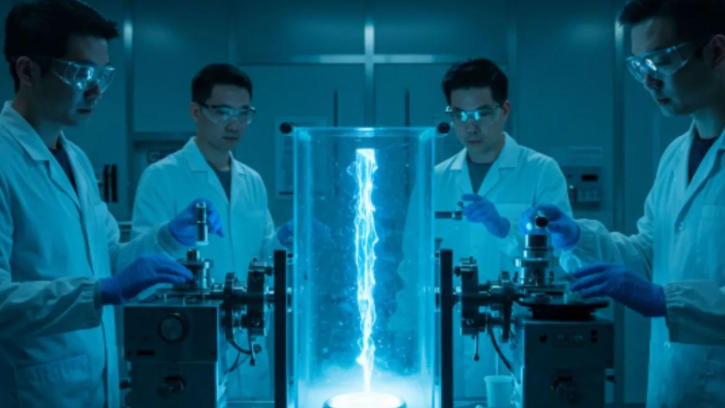

In a groundbreaking experiment, Italian scientists have successfully "frozen" light. They proved that light can behave as a supersolid—an extremely rare state of matter. Their discovery, recently published in Nature, could revolutionize quantum computing and optical technology.
What Is Supersolid Light?
A supersolid is a unique phase of matter. It has the rigid structure of a solid but flows without friction like a superfluid. Previously, scientists had only observed supersolidity in Bose-Einstein condensates (BECs). These form when bosons cool to near absolute zero and occupy the same quantum state.
However, a research team led by Antonio Gianfate from CNR Nanotec and Davide Nigro from the University of Pavia has now proven that light can also exhibit this strange behavior.
How Scientists "Froze" Light
Instead of using extreme cold to freeze light, researchers applied advanced quantum techniques. First, they used a specially designed semiconductor platform to manipulate photons like electrons in a conductor.
Next, they fired a laser at a gallium arsenide structure embedded with microscopic ridges. This process created hybrid light-matter particles called polaritons.
As the number of photons increased, they observed the formation of satellite condensates. Notably, these condensates shared the same energy but had opposite wavenumbers. This pattern confirmed the presence of a supersolid state.
“At temperatures near absolute zero, quantum effects emerge,” the researchers explained. “This is just the beginning of understanding supersolidity in light.”
Why This Discovery Matters
This breakthrough could significantly impact quantum technology. For instance, supersolid light may help develop more stable quantum bits (qubits), which are essential for quantum computing.
Moreover, this discovery could improve optical devices, photonic circuits, and fundamental quantum research. Looking ahead, scientists plan to refine their techniques to create more stable and controlled supersolid light formations.