
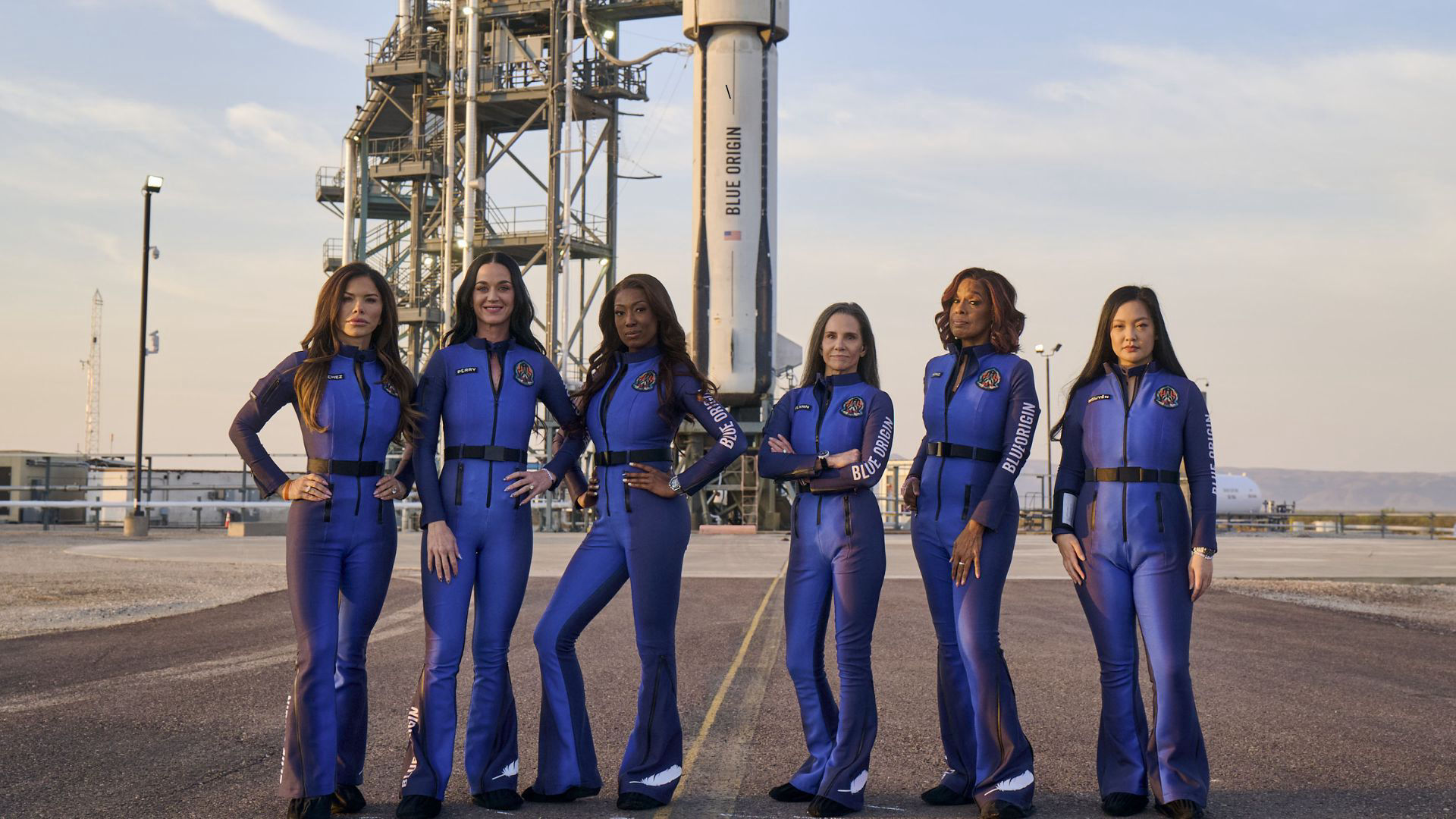

Blue Origin successfully launched an all-female crew into space, marking a historic milestone. On Monday, April 14, the New Shepard rocket carried six women, including American singer Katy Perry, journalist Lauren Sánchez (also Jeff Bezos’ fiancée), CBS anchor Gayle King, and three others, to the edge of space and back.
Flight Details and Cost
The suborbital journey lasted around 11 minutes. Each participant had to place a deposit of $150,000 (around ₹1.3 crore) to reserve a seat. This was the first all-women mission since 1963. While the mission received global attention, critics raised concerns about its high cost and environmental impact.
What Is Space Tourism?
Space tourism is when private individuals pay large amounts of money to visit space for enjoyment. Passengers often travel up to the Kármán line, which is 100 kilometers above sea level and marks the official boundary of space.
On this Blue Origin flight, the crew crossed that line and experienced weightlessness before returning. These short trips are different from full space missions, where astronauts stay for days or even weeks and conduct scientific research.
Companies like Elon Musk’s SpaceX, Richard Branson’s Virgin Galactic, and Jeff Bezos’ Blue Origin are the main players in the space tourism market.
Growing Interest in Space Travel
The all-women flight highlighted the rising popularity of space tourism. The global market was worth about $848 million in 2023 and rose to $1.3 billion last year. Experts expect it to reach $6.7 billion by 2030, growing at nearly 32% every year.
Some believe space tourism will encourage new innovations and boost interest in space science. Annette Toivonen, a space tourism expert, told DW, “We have gotten a lot of products that are safe in a space environment that we copy in a safe way for the benefit of people on Earth.”
She also said that the search for cleaner fuels might benefit air travel. “Now, there’s a lot of money for trying to create alternatives for fossil fuels. Then they might discover some kind of hydrogen fuel system that could be copied for airplanes.”
Jeff Bezos, who flew on Blue Origin’s first mission in 2021, defended space tourism. He told CNN, “It’s about building a road to space for the next generations to do amazing things there, and those amazing things will solve problems here on Earth.”
Experiments in Space
Space tourists are not just going for fun. Some participate in small research projects during their trip. These include studying how zero gravity affects human health, how plants grow, and how materials behave in space, according to Space.com.
Criticism Over Cost and Purpose
However, space tourism faces backlash. The high cost makes it accessible only to the super-rich. A ticket on Virgin Galactic costs about $450,000. Elon Musk’s SpaceX charged $55 million per seat for a civilian flight in 2021. Blue Origin hasn’t publicly shared its pricing.
Critics say these missions don’t offer real scientific value. American actress Olivia Munn said, “It’s so much money to go to space. There’s a lot of people who can’t even afford eggs… I think it’s a bit gluttonous.” She added, “What are they going to do up there that has made it better for us down here?”
Environmental Impact of Rocket Launches
Launching rockets into space harms the atmosphere. These launches release gases that can damage the ozone layer, which protects Earth from harmful ultraviolet rays.
Eloise Marais, a professor at University College London, explained, “The aspect that has been most focused on is the depletion of ozone in the protective stratospheric ozone layer.” She added that even though Virgin Galactic and Blue Origin don’t use chlorine in their fuel, they release nitrogen oxides that also damage the ozone layer.
Virgin Galactic uses a hybrid engine that burns rubber, creating a thick cloud of soot. Filippo Maggi, an aerospace engineering expert, told Space.com, “Hybrid engines can use different types of fuels, but they always generate a lot of soot.”
Although Blue Origin uses cleaner fuels like liquid oxygen and hydrogen, there are still concerns. Marais warned that water vapor from these launches could affect the climate when released into the dry stratosphere.
Carbon dioxide is another concern. Dallas Kasaboski, an analyst at Northern Sky Research, said, “A single Virgin Galactic suborbital spacecraft that lasts about an hour and a half can produce as much pollution as a 10-hour trans-Atlantic flight.”
Unanswered Questions About Space Tourism's Effects
While the space industry is growing, scientists say they don’t have enough data to fully understand the long-term environmental effects of rocket launches. Martin Ross, a scientist from the Aerospace Corporation, said, “The amount of fuel currently burned by the space industry is less than one per cent of the fuel burned by aviation. So there has not been a lot of research, and that makes sense. But things are changing in a way that suggests that we should learn about this in more detail.”