
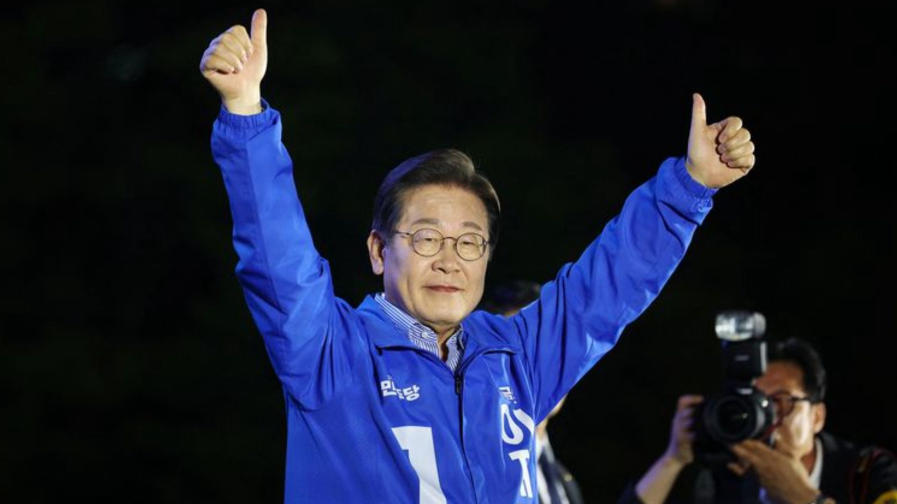

Lee Jae-myung, leader of the Democratic Party, has won South Korea’s presidential election held on June 3. His victory follows the impeachment of former President Yoon Suk Yeol, whose brief declaration of martial law caused national unrest.
Lee Defeats Conservative Rival
Lee’s main competitor, Kim Moon-soo of the People Power Party, conceded defeat. Exit polls showed Lee securing 51.7% of the vote, while Kim lagged with 39.3%. Lee will now take over from the conservative Yoon, who had triggered a political crisis with his failed martial law attempt.
From Poverty to Presidency
Lee’s journey is a classic rags-to-riches story. He was born in 1963 in Andong, a mountain village in Gyeongbuk Province, as the fifth of seven children. Poverty forced him to leave middle school and start working in factories at a young age. At 13, he suffered a workplace injury that left his arm permanently damaged.
Despite hardships, he passed entrance exams in 1978, earned a scholarship to Chung-Ang University, and became a lawyer after passing the bar in 1986. He married Kim Hye-kyung in 1992 and they have two children.
A Long Political Career
Lee entered politics in 2005, joining the Uri Party, which later became the Democratic Party. After an initial defeat in 2006, he won the Seongnam mayoral elections in both 2010 and 2014. He earned praise for launching welfare schemes like free school uniforms.
Later, he became governor of Gyeonggi Province. During the COVID-19 pandemic, he clashed with the central government by demanding relief funds for all citizens in the province.
Support and Criticism
Lee’s outspoken nature has made him a divisive figure. He enjoys strong support from working-class voters, while Korea’s elite often criticize him. According to Dr. Lee Jun-han from Incheon National University, “Still, on certain issues – like addressing past wrongs [during the Japanese colonial era], welfare and corruption – he has built a loyal and passionate support base by taking a firm and uncompromising stance.”
He ran for president in 2022, promising universal basic income, but narrowly lost to Yoon Suk Yeol.
Legal Troubles and an Assassination Attempt
Lee has faced many controversies. In 2004, he was caught drink-driving—an act deeply frowned upon in South Korea. In 2018, he faced allegations of an extramarital affair. More seriously, he faces legal cases tied to corruption and bribery from a 2023 land development project.
He was also convicted in 2024 for making a false claim during a televised debate. Though an appeals court cleared him in March, the Supreme Court reversed that ruling. His next hearing is scheduled for June 18.
If convicted, Lee may still remain in office due to Article 84 of the Constitution, which protects sitting presidents from prosecution unless they commit treason or incite rebellion.
In January 2024, a man stabbed Lee in the neck while asking for an autograph. He underwent emergency surgery for a sliced jugular. Since then, he campaigns wearing a bulletproof vest and remains under tight security.
Yoon’s Fall, Lee’s Rise
Lee's political comeback began after Yoon declared martial law in December 2024. Lee quickly mobilized public protests and led lawmakers to pass a resolution lifting martial law. He live-streamed himself climbing the National Assembly fence, saying, “It was a race against time.”
In April, the Constitutional Court upheld Yoon’s impeachment. This triggered early elections, which led to Lee’s victory.
What Lies Ahead
As president, Lee faces several challenges. South Korea's economy is slowing. North Korea remains aggressive. Also, trade tensions with U.S. President Donald Trump are heating up.
Lee has pledged to continue South Korea’s alliance with the U.S. and maintain cooperation with Japan. But the big question remains—can he reduce the country’s deep political divide?