
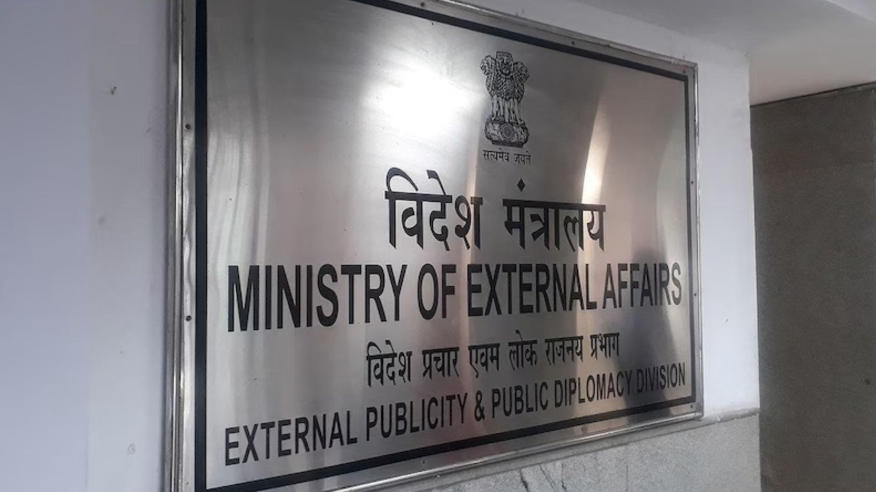

India firmly rejected a ruling from the Permanent Court of Arbitration (PCA) in The Hague on Friday. The ruling involved two hydroelectric projects—Kishenganga and Ratle—located in Jammu and Kashmir. India said it has never accepted the framework used by Pakistan to raise the dispute.
India Calls the Ruling “Illegal”
The Ministry of External Affairs (MEA) said India does not recognise the so-called "supplemental award" issued by the court. This award addresses Pakistan’s objections to the design of the two projects.
According to the PCA, India's decision in April to suspend the Indus Waters Treaty does not stop the court from ruling on the case. The court also said its decision is binding on both India and Pakistan.
India, however, rejected this claim. The MEA said, “This latest charade at Pakistan’s behest is yet another desperate attempt by it to escape accountability for its role as the global epicenter of terrorism.”
It added, “Pakistan’s resort to this fabricated arbitration mechanism is consistent with its decades-long pattern of deception and manipulation of international forums.”
India Never Recognised the Arbitration Process
India has always disagreed with the PCA proceedings. The MEA said the arbitration began after Pakistan objected to the project designs under the Indus Waters Treaty. But India maintains that this arbitration process itself is invalid.
In its statement, the MEA said, “Today, the illegal Court of Arbitration, purportedly constituted under the Indus Waters Treaty 1960, albeit in brazen violation of it, has issued what it characterizes as a ‘supplemental award’ on its competence concerning the Kishenganga and Ratle hydroelectric projects in the Indian Union Territory of Jammu and Kashmir.”
It also stated, “India has never recognised the existence in law of this so-called Court of Arbitration.”
India Says the Tribunal Violates the Treaty
India believes that forming this arbitration panel breaks the Indus Waters Treaty. As a result, any actions or decisions by this body are also not valid under international law.
The MEA noted, “India’s position has all along been that the constitution of this so-called arbitral body is in itself a serious breach of the Indus Waters Treaty and consequently any proceedings before this forum and any award or decision taken by it are also illegal for that reason.”
India Suspended the Treaty After Terror Attack
India had suspended the Indus Waters Treaty on April 22, one day after a terrorist attack in Pahalgam, Jammu and Kashmir. The attack triggered a strong response from India, which included putting the treaty “in abeyance.”
The MEA explained, “Following the Pahalgam terrorist attack, India has in exercise of its rights as a sovereign nation under international law, placed the Indus Waters Treaty in abeyance, until Pakistan credibly and irrevocably abjures its support for cross-border terrorism.”
It added, “Until such time that the treaty is in abeyance, India is no longer bound to perform any of its obligations under the treaty.”
India Says Court Has No Authority
India clearly stated that the arbitration body has no legal authority to judge its actions as a sovereign nation.
The MEA said, “No court of arbitration, much less this illegally constituted arbitral body which has no existence in the eye of law, has the jurisdiction to examine the legality of India’s actions in exercise of its rights as a sovereign.”
In conclusion, the MEA stated that India completely rejects this "supplemental award," just as it has rejected all earlier rulings from this body.