
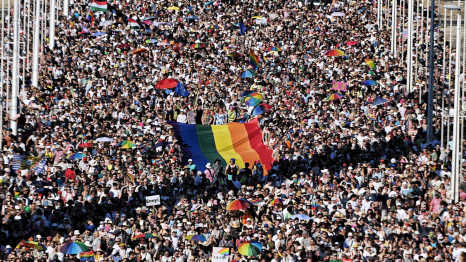

Budapest saw a historic turnout for its 30th annual Pride parade, with organisers estimating around 200,000 people marching in support of LGBTQ rights on Saturday. This marked a massive increase from the previous record of 35,000 attendees.
March Defies Ban and Government Crackdown
Participants gathered joyfully under rainbow flags, despite a government ban enforced by Prime Minister Viktor Orban’s nationalist administration. The government recently changed the laws and the constitution to restrict the event, citing “child protection” as the reason for its years-long clampdown on LGBTQ rights.
Still, Budapest’s opposition-led city hall stepped in to co-host the event, allowing the parade to take place.
“I am proud to be gay… and I am very scared that the government wants to bring us down,” said 66-year-old Zoltan, one of the participants. He added, “I am very surprised that there are so many people, I want to cry.” Zoltan declined to give his full name.
Participants Face Legal Risks
Prime Minister Orban warned that while police would not forcibly stop the march, those involved could face “legal consequences.” Organisers could face up to one year in prison, and participants might have to pay fines of up to 500 euros ($590).
Moreover, the government has installed facial-recognition cameras on lamp posts along the route to track attendees. These surveillance measures have raised further concerns.
According to Szabolcs Pek, an analyst at Iranytu Institute, “This is a big embarrassment for Fidesz.”
March Begins in Tense Atmosphere
The march started under a scorching sun and proceeded in a stop-start manner as marchers waited for police to manage traffic. Many people, like 22-year-old student Marcell Szanto, joined to show support. “I definitely wanted to come, if only to show my solidarity, and to show how important this issue is – not only to me, but to almost everyone living in Budapest,” he said.
Several European lawmakers also joined the march in open defiance of the ban.
International Support and Protest Slogans
A huge banner near city hall read, “Freedom and love can’t be banned.” This slogan captured the spirit of the parade. Earlier in the week, EU chief Ursula von der Leyen had urged Hungary to cancel the ban.
In addition, 33 countries, mostly EU members, signed a joint statement backing the parade. At a Saturday press conference, several French MEPs demanded that the EU take stronger action against Hungary for curbing civil rights and violating rule-of-law standards.
Hungary’s Anti-LGBTQ Policies Continue
Since returning to power in 2010, Orban’s government has steadily rolled back LGBTQ rights. Hungary is now the first EU country to ban a Pride march. Orban has said he feels encouraged by former U.S. President Donald Trump’s anti-diversity stance.
Some far-right groups staged counter-protests along the parade route. One group carried a large wooden cross with protest signs attached.
Still, opposition leader Peter Magyar wrote on Facebook that the government’s move had backfired. “The government scored not a goal, but a huge own goal with their attempt to ban today’s event,” he posted.
Budapest Mayor Gergely Karacsony thanked Orban sarcastically for “advertising for a more tolerant society” in his social media post, referring to the unexpected surge in public support.
Not everyone supported the parade. One woman, who gave her name only as Katalin, said she agreed with the ban. “Disgusting… it’s become a fad to show off ourselves,” she told AFP, though she hoped the event would remain peaceful.