
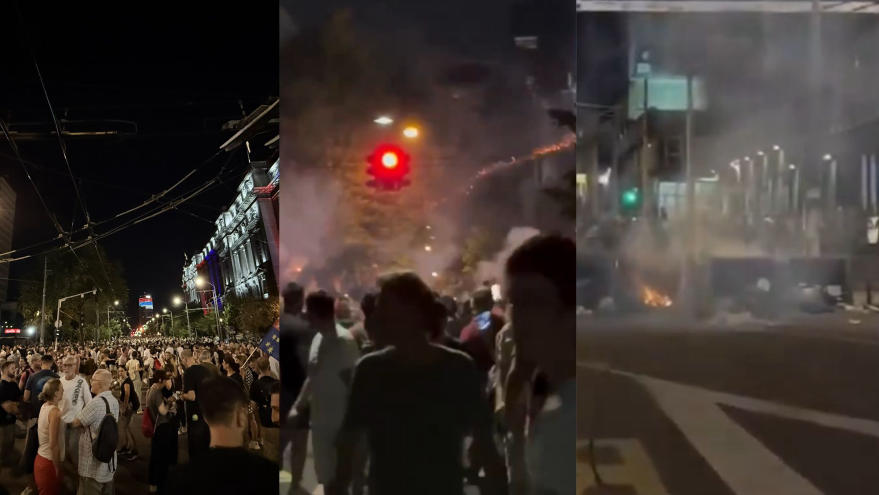

Clashes between rival groups of protesters flared again late Thursday in Serbia, police said, after months of anti-government demonstrations boiled over into street violence this week.
Anti-corruption protests have gripped Serbia since November. The protests began after the collapse of the Novi Sad railway station roof, which killed 16 people. The tragedy was widely blamed on entrenched corruption.
Late Thursday, anti-graft demonstrators gathered in several cities across Serbia.
Escalation After Pro-Government Attack
The latest protests followed a previous attack by supporters of the ruling party on demonstrators on Tuesday in Vrbas, about 160 kilometres (100 miles) north of Belgrade.
On Wednesday, large groups of pro-government supporters, many wearing masks, confronted protesters. Both sides threw bottles, stones, and fireworks. Police arrested nearly 50 people nationwide, and around 30 riot officers were injured.
Big protests are happening tonight across Serbia 🇷🇸 against Vučić’s regime. Tension is growing, and there are clashes with police in many cities.
— Based Serbia (@SerbiaBased) August 13, 2025
Vučić should call early elections before things get worse.
This is video from Novi Sad. pic.twitter.com/IXkuzwYGHb
Vandalism and Heavy Police Response
On Thursday, protesters vandalised the Novi Sad headquarters of the ruling Serbian Progressive Party (SNS) and two other SNS offices, RTS television reported. Demonstrations spread to other cities as well.
In Belgrade, protesters gathered in front of government buildings and the army headquarters, then moved toward nearby SNS offices. However, a heavy riot police presence and teargas blocked their path.
“These are no longer peaceful student protests but people who want to provoke violence… This is an attack on the state,” Interior Minister Ivica Dacic said at a news conference.
At least five police officers were injured, and 14 protesters were arrested on Thursday evening, the ministry reported.
Rising Frustration and Demands
Protesters, frustrated with government inaction, demand an investigation into the Novi Sad tragedy. They are also pressuring right-wing President Aleksandar Vucic to call early elections.
Over the past nine months, thousands of mostly peaceful, student-led demonstrations have taken place, sometimes drawing hundreds of thousands.
However, this week’s violence marks a sharp escalation. It highlights growing strain on Vucic’s populist government, which has been in power for 13 years.
Government Crackdown
Since June 28, when around 140,000 demonstrators gathered in Belgrade, the government has intensified its crackdown on activists, according to UN human rights experts.
Protesters and activists linked to the movement have faced “a troubling pattern of repression,” including excessive police force, intimidation, and arbitrary arrests.
Vucic and Supporters Respond
Vucic has remained defiant. He repeatedly rejected calls for early elections and called the protests part of a foreign plot to overthrow him.
Student protesters accused the police of protecting pro-government supporters while ignoring attacks on their gatherings. “The authorities tried to provoke a civil war last night,” students wrote on their official Instagram page.
Vucic, who visited pro-government encampments overnight Wednesday, denied his supporters started the violence. “No one attacked them anywhere,” he said about anti-government protesters. “They went everywhere to attack those who think differently,” he added.
Political Impact
So far, the protests have led to the resignation of the prime minister and the collapse of his cabinet. Yet, Vucic remains in power with a reshuffled government.