
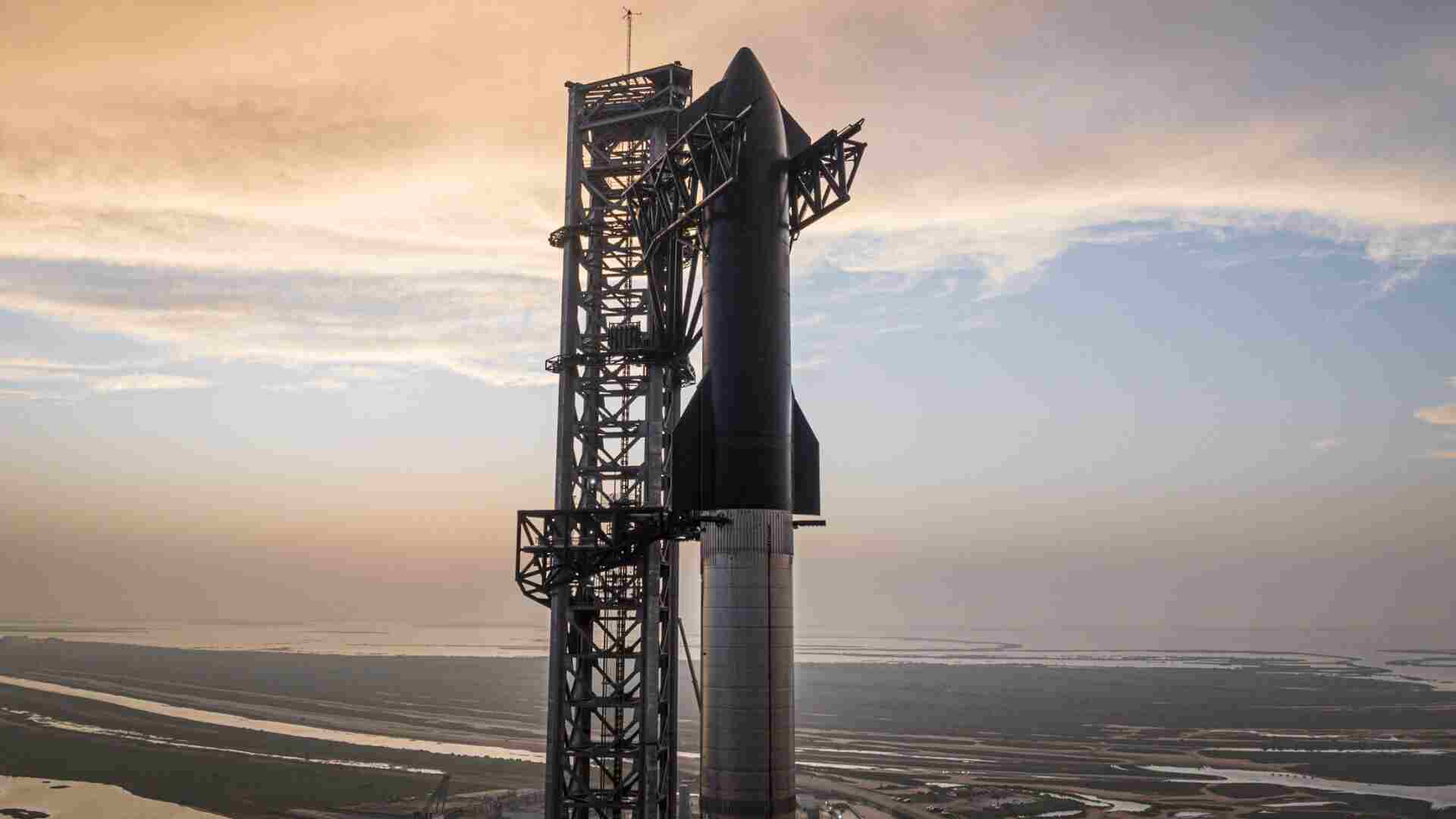

SpaceX once again stood down from launching its Starship rocket on Monday evening (Aug 25). The company said poor weather conditions forced the cancellation. The call-off came less than 24 hours after a separate attempt was scrubbed because of a liquid oxygen leak.
Starship, mounted on its powerful Super Heavy booster, stands at 397 feet (121 meters), making it taller than the Statue of Liberty. It was scheduled for liftoff from Starbase, Texas, at 7:30 pm local time (0030 GMT) for its tenth test flight.
On X, SpaceX confirmed: “Standing down from today’s flight test attempt due to weather.” The company added that its team is now working to find “the next best available opportunity to fly.”
Standing down from today’s flight test attempt due to weather. Starship team is determining the next best available opportunity to fly
— SpaceX (@SpaceX) August 26, 2025
A String of Setbacks
This fresh delay adds to SpaceX’s growing list of challenges with Starship. The rocket’s upper stage has exploded in all three of its test flights this year. In two cases, debris scattered over Caribbean islands, while another stage broke apart after briefly reaching space.
In June, a static fire test ended in another explosion on the ground. Until now, Starship has not managed to put a payload into orbit or safely recover its upper stage.
Despite repeated failures, Elon Musk has not lost confidence. Responding to a user on X, he wrote on Sunday: “In about 6 or 7 years, there will be days where Starship launches more than 24 times in 24 hours.”
Starship and the Dream of Mars
Starship is the centerpiece of Musk’s vision for reusable space travel. SpaceX plans to replace its Falcon rockets with Starship in the future. NASA has also selected Starship for its first crewed lunar mission since the Apollo program, tentatively scheduled for 2027.
Musk sees the rocket as humanity’s gateway to the Moon and eventually Mars. Despite the setbacks, SpaceX is pushing forward with its “fail fast, learn fast” strategy. The company has already succeeded in catching Starship’s massive booster with its “chopstick” launch tower arms three times.
Rising Criticism
However, not everyone shares Musk’s optimism. Space analyst Dallas Kasaboski told AFP, “I think there is a lot of pressure on this mission. We’ve had so many tests and it hasn’t proven itself reliable — the successes have not exceeded the failures.”
Others have raised sharper doubts. Will Lockett, a former engineer turned commentator, suggested that the Starship program might be “fundamentally flawed.”