
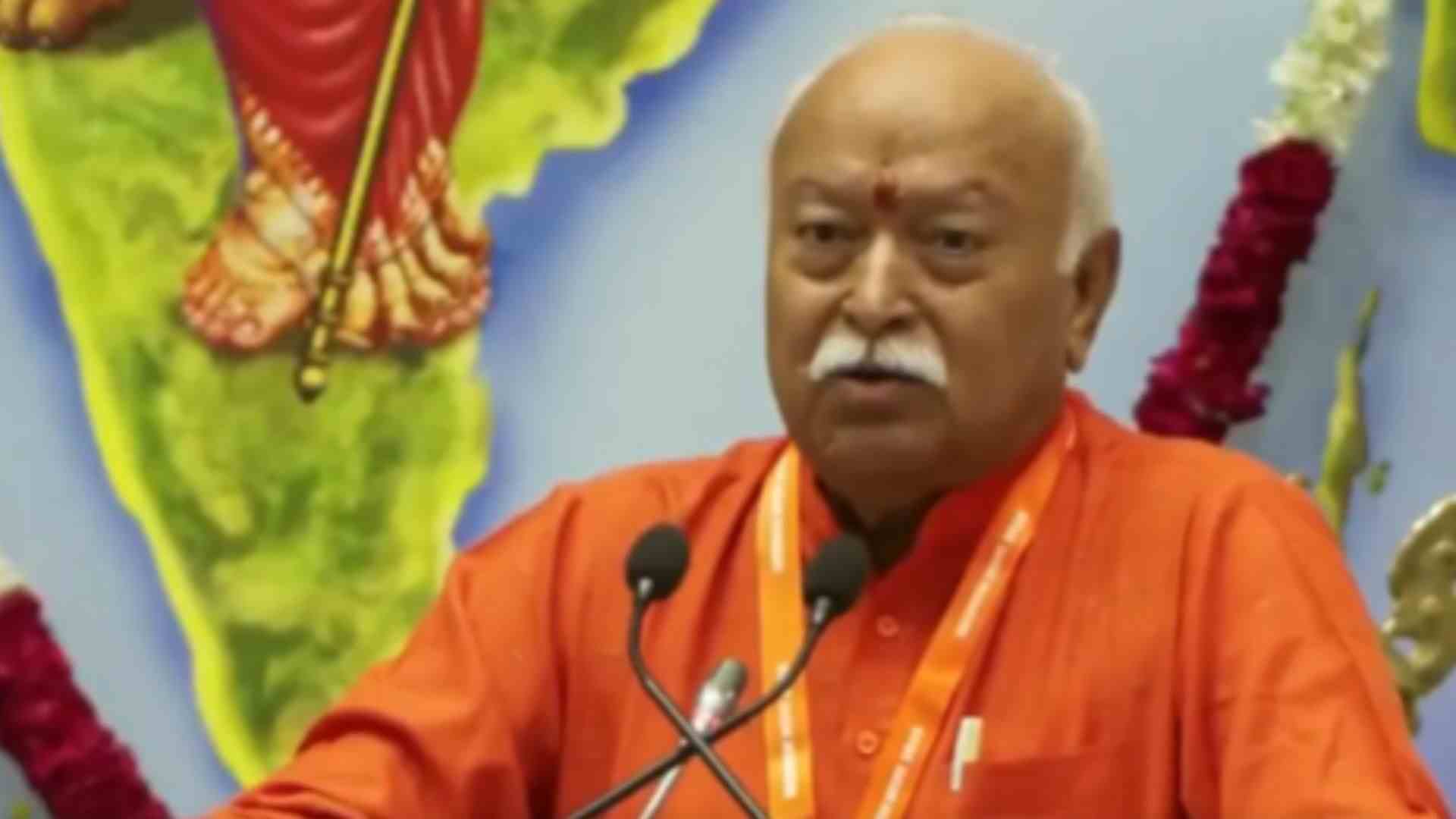

RSS chief Mohan Bhagwat said on Tuesday that a Hindu Rashtra is not like the western idea of a nation state. Moreover, he stressed that it has no link with politics or power. Instead, it treats everyone equally and makes no distinction on the basis of religion or language.
RSS keeps its own identity
Furthermore, Bhagwat underlined that the RSS works independently and does not interfere in government matters. “Discussions are held on ‘Achar, Vichar, Sanskar’ (conduct, ideology, and values) but it does not impose its view on anyone,” he said. Although he did not name any group, many saw this as a message that the RSS keeps its own agency apart from the BJP.
Even though the Sangh avoids direct electoral politics, it is widely seen as shaping the BJP’s policies, strategies, and appointments.
Lecture series for centenary
Meanwhile, Bhagwat spoke at the opening of a three-day lecture series called New Horizons, part of the RSS centenary celebrations. He reminded the audience that the organisation was not formed against anyone, even though it faced many challenges and allegations.
“Sangh was not a party to any protest or opposition... when someone asked Guruji (MS Golwalkar; the man who built the organisation) why a Sangh Shakha was needed in areas with no Muslims or Christians, he said a Hindu Samaj and a Shakha would exist even if there were no Muslims anywhere in the world,” Bhagwat recalled.
Inclusivity as core principle
In addition, Bhagwat said the Sangh supports unity without uniformity. “We do not believe in unity from uniformity... There is no Hindu versus others. Inclusivity has no outer limit. We can have mathed (differences of opinion) not manbhed (discord). Even those who oppose us are our own,” he said.
He also highlighted that the DNA of people living in India for the past 40,000 years is “one.”
Critics and values of RSS
At the same time, opponents accuse the RSS of pushing India as a Hindu-majority state. However, the organisation denies this. Bhagwat said its goal is to make India a global leader. He urged Indians to return to traditions explained by Dayanand Saraswati and Swami Vivekananda.
Additionally, at a time when critics accuse the RSS and BJP of polarisation, Bhagwat urged acceptance. “Do not try to change others and have faith in your own... Accept the other, do not insult them. Do not fight over the way (of prayer)... those who follow this are Hindus,” he said.
Looking back at India’s past
Later, Bhagwat reflected on India’s history. He said the country once flourished with peace and prosperity. According to him, the “struggle for existence and survival of the fittest did not apply for India.” He explained that patience and abundance removed the need for conflict.
Bhagwat also asked people to unite for the nation’s progress. Quoting an old saying, he said, “Coming together is the beginning, staying together is progress and working together is success.” He added, “The Sangh is not here to claim credit for anything... How long will Shivaji and Lord Ram come for rescuing... we cannot give the license or the contract to leaders or parties. We all have to take responsibility for the country.”
Sangh’s resilience through bans
Significantly, Bhagwat said the RSS grew despite many bans and accusations. He noted that the organisation expanded “without men, money and ammunition.” He recalled that the Sangh was banned three times: in 1948 after Mahatma Gandhi’s assassination, in 1975 during the Emergency, and in 1992 after the Babri Masjid demolition.
Bhagwat also pointed out that a similar lecture series took place in 2018. “It is not our job to convince people, but to present facts and let them take their own call,” he said.
Wide audience at the event
Finally, the centenary lecture drew a large audience. Union ministers Jyotiraditya Scindia, Ravneet Singh Bittu, and Anupriya Patel attended. Diplomats, former CEC S.Y. Quraishi, academics, doctors, and political leaders were also present.