
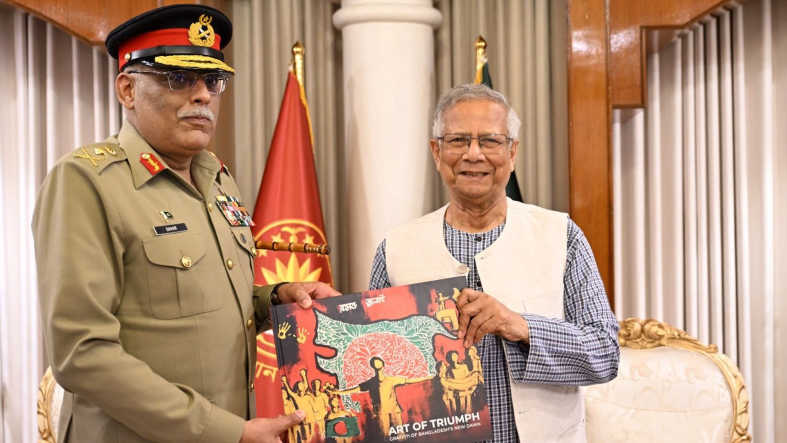

Bangladesh’s interim leader Muhammad Yunus has come under fire for presenting a controversial gift to a top Pakistani military official. The gift, given to Pakistan’s Joint Chiefs of Staff Committee chairperson General Sahir Shamshad Mirza during his visit to Dhaka, included a distorted map of Bangladesh that shows Assam and other northeastern Indian states as part of the country.
The image of the gift, shared on Yunus’ official X account, revealed a book titled “Art of Triumph: Bangladesh’s New Dawn.” The book appears to celebrate the 2024 student movement that led to the fall of the Sheikh Hasina government. However, the map inside it has ignited sharp criticism both within and outside Bangladesh.
Chairman, Joint Chiefs of Staff Committee of Pakistan Calls on Chief Adviser
— Chief Adviser of the Government of Bangladesh (@ChiefAdviserGoB) October 26, 2025
DHAKA, October 26: The visiting Chairman of Pakistan’s Joint Chiefs of Staff Committee (CJCSC), General Sahir Shamshad Mirza, paid a courtesy call on Chief Adviser Professor Muhammad Yunus at the State… pic.twitter.com/A9QmFMHk4F
Map Linked to 'Greater Bangladesh' Concept
The map reflects the controversial idea of “Greater Bangladesh,” a concept promoted by the Dhaka-based Islamist group Sultanat-e-Bangla. According to this ideology, Bangladesh’s territory extends far beyond its actual borders, including India’s entire Northeast, West Bengal, parts of Bihar, Jharkhand, and Odisha, as well as Myanmar’s Arakan state.
This distorted map first appeared publicly in April 2025, displayed during an exhibition at the University of Dhaka on Pohela Baishakh, the Bengali New Year. The issue reached India’s Parliament in August 2025, when Congress MP Randeep Singh Surjewala raised it in the Rajya Sabha.
The “Greater Bangladesh” narrative gained further attention in 2024, when Nahidul Islam, a close aide of Yunus, circulated a similar map online showing parts of Assam, Tripura, and West Bengal within Bangladesh’s borders.
Yunus’s Repeated Reference to Northeast India
This is not the first time Muhammad Yunus has made remarks about India’s Northeast. During his visit to China in April, he described Bangladesh as the region’s “only guardian of the ocean,” claiming that “the seven states of India, the eastern part of India... they are a landlocked country. They have no way to reach out to the ocean.”
His statement was viewed in India as a challenge to the country’s strategic position. In response, External Affairs Minister S. Jaishankar emphasized that the Northeast is a vital connectivity hub for the BIMSTEC region — linking Bangladesh, Bhutan, India, Myanmar, Nepal, Sri Lanka, and Thailand.
Strained India–Bangladesh Relations
Relations between India and Bangladesh have grown tense since the toppling of the Sheikh Hasina government, with Yunus leaning closer to China and Pakistan. The situation has become even more sensitive as former Prime Minister Sheikh Hasina lives in exile in India, deepening mistrust between the two nations.
India’s Ongoing Border Challenges
India has faced similar disputes with other neighbors. With China, tensions continue over the Arunachal Pradesh and Aksai Chin regions. In 2023, China released a map claiming both areas as its territory, prompting a strong protest from New Delhi.
Meanwhile, Pakistan continues to claim sovereignty over Kashmir, including the union territories of Jammu & Kashmir and Ladakh, as well as Pakistan-occupied Kashmir (PoK).
Broader Regional Implications
The latest controversy involving Yunus’s map comes at a time when South Asia’s political landscape is already fragile. The inclusion of Indian territories in the distorted Bangladeshi map has revived old anxieties about regional expansionism and ideological extremism.
As tensions escalate, analysts warn that Yunus’s growing proximity to Beijing and Islamabad could reshape Dhaka’s traditional ties with New Delhi, potentially marking a major shift in South Asian geopolitics.