
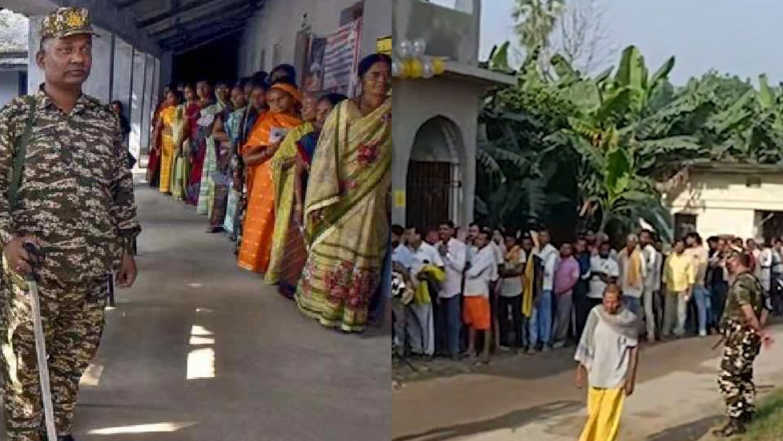

The first phase of the 2025 Bihar Assembly election witnessed a historic voter turnout of 64.66 percent, the highest ever recorded in the state. The Election Commission released this provisional figure on Thursday, marking a major rise in participation compared to previous elections.
Before this, the state’s highest voter turnout for an Assembly poll was 62.57 percent in 2000, while the record for Lok Sabha elections stood at 64.6 percent in 1998.
Chief Election Commissioner Gyanesh Kumar thanked voters and polling officials for their commitment, saying their effort made this high participation possible.
Impact of voter list revision
This year’s turnout gain carries added importance because the Election Commission recently completed a special intensive revision (SIR) of Bihar’s voter list. The exercise removed 47 lakh names, reducing the total number of registered voters from 7.89 crore to 7.42 crore.
The opposition had strongly opposed the revision, calling it an attempt to remove voters from poor and marginalised communities who often support them.
The smaller voter base could partly explain the higher turnout percentage — depending on whether the same number of people voted as before.
For instance, if 60 of 100 voters participated earlier (60 percent), and after the revision the list dropped to 80 voters but 60 still voted, turnout would rise to 75 percent. However, if only 40 voted, turnout would fall to 50 percent.
High turnout may signal anti-incumbency — or not
Political observers often link high voter turnout with anti-incumbency sentiment, something the opposition hopes will work in its favor this time.
Over the past three Bihar elections, voter enthusiasm has often coincided with political change.
-
In 2010, Nitish Kumar’s JDU-BJP alliance scored a landslide with 52.73 percent turnout.
-
In 2015, after Kumar switched sides and allied with Lalu Prasad Yadav’s RJD, turnout rose by 4.18 percent, and the alliance won again.
-
In 2020, Kumar returned to the BJP, winning once more though his JDU lost 28 seats and became the junior partner. The overall turnout then was 57.29 percent, only slightly higher than 2015.
In comparison, the 2025 first-phase turnout is 7.37 percent higher than the 2020 state average and 8.46 percent higher than the first phase in 2020, which saw 56.2 percent.
Opposition sees hope in rising numbers
Analysts say the higher turnout could benefit the RJD-Congress Mahagathbandhan alliance, led by Tejashwi Yadav, who hopes to become chief minister if the bloc wins a majority.
Still, experts warn that a large turnout doesn’t always mean a change in power. For example, Chhattisgarh saw a 7 percent rise in turnout between 2008 and 2013, but the BJP won both times. Similarly, in Madhya Pradesh, turnout increased from 67.25 percent in 2003 to 72.07 percent in 2013, yet the BJP remained in power across all three elections.
The real impact of the voter list revision and the removal of 47 lakh names will become clearer once results are declared.
Key contests in the first phase
Voting took place in 121 of Bihar’s 243 seats on Thursday. The remaining 122 constituencies will vote on November 11, and the results will be announced on November 14.
Prominent candidates featured in this round included Tejashwi Yadav, contesting from Raghopur, a family stronghold that has elected either his father Lalu Prasad Yadav or mother Rabri Devi seven times in nine elections. Yadav has held the seat since 2015.
Other high-profile contests included:
-
Tarapur, where Deputy Chief Minister and BJP state president Samrat Choudhary contested.
-
Alinagar, where folk singer Maithili Thakur represented the BJP.
-
Mokama, which saw drama after JDU candidate Anant Singh was arrested in a murder case.
Background: Bihar’s political balance
In the 2020 Assembly election, the RJD emerged as the single largest party with 75 seats, narrowly ahead of the BJP’s 74. The JDU came third with 43 seats, while the Congress, allied with RJD, won 28.
With one more phase of polling left, all eyes are now on whether Bihar’s record-breaking voter participation will signal change — or continuity — in one of India’s most politically dynamic states.