
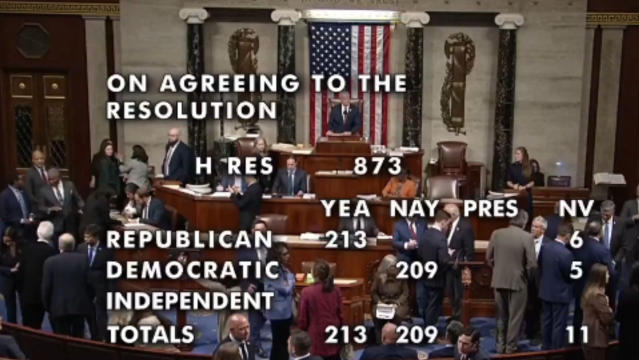

The US House of Representatives passed a crucial bill on Wednesday that ends the longest government shutdown in American history and restores government operations. Both chambers of Congress have approved the legislation and sent it to President Donald Trump for his signature, which will officially reopen the government.
The Republican-controlled House narrowly voted 213-209 to advance the measure. Trump’s backing helped unite most Republican lawmakers despite strong opposition from Democrats. Many Democrats expressed frustration after their prolonged standoff with Senate Republicans failed to secure an agreement on extending federal health insurance subsidies.
The final vote followed party lines as the House approved the Senate-passed funding package. This measure will reopen government agencies and departments. However, many Democrats criticized their leaders, calling the decision a surrender to Republican demands.
House Speaker Mike Johnson delivered a sharp speech before the vote, blaming the opposition for the political deadlock.
“They knew that it would cause pain, and they did it anyway,” he said. “The whole exercise was pointless. It was wrong and it was cruel.”
Key Provisions in the Funding Bill
The federal funding bill will keep most government agencies operational through January 30. This temporary measure reflects the continuing divide between Republicans and Democrats over long-term government funding for the rest of the fiscal year.
The bill ensures full funding for the Supplemental Nutrition Assistance Program (SNAP), commonly known as food stamps, until the fiscal year ends on September 30. It also replenishes SNAP’s emergency funds and fully supports child nutrition programs, including free and reduced-price school meals.
Additionally, lawmakers have allocated $203.5 million to protect members of Congress and improve physical security around the Capitol complex.
The bill also guarantees retroactive pay for around 1.4 million federal workers who were furloughed or forced to work without pay during the shutdown. Many of these employees missed two full paychecks and part of a third during the 40-day standoff.
Democratic Discontent Over the Compromise
The deal has drawn strong criticism from Democrats. Eight Senate Democrats broke ranks earlier in the week to support the funding package, which continues government spending until January 30. The measure keeps the government on track to add about $1.8 trillion annually to the national debt, now exceeding $38 trillion.
Republican Representative David Schweikert of Arizona mocked the political drama, saying, “I feel like I just lived a Seinfeld episode. We just spent 40 days and I still don’t know what the plotline was.” He added, “I really thought this would be like 48 hours: people will have their piece, they’ll get a moment to have a temper tantrum, and we’ll get back to work. What’s happened now when rage is policy?”
Many House Democrats remained angry over the Senate deal, especially after their recent victories in New Jersey, Virginia, and New York City, which they believed strengthened their negotiating position on health insurance subsidies. Although the Senate’s compromise schedules a December vote on those subsidies, Speaker Johnson has made no similar commitment in the House.
Outgoing Democratic Representative Mikie Sherrill, recently elected as New Jersey’s next governor, criticized the bill during her farewell speech.
“To my colleagues: do not let this body become a ceremonial red stamp from an administration that takes food away from children and rips away healthcare,” Sherrill said.
What Lies Ahead
The passage of the bill ends a historic shutdown that disrupted federal operations for more than a month. However, the political divide between Republicans and Democrats remains deep. With only temporary funding secured, Congress faces renewed budget negotiations early next year—raising concerns that another standoff could be on the horizon.