
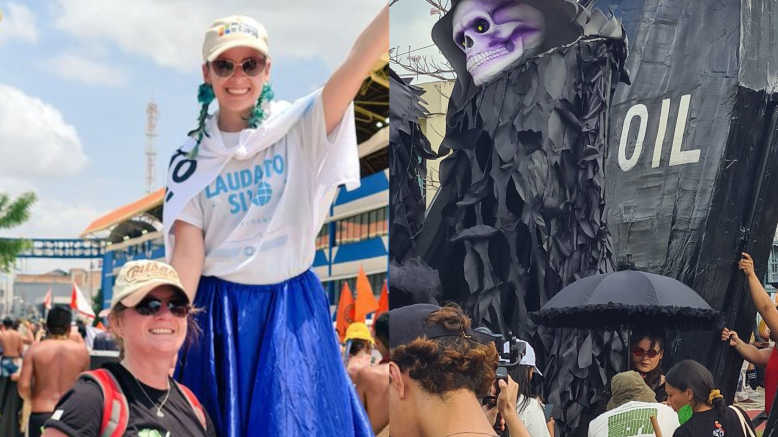

Protesters filled the streets of Belèm on Saturday in the biggest demonstration held during the annual United Nations climate summit. Many wore black clothes to represent a “funeral” for fossil fuels. Hundreds chose red shirts to symbolize the blood of colleagues fighting to defend the environment. Others carried flags, chanted, or held signs as they walked together in a march traditionally held at the halfway point of the talks.
Organizers used trucks fitted with sound systems and raised platforms to guide the march. Groups representing many social and environmental movements joined. At the front, Kichwa activist Marisol Garcia from Peru said protesters wanted to pressure world leaders to make “more humanized decisions.”
March Passes Near the COP30 Venue
The crowd marched about 4 kilometers, following a route that took them close to the main venue for the climate conference, known as COP30.
Earlier in the week, protesters disrupted the summit twice by surrounding the venue. One of those incidents, on Tuesday, left two security guards with minor injuries.
Inside the conference center, delegates scheduled a full day of talks. They planned discussions on how to deliver the $300 billion in annual climate finance pledged last year. This money is meant to help poorer countries reduce fossil fuel use, adjust to harsher climate conditions, and recover from extreme weather.
Protesters Enjoy Greater Freedom to Demonstrate
Many participants said they felt more freedom to protest compared with past climate conferences in more restrictive countries such as Azerbaijan, the UAE, and Egypt. Thousands joined Saturday’s march, and the procession stretched across nearly the entire route.
Youth leader Ana Heloisa Alves, 27, said it was the largest climate march she had ever joined. “This is incredible,” she said. “You can’t ignore all these people.”
Alves attended to defend the Tapajós River, which the Brazilian government hopes to develop commercially. Her group carried signs reading, “The river is for the people.”
Activists Call for Broader Participation
Pablo Neri, a coordinator in Pará for the Landless Rural Workers’ Movement, said the organizers of the climate talks should involve more people. He argued that the climate movement is shifting toward greater public participation and that the talks should reflect that change.
The United States did not attend the summit. President Donald Trump has dismissed climate change as a scam and withdrew the US from the 2015 Paris Agreement, which aimed to slow global warming.
Protesters Criticize US Role
One protester, Flavio Pinto from Pará, directly targeted the United States. He wore a brown suit, stood on stilts, and sported an oversized top hat designed like the American flag. He also fanned himself with fake $100 bills printed with Trump’s face. His sign read, “Imperialism produces wars and environmental crises.”
Women March for Land, Culture, and Survival
Another group of mostly women joined the demonstration wearing dome-shaped hats made from Babaçu palm fronds. Their leader, Vitoria Balbina, represents the Interstate Movement of Coconut Breakers of Babaçu. She said they marched to demand access to Babaçu trees located on private land. These trees provide income and carry cultural meaning for their communities. Balbina said the march is not only a fight for the environment but also “a way of life.”
A Colorful Sea of Flags
As the march climbed a hill, red, white, and green flags filled the view. A crowd formed outside a local supermarket to watch. People leaned on railings, took photos, and commented on the spectacle. One man carrying groceries simply said, “Beautiful.”
Few Major Decisions Expected at COP30
The climate talks will continue through Friday. Analysts and some delegates said they do not expect any major new agreements to be announced. However, they hope for progress on earlier commitments, especially funding to help poorer countries adapt to worsening climate impacts.