
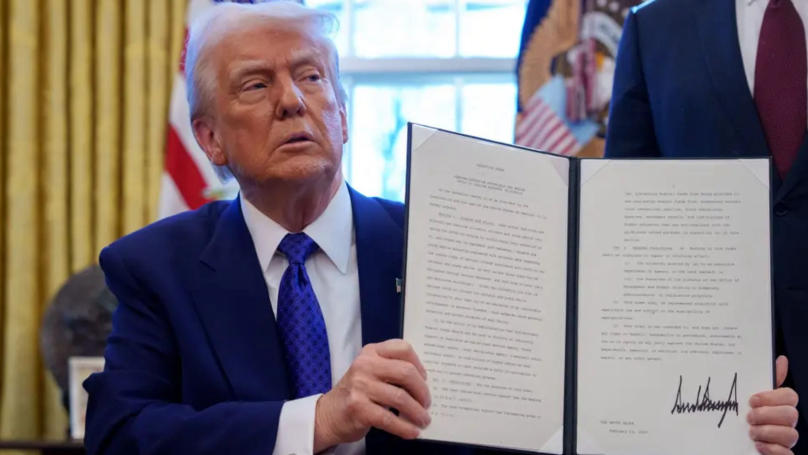

US President Donald Trump signed a new executive order on Thursday that aims to stop states from creating or enforcing their own rules on Artificial Intelligence. The order also creates a federal task force with the “sole responsibility” of challenging state-level AI regulations.
During the signing ceremony, Trump praised major AI companies for wanting to “invest” in the United States. He argued that different laws in every state would slow down innovation. He said, “if they had to get 50 different approvals from 50 different states, you could forget it.”
This move revives an earlier Republican effort to impose a 10-year ban on state AI regulations. That proposal was part of Trump’s One Big Beautiful Bill Act but failed due to bipartisan opposition and divisions within the Republican Party. The new executive order brings the idea back, although it does not carry the same legal weight as a law passed by Congress.
A Boost for Silicon Valley
The order, titled “Ensuring a national policy framework for artificial intelligence,” marks a major win for Silicon Valley and AI companies. These firms have long argued that different state rules would create confusion and unnecessary bureaucracy.
The executive order includes several measures designed to block AI regulation. It directs the Department of Justice to create an “AI Litigation Task Force,” which will focus on fighting state laws. It also asks federal agencies to review state regulations that may “require AI models to alter their truthful outputs.”
Because of these provisions, states with strict AI laws are likely to face challenges. California requires companies to disclose safety testing for new AI systems. Colorado mandates risk assessments to prevent algorithmic discrimination in hiring. Both states could become early targets under the new federal approach.
Strong Pushback from States and Rights Groups
Trump’s order has already triggered strong opposition from state leaders and civil liberties organizations. They warn that the move shifts power toward big tech companies and reduces protections for vulnerable groups.
Critics say that without state oversight, communities and children will face higher risks from chatbots, surveillance tools, and algorithm-driven systems.
Teri Olle, vice-president of Economic Security California Action, sharply criticised the order. “Trump’s campaign to threaten, harass and punish states that seek to pass commonsense AI regulations is just another chapter in his playbook to hand over control of one of the most transformative technologies of our time to big tech CEOs,” she said. “This is not about allowing for American innovation.”