
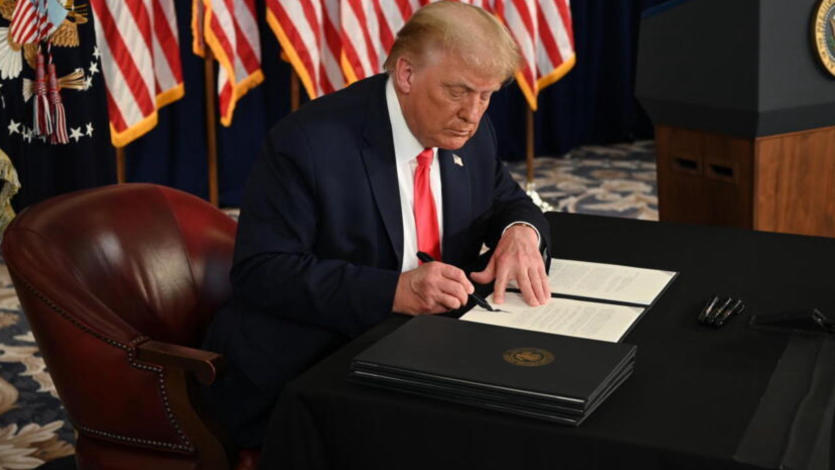

US President Donald Trump has signed an executive order that places “illicit fentanyl and its core precursor chemicals” in the category of weapons of mass destruction. As a result, the United States will now treat fentanyl crimes far more seriously. This step marks a major shift in how authorities view and prosecute fentanyl-related offences.
Announcing the decision from the Oval Office, Trump said the order aims to protect Americans from the growing drug crisis. “Today I’m taking one more step to protect Americans from the scourge of deadly fentanyl flooding into our country with this historic executive order. No bomb does what this is doing," he said.
How the Law Already Treated Weapons of Mass Destruction
Under current US law, the use, threat, or attempted use of weapons of mass destruction is already a serious crime. In some cases, the punishment can even include the death penalty.
The law defines weapons of mass destruction in broad terms. It includes “any weapon involving a biological agent, toxin, or vector.” Now, with this order, fentanyl falls within that legal framework.
What the New Executive Order Changes
The executive order describes fentanyl as “closer to a chemical weapon than a narcotic.” Therefore, the government will no longer treat it only as a public health or criminal issue. Instead, it will now see it as a direct national security threat.
The order directs Attorney General Pam Bondi to “immediately pursue investigations and prosecutions into fentanyl trafficking.” As a result, federal agencies are expected to move faster and take tougher action against offenders.
Role of State and Treasury Departments
In addition, the order assigns new duties to senior cabinet members. US Secretary of State Marco Rubio and Treasury Secretary Scott Bessent must now “pursue appropriate actions against relevant assets and financial institutions in accordance with applicable law.”
Their efforts will focus on people and groups linked to the manufacture, distribution, and sale of illicit fentanyl and its key precursor chemicals. This may include sanctions, asset seizures, and financial probes.
Fentanyl Declared a National Security Threat
According to the executive order, fentanyl production and distribution will now threaten US national security.
“The production and sale of fentanyl by Foreign Terrorist Organizations and cartels fund these entities’ operations, which include assassinations, terrorist acts, and insurgencies around the world, and allow these entities to erode our domestic security and the well-being of our Nation,” the order says.
Link to Trump’s War on Drugs
The reclassification also aligns with Trump’s broader campaign against what his administration calls “narco-terrorists.” As part of this effort, the US has carried out military strikes against suspected drug-smuggling boats.
Since early September, these strikes have reportedly killed nearly 90 people. Trump has claimed that destroying each boat saves tens of thousands of American lives.
Questions Around Drug Smuggling Routes
However, experts raise concerns about the strategy. They say the targeted boats likely carried cocaine, not fentanyl. Fentanyl, though far deadlier, mainly enters the US through land routes from Mexico, not by sea from Colombia or Venezuela.
Even so, Trump has expanded the military presence in the Caribbean. This buildup includes the deployment of the world’s largest aircraft carrier and several other warships. Meanwhile, US military aircraft have flown repeatedly along Venezuela’s coastline in recent weeks.