
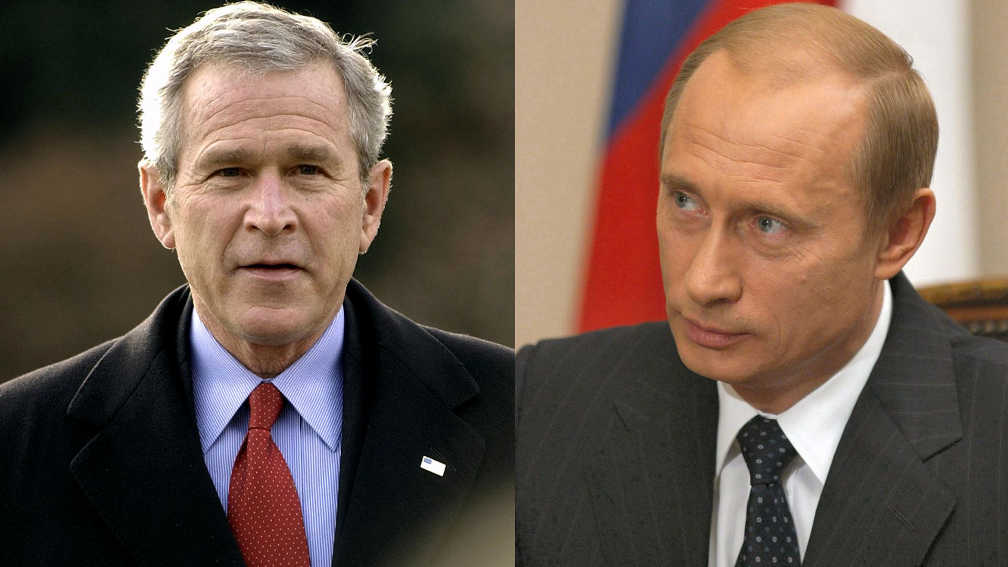

The National Security Archive has released newly declassified, word-for-word transcripts of private conversations between Russian President Vladimir Putin and former US President George W Bush. These discussions took place between 2001 and 2008.
The documents reveal that both leaders shared serious concerns about Pakistan’s nuclear stability. During their first face-to-face meeting in Slovenia in June 2001, Putin bluntly described Pakistan as “just a junta with nuclear weapons.” The remark reflected deep unease on both sides about who truly controlled Pakistan’s nuclear arsenal.
Public alliance, private doubts
After the September 11 attacks, the United States publicly built a close partnership with Pakistan’s then president, Pervez Musharraf, to fight terrorism. However, the transcripts show a very different picture behind closed doors.
Both Bush and Putin viewed Musharraf’s military-led government as a major nuclear risk. Putin openly criticised Western countries for failing to push Pakistan toward democracy. He believed this lack of pressure allowed serious nuclear dangers to grow unchecked.
AQ Khan casts a long shadow
The role of Abdul Qadeer Khan, the architect of Pakistan’s nuclear programme, dominates many of the conversations. In 2004, Khan admitted that he had run an international nuclear black market. He supplied centrifuge designs and sensitive material to Iran, Libya, and North Korea.
This admission badly strained relations between Washington and Moscow. It also confirmed long-held fears that Pakistan’s nuclear technology had spread far beyond its borders.
Iran link alarms both leaders
One of the most striking exchanges focused on Iran’s secret nuclear facilities and their links to Pakistani technology.
President Putin said, “But it’s not clear what the labs (Iran) have, where they are… Cooperation with Pakistan still exists.”
President Bush replied, “I talked to Musharraf about that. I told him we’re worried about transfers to Iran and North Korea. They put AQ Khan in jail, and some of his buddies. Under house arrest. We want to know what they said. I keep reminding Musharraf of that. Either he’s getting nothing, or he’s not being forthcoming.”
Putin then added, “As far as I understand, they found uranium of Pakistani origin in the centrifuges.”
Bush responded, “Yes, the stuff the Iranians forgot to tell the IAEA about. That’s a violation.”
Putin followed up by saying, “It was of Pakistani origin. That makes me nervous.”
Bush agreed, saying, “It makes us nervous, too.”
Putin pressed further with, “Think about us.”
Bush concluded bluntly, “We don’t need a lot of religious nuts with nuclear weapons. That’s what Iran has running the country.”
Indian intelligence sees confirmation, not surprise
For India, these disclosures do not come as a shock. Indian intelligence officials told CNN-News18 that the transcripts only confirm what New Delhi has believed for years. From India’s point of view, Pakistan’s nuclear programme has always posed a global security threat.
Indian agencies argue that the problem goes beyond the “rogue” actions of AQ Khan. They believe nuclear proliferation happened under state protection, with Pakistan’s military firmly in control and little civilian oversight.
A dangerous precedent for the region
From New Delhi’s perspective, the United States made a critical choice after 9/11. It prioritised counter-terror cooperation with Pakistan over holding Islamabad accountable for nuclear proliferation. This, Indian officials say, effectively shielded Pakistan from serious consequences.
As a result, the Pakistani security establishment felt emboldened. Indian agencies warn this has increased the risk of nuclear or radiological “leakage,” especially during future military stand-offs in the region.
To Indian intelligence, the most serious threat lies in the overlap between Pakistan’s military command and Islamist radical networks. This combination, they believe, continues to pose a major danger to regional and global stability.