
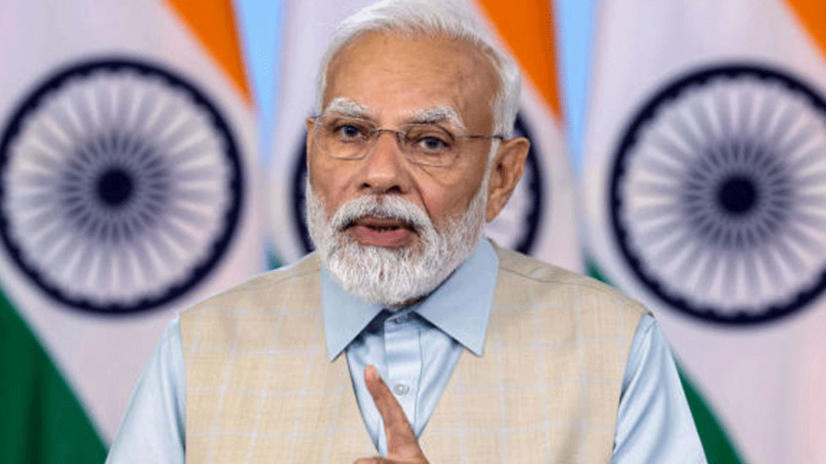

Prime Minister Narendra Modi on Tuesday said India has “boarded the Reform Express,” highlighting a series of major reforms introduced in 2025 across key sectors such as taxation, labour, trade, energy, education, and rural employment.
In a post on X, Modi said these changes strengthened India’s growth momentum and would support the long-term vision of a developed nation.
“India has boarded the Reform Express! 2025 witnessed pathbreaking reforms across various sectors which have added momentum to our growth journey. They will also enhance our efforts to build a Viksit Bharat," PM Modi wrote.
India has boarded the Reform Express!
— Narendra Modi (@narendramodi) December 30, 2025
2025 witnessed pathbreaking reforms across various sectors which have added momentum to our growth journey. They will also enhance our efforts to build a Viksit Bharat.
Shared a few thoughts on @LinkedInhttps://t.co/M30VgAAAR1
2025 marked as a year of continuous reforms
In a longer LinkedIn post, the Prime Minister described 2025 as a landmark year when reforms became a sustained national mission rather than isolated steps.
“2025 will be remembered as a year for India when it focused on reforms as a continuous national mission, building on the ground covered over the past 11 years. We modernised institutions, simplified governance, and strengthened the foundations for long-term, inclusive growth," he said.
Major GST and tax reforms unveiled
Among the most significant changes was a major restructuring of the Goods and Services Tax. The government introduced a simplified two-slab GST system of 5 per cent and 18 per cent to cut disputes and improve compliance.
The move reduced pressure on households, MSMEs, farmers, and labour-intensive industries. It also helped lift consumer spending during the festive season.
The government also announced major tax relief for the middle class. Individuals earning up to Rs 12 lakh annually were exempted from income tax. In addition, the Income Tax Act of 1961 was replaced by the Income Tax Act, 2025.
Boost for MSMEs and capital markets
To ease the burden on smaller firms, the government expanded the definition of small companies. Businesses with turnovers of up to Rs 100 crore now fall under this category, lowering compliance requirements.
In the insurance sector, the government allowed 100 per cent foreign direct investment. The aim is to increase insurance coverage, strengthen competition, and improve service quality.
For capital markets, the Securities Market Code Bill was introduced. The bill seeks to protect investors, improve governance, and reduce regulatory burdens.
Push for maritime, blue economy, and ease of doing business
The government passed five new laws related to the maritime and blue economy sectors during the Monsoon Session of Parliament. These laws replaced outdated legislation and aimed to cut logistics costs.
Under the Jan Vishwas initiative, the government repealed 71 obsolete laws to remove unnecessary criminal penalties. It also revoked or suspended several Quality Control Orders to lower costs and promote exports.
Labour, trade, and global engagement reforms
Labour reforms merged 29 existing laws into four labour codes. The changes aim to protect workers, reduce complexity for businesses, expand social security, and encourage greater participation of women in the workforce.
On the international front, India signed trade agreements with New Zealand, Oman, and Britain. It also operationalised a free trade agreement with the European Free Trade Association.
Energy, rural jobs, and education reforms
In the energy sector, the government introduced the SHANTI Act to support the safe and responsible expansion of nuclear power. The law also opens the sector to private participation and supports long-term clean energy goals.
Rural employment guarantees were increased from 100 to 125 days under a revised framework. In education, reforms proposed a single higher education regulator to replace multiple existing bodies, aiming to streamline governance and improve quality.
Together, the reforms of 2025 reflect what the Prime Minister described as a decisive push to modernise India’s economy and lay the groundwork for sustained and inclusive growth.