
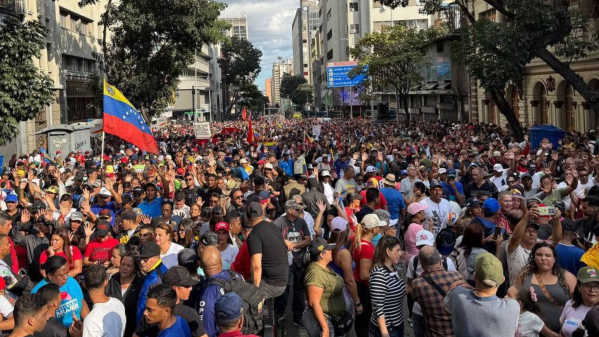

Supporters of Venezuela’s former leader Nicolas Maduro held protests on Saturday, one week after US forces captured him. However, turnout was far lower than in past demonstrations. Only a few hundred people gathered to demand his release, even as the interim government took steps to restore relations with the United States.
Around 1,000 protesters rallied in western Caracas. A few hundred more assembled in the eastern Petare district. They waved flags and held placards showing the faces of Maduro and his wife, Cilia Flores. In earlier years, Maduro’s allies had drawn much larger crowds.
Protesters Demand Return of Maduro
Some demonstrators said they would continue protesting until Maduro and his wife return home. Soledad Rodriguez, a 69-year-old supporter, voiced strong emotions.
“I’ll march as often as I have to until Nicolas and Cilia come back,” she said, referring to the couple who were taken to New York to face drug-trafficking charges.
“I trust blindly that they will come back – they have been kidnapped.”
Despite these calls, senior government leaders stayed away from the rallies.
Top Leaders Skip Demonstrations
No major figures from the interim government appeared at the protests. The administration has said it is reopening diplomatic contacts with Washington and discussing possible oil sales to the United States.
Interim president Delcy Rodriguez instead attended an agricultural fair. In televised remarks, she said she would “not rest for a minute until we have our president back.”
Two other powerful figures were also absent. Interior Minister Diosdado Cabello and Defence Minister Vladimir Padrino Lopez did not attend the demonstrations either.
Diplomatic Signals Toward Washington
Maduro’s son, Nicolas Maduro Guerra, released a video on Saturday claiming his father was “doing well” in jail.
Maduro’s capture followed deadly nighttime raids on January 3. The arrest shocked the country. However, signs of cooperation with Washington emerged soon after. This came following US President Donald Trump’s claim that he was now “in charge” of Venezuela.
Rodriguez said Venezuela would engage the US through “the diplomatic route.” Washington confirmed that US envoys visited Caracas on Friday to discuss reopening the American embassy.
A State Department official told AFP that the envoys left again on Friday “as scheduled.”
“The Trump Administration remains in close contact with interim authorities” in Venezuela, the official added.
The Venezuelan government did not respond to AFP when asked whether Rodriguez met the US delegation.
Balancing US Ties and Domestic Support
Rodriguez has promised to cooperate with Trump on access to Venezuela’s vast oil reserves. At the same time, she has tried to reassure Maduro supporters.
She stressed that Venezuela is not “subordinate” to Washington. This appeared aimed at calming a political base that remains loyal to the former leader.
Meanwhile, the US embassy in Colombia warned American citizens that “the security situation in Venezuela remains fluid.” It advised them to leave the country “immediately” as commercial flights become available.
Families Wait for Prisoner Releases
Outside Venezuelan prisons, families anxiously waited for the release of political detainees. The interim government had promised to free prisoners jailed under Maduro.
On Thursday, Rodriguez’s administration began releasing inmates. Officials said a “large” number would be freed. Washington took credit for encouraging the move.
However, prisoners’ rights groups said fewer than 20 people had been released by Saturday. Those freed included several high-profile opposition figures.
Families camped overnight outside El Rodeo prison, east of Caracas. Many slept on the pavement under blankets.
“I am tired and angry,” Nebraska Rivas, 57, told AFP while waiting for her son.
“But I have faith that they will hand him over to us soon,” she said, after spending two nights outside the prison.
Oil Talks Take Centre Stage
After Maduro’s capture, Trump pledged to secure access for US companies to Venezuela’s oil reserves. Currently, Chevron is the only US firm allowed to operate in the country under a sanctions exemption.
On Saturday, the White House said Trump signed an emergency executive order. It protects US-held revenues from Venezuelan oil sales and prevents courts or creditors from seizing them.
At a White House meeting on Friday, Trump urged top oil executives to invest in Venezuela. The response was cautious.
ExxonMobil chief executive Darren Woods called Venezuela “uninvestable” without major reforms.
Experts say Venezuela’s oil infrastructure has deteriorated after years of mismanagement and international sanctions.