
JUSZnews

NEWS WITHOUT INTERRUPTION

Subscribe
Operation Sindoor Takes Center Stage at Republic Day 2026 Parade, Showcasing India’s Military Prowess
The Operation Sindoor tableau at the 77th Republic Day parade showcased India’s tri-services combat power, highlighting joint military coordination, advanced technology, and a clear message of deterrence and readiness.
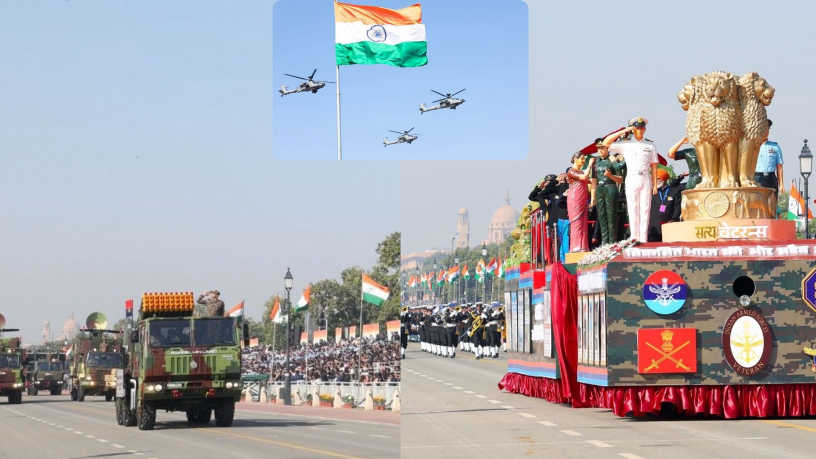
A spectacular tri-services tableau on Operation Sindoor stole the spotlight during India’s 77th Republic Day parade, highlighting the Army, Navy, and Air Force’s ability to conduct fast, coordinated, and high-impact operations. Complete with replicas of missiles, tanks, and an integrated command centre, the display sent a clear message of deterrence, readiness, and technological sophistication. President Droupadi Murmu took the salute as European Council President Antonio Costa and European Commission President Ursula von der Leyen looked on, witnessing India’s rare public demonstration of joint military capability.

Integrated Command Centre at the Core

At the heart of the tableau was a glass-encased integrated operational centre, representing real-time surveillance, mission planning, and execution. Digital panels showcased how satellite, drone, and radar data were fused to guide precision strikes and defensive maneuvers. Replicas of BrahMos cruise missiles, Akash air defence systems, and S-400 units were displayed, emphasizing India’s dual capability for deep strikes and airspace security. A senior defence official said, “The tableau represents how future conflicts will be fought through seamless coordination and real-time intelligence.”

From Retaliation to Deterrence: Operation Sindoor Explained

Operation Sindoor was launched on May 7, 2025, after a terror attack in Pahalgam, Jammu and Kashmir, which killed over two dozen tourists. Indian forces conducted coordinated strikes on terror camps in Pakistan and Pakistan-occupied Kashmir, sparking a four-day military standoff. During the confrontation, Pakistan attempted missile strikes on Indian cities, all intercepted by India’s layered air defence systems. Hostilities ceased on May 10 following a ceasefire request by Pakistani commanders. An officer involved in the mission said, “The operation established credible deterrence and demonstrated India’s readiness to escalate if provoked.”

Weapons and Systems on Display

The Operation Sindoor tableau featured scaled models of key platforms, including:
  • BrahMos supersonic cruise missiles for precision strikes
  • Akash and MRSAM systems for air defence
  • Suryastra Universal Rocket Launcher System
  • T-90 Bhisma and Arjun Main Battle Tanks
  • Nag Missile System Mk-2
These models recreated battlefield sequencing from reconnaissance to attack, showing the transition from platform-centric to network-enabled operations.

Tri-Services Coordination in Action

The tableau was followed by a phased battle array, simulating the operation in motion. The Army’s armored and mechanized columns moved in sync with Dhruv and Rudra helicopters. Apache and Prachand aircraft simulated close air support. Rafale, Su-30 MKI, and MiG-29 jets demonstrated air dominance achieved during Operation Sindoor. A parade official noted, “This is the first time the public is seeing how all three services fight as one force.”

Technology and the Future of Warfare

The Defence Research and Development Organisation (DRDO) showcased the Long Range Anti-Ship Hypersonic Missile (LR-AShM), highlighting India’s next-generation deterrence capabilities. Drone, counter-drone, and loiter munition units from the newly-raised Shaktiban Regiment underscored the increasing role of unmanned systems in modern warfare.

Strategic Messaging to the World

Analysts said highlighting Operation Sindoor during Republic Day, with European leaders present, sent a deliberate strategic signal. “The parade conveyed that India is no longer limited to defensive postures. It has demonstrated credible offensive reach and joint operational maturity,” a former senior military commander said. The presence of a European Union military contingent also reinforced India’s growing defence partnerships.

Public Response and Official Assessment

Spectators lining Kartavya Path applauded and captured the tableau on their mobile phones. Officials said the enthusiastic response reflects the public’s growing interest in India’s operational capabilities. “The tableau is not about showcasing weapons alone. It tells the story of planning, coordination, and execution,” said a defence official.

A Symbol of India’s Evolving Military Doctrine

Defence officials described Operation Sindoor as a reference point for India’s modern military doctrine, emphasizing speed, precision, and escalation control. “The message is simple: any attack on Indian civilians will invite a swift and decisive response,” an official said. As the tableau moved along Kartavya Path, flanked by tanks and fighter aircraft overhead, it reinforced the central theme of this year’s parade: a confident, capable, and combat-ready India.