
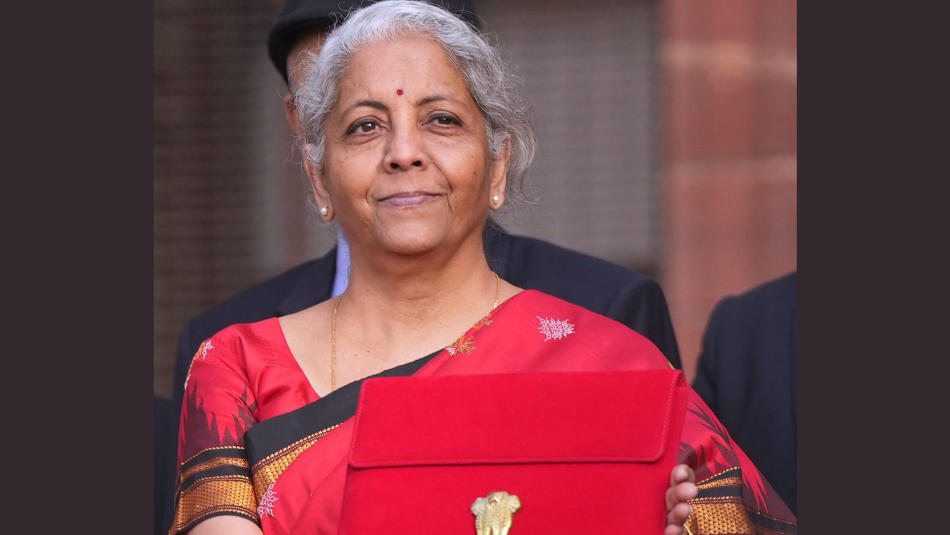

Finance Minister Nirmala Sitharaman presented the Union Budget 2026–27 on Sunday. The Budget strongly focuses on manufacturing, infrastructure, and job creation. It also proposes a simpler tax and customs system. Sitharaman described the government’s modernisation drive as a “reforms express”.
The Budget is built around three core kartavyas. These include boosting growth through higher productivity and competitiveness, building people’s skills, and ensuring inclusive development under the vision of Sabka Saath, Sabka Vikaas.
This was Sitharaman’s ninth consecutive Budget. She outlined several steps to sustain growth amid global uncertainty. These include expanding electronics and semiconductor manufacturing, reducing risks in infrastructure projects, skilling youth for new technologies, and easing compliance for taxpayers and importers.
Manufacturing Gets Major Push
Budget 2026 places strong emphasis on manufacturing. The government sharply raised the allocation for electronics components manufacturing to Rs 40,000 crore.
It also announced new schemes for rare earth magnets, chemical parks, container manufacturing, and capital goods. These measures aim to reduce imports and strengthen domestic supply chains.
The textiles sector received an integrated package that focuses on employment, covering fibres, clusters, skilling, and sustainability.
Infrastructure to Drive Growth
The government increased spending on infrastructure-led growth. It proposed higher capital expenditure and several new initiatives. These include a risk guarantee fund to support private developers, new freight corridors and national waterways, and REITs to recycle large real estate assets of central public sector enterprises.
A seaplane viability gap funding scheme was also announced.
The Centre raised its capital expenditure target to Rs 12.2 lakh crore for FY27, up from Rs 11.2 lakh crore in the current year. At the same time, the government aims to maintain fiscal discipline. Sitharaman said the fiscal deficit is expected to fall to 4.3% of GDP in 2026–27, compared to 4.4% this year.
The Budget places Tier-II and Tier-III cities at the centre of urban development through City Economic Regions linked to reforms.
“We shall continue to focus on developing infrastructure in cities with over 5 lakh population (Tier II and Tier III), which have expanded to become growth centres," Sitharaman said.
Strong Push for Skilling and Services Jobs
The Budget gives renewed importance to skilling, especially in the services sector. The government will set up a high-powered Education-to-Employment and Enterprise Committee. It will align training with market needs and emerging technologies.
Creative industries also received a boost. The Budget supports animation, visual effects, gaming, comics, design, and hospitality. It also promotes tourism-linked skilling, including guides and digital heritage work.
“I propose to support the Indian Institute of Creative Technologies, Mumbai in setting up AVGC Content Creator Labs in 15,000 secondary schools and 500 colleges," Sitharaman said.
AI and Semiconductor Strategy Strengthened
The Budget positions artificial intelligence as a tool across sectors rather than a standalone theme. It promotes AI use in governance, agriculture, education, and skilling. The government plans AI-based advisory tools for farmers and AI integration in education curricula.
The semiconductor push expanded under India Semiconductor Mission 2.0. The focus is on domestic equipment manufacturing, materials, research centres, and workforce development. This signals a long-term plan to build a strong chip ecosystem in India.
Big Changes in Taxation and Compliance
A major reform comes with the Income Tax Act, 2025, which will take effect from April 1, 2026. It introduces simpler rules and redesigned forms.
The Budget offers relief to taxpayers by extending the deadline for filing revised returns to March 31, instead of December 31. It also introduces staggered ITR deadlines.
Individuals filing ITR-1 and ITR-2 will continue to file returns until July 31. Non-audit business cases and trusts will get time until August 31.
“I propose to extend time available for revising returns from 31st December to up to 31st March with the payment of a nominal fee. I also propose to stagger the timeline for filing of tax returns. Individuals with ITR 1 and ITR 2 returns will continue to file till 31st July and non-audit business cases or trusts are proposed to be allowed time till 31st August," Sitharaman said.
The Budget clarified TDS rules for manpower services and proposed a rule-based system for lower or nil TDS certificates. It cut TCS rates to 2% for overseas tours, education, and medical expenses under the LRS.
To reduce litigation, the government proposed integrated assessment orders, lower pre-deposit requirements, and wider immunity provisions.
Sitharaman also said TDS on property sales by non-residents will be deposited using the buyer’s PAN instead of requiring a TAN.
Customs Duty Rationalised
The government continued customs duty rationalisation to support domestic manufacturing and clean energy. It extended exemptions for capital goods used in lithium-ion batteries, critical minerals, nuclear power, and aircraft manufacturing.
It cut customs duty on personal imports from 20% to 10%. The Budget also exempted 17 cancer drugs and additional treatments for rare diseases from customs duty.
Process reforms aim to enable trust-based and technology-driven clearances, faster cargo movement, and lower compliance costs, especially for exporters and MSMEs.
STT Hike Shakes Markets
The Budget raised securities transaction tax (STT) on futures from 0.02% to 0.05% and on options from 0.10% to 0.15%. This move unsettled markets. The Sensex fell over 2,300 points from the day’s high, while the Nifty dropped to 24,571.75.
PM Modi Reacts to Budget
Reacting to the Budget, Prime Minister Narendra Modi said, “The Union Budget reflects the aspirations of 140 crore Indians. It strengthens the reform journey and charts a clear roadmap for Viksit Bharat."