
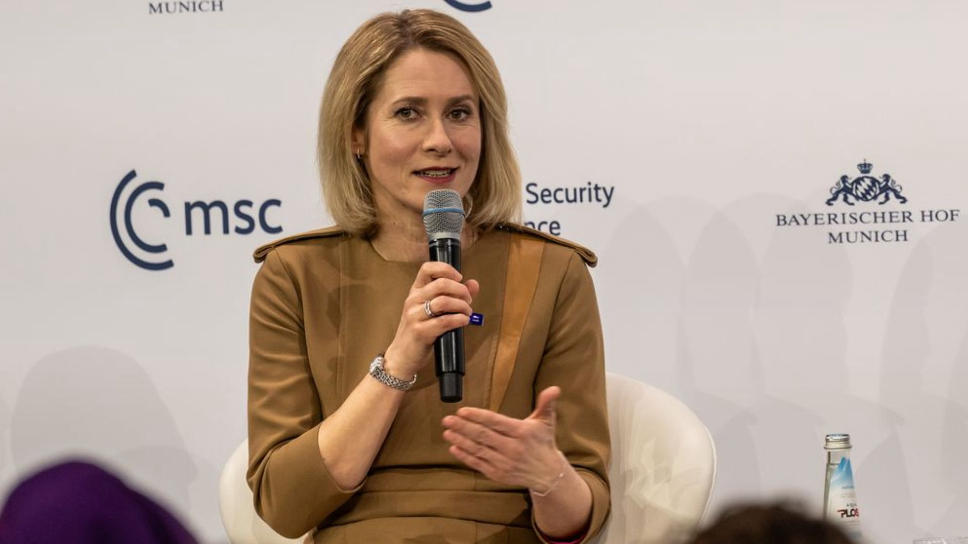

At the historic Bayerischer Hof, where the Munich Security Conference took place, sharp disagreements emerged over the future of the West. Kaja Kallas strongly rejected claims from the United States leadership that Europe is in decline.
She criticised the narrative promoted by the Donald Trump administration, which has warned about the continent’s future. Kallas dismissed those concerns and defended Europe’s direction and values.
Europe rejects decline narrative
The dispute intensified after the release of a recent US national security document that described Europe as weakened by migration, low birth rates, and liberal governance. Addressing global leaders on the final day of the conference, Kallas directly challenged that view and called it “European-bashing.”
“Contrary to what some may say, woke, decadent Europe is not facing civilisational erasure,” she said. “In fact, people still want to join our club and not just fellow Europeans.”
She argued that Europe remains attractive to people around the world and continues to stand as a symbol of opportunity and stability.
A growing gap in worldviews
The tension reflects a deeper difference between Washington and Brussels in how they see the modern global order. US officials have warned that Europe’s economic struggles reflect deeper cultural issues and could make the continent “unrecognisable” in the coming decades.
Marco Rubio spoke at the conference and took a softer tone but stood by the administration’s main position. He described the US as a “child of Europe” but warned that Western civilisation depends on strong borders and rejecting what he called a “climate cult.”
Kallas responded by presenting Europe’s focus on human rights and diverse societies as a strength. She said that during a recent visit to Canada, she saw strong interest in Europe’s model, showing that the “European project” still inspires people globally.
Greenland tensions add to mistrust
Relations between both sides have also been strained by the renewed US interest in Greenland. The proposal forced Denmark and its European allies to unite in defence of sovereignty.
Friedrich Merz highlighted this tension in his opening remarks, saying the “culture war of the MAGA movement is not ours.” Along with Emmanuel Macron, he called for Europe to build a stronger and more independent role within NATO. They even discussed the idea of a joint European nuclear deterrent to reduce reliance on Washington.
UK backs diversity and resilience
Keir Starmer also stressed that Europe’s strength lies in its diversity. He said open and free societies are “not against the tenor of our times,” but are instead the future.
Meanwhile, US leaders tried to reassure allies that the long-standing trans-Atlantic partnership would continue, even as they expect Europe to take on more responsibility for its own defence.
Ukraine war shifts focus to hard power
Despite the ideological disagreements, leaders found common ground on security. There was wide agreement that Europe must strengthen its military capabilities, especially as the war in Ukraine continues.
Volodymyr Zelenskyy warned that delays in decision-making are dangerous. “weapons evolve faster than political decisions,” he said, pointing to increased attacks by Russia on energy infrastructure during a harsh winter. He added that the Kremlin’s “idea of war” could go beyond Ukraine’s borders.
US officials remain doubtful about Russia’s willingness to negotiate, but they have made it clear that Europe should now take the lead in strengthening its conventional defence systems.
Europe pushes for strategic independence
For European leaders, this moment is not just about defence. It is also about building greater independence in global politics. Kallas described it as a chance for Europe to take control of its own future.
The message from the conference was clear. Europe may not agree with Washington’s view that it is in decline, but it is determined to prove its strength by acting as a confident and independent global power.