
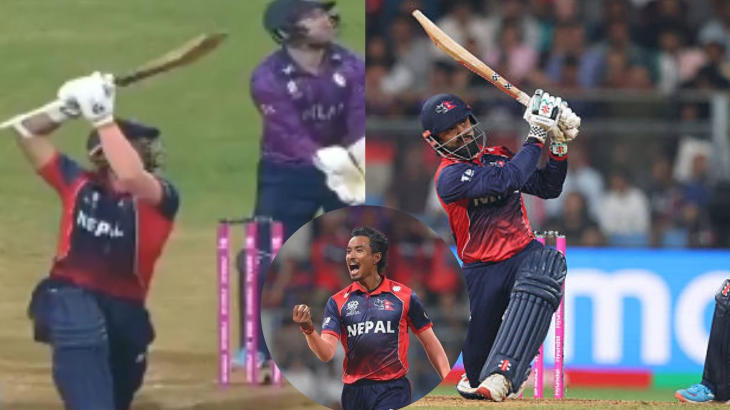

Nepal outclassed Scotland by seven wickets in the 33rd match of the ICC Men's T20 World Cup 2026 at Wankhede Stadium in Mumbai. Scotland scored 170/7 in 20 overs after being asked to bat first. A blazing knock of 71 runs off 45 balls by Michael Jones, along with his 80-run partnership with George Munsey for the first wicket and another 52-run stand with Brandon McMullen for the second wicket, helped Scotland reach a competitive total. However, they lost six wickets in the last five overs, slipping from 132/1 to 170/7 and adding only 38 runs. Sompal Kami (3/25 in 4 overs) was the most successful bowler for Nepal, while Nandan Yadav picked up two wickets.
While chasing, Kushal Bhurtel and Aasif Sheikh gave Nepal a blazing start, adding 74 runs for the first wicket. Nepal then lost a few quick wickets, but a blazing half-century by Dipendra Singh Airee helped the team finish the chase with four balls to spare. Airee scored 50 runs off 23 balls and remained unbeaten till the end. Michael Leask (3/30 in 4 overs) was the most successful bowler for Scotland.
With this win, Nepal finally secured a memorable victory in the tournament, beating Scotland in a dramatic contest in Mumbai. The result ended a 12-year wait for their third win in the competition’s history and was celebrated loudly by fans.
Scotland start strong but lose control
Scotland began confidently with an opening stand of 80 runs. Michael Jones looked in great touch and scored freely in the early overs. However, things changed in the second half of the innings.
Kami turned the game around with two quick wickets, which triggered a collapse. Scotland struggled to keep the momentum and lost several wickets in a short span.
Later, support from Nandan Yadav also helped restrict Scotland’s total. In just 27 balls, Scotland lost six wickets for 30 runs, which slowed their scoring badly.
Nepal’s chase begins well, then stumbles
Nepal’s openers gave a strong start and reached 74 without losing a wicket. However, the situation changed quickly when Michael Leask struck with the ball.
Leask took three key wickets, including dismissing Kushal Bhurtel, Aasif Sheikh and captain Rohit Paudel. His spell put Scotland back in the game as Nepal slipped from 74 for 0 to 98 for 3. At the end of 14 overs, Nepal needed 71 runs from 36 balls.
The crowd at Wankhede Stadium, largely supporting Nepal, grew anxious as the pressure increased.
Airee and Jha turn the match
Then Airee stepped in and changed the course of the match. He attacked confidently, hitting four fours and three sixes, and kept the scoreboard moving with quick running. He faced only two dot balls during his innings.
He built a steady and aggressive unbeaten partnership with Gulsan Jha, who supported him well with 24 runs from 17 balls. Together, they broke Scotland’s resistance and brought Nepal close to victory. Jha eventually struck the winning runs.
This victory helped Nepal recover emotionally from narrow defeats to Bangladesh, South Africa and England in the previous two editions.
Scotland’s bowlers fight early
Scotland started strongly with the ball and kept things tight in the early overs. Brad Currie even dropped a tough return catch off Bhurtel. Brad Wheal also came close to getting an early wicket, but a review showed the ball had touched the leg bail without dislodging it.
Bhurtel later attacked Mark Watt, hitting him for 4-6-6 in one over. Nepal finished the powerplay strongly at 56 without loss.
However, Leask’s introduction brought Scotland back into the match. His first ball resulted in Bhurtel’s dismissal, caught by Tom Bruce. He continued his impact by removing Sheikh and Paudel, putting Nepal under pressure.
Airee’s late assault seals the chase
Jha began the recovery by hitting Oliver Davidson for a boundary. Soon after, Airee took control of the match. He struck two consecutive sixes off Leask and followed it with powerful shots that brought Nepal back into the contest.
As the required runs dropped quickly, the crowd grew louder. Airee continued attacking, and when Jha hit a six over extra cover off Currie, the match was nearly sealed. Nepal soon crossed the finish line, sparking celebrations among fans.
Scotland’s innings built on strong start
Earlier, Scotland had chosen to bat on a slightly worn surface. Their openers made the most of the conditions. George Munsey and Jones added quick runs, with Scotland reaching 50 in just 32 balls.
Jones later built another solid partnership with Brandon McMullen. After 15 overs, Scotland were in a strong position at 131 for 1.
But Kami changed everything. He dismissed Jones with a well-disguised slower ball and then removed McMullen with a brilliant one-handed catch in his follow-through. He later got Bruce as well, celebrating calmly in a Buddha-style pose after turning the match around.
Despite a final six from Watt, Scotland’s total proved insufficient as Nepal completed a dramatic and emotional win.
Nepal played overall good cricket in this World Cup. Against Scotland, Sompal Kami, the only player remaining from Nepal’s 2014 campaign, led the fight with the ball. Later, Dipendra Singh Airee played a match-winning knock, smashing an unbeaten 50 off just 23 balls to guide his team through a tense chase. This was a historic win for Nepal and a match they will never forget. Although Nepal failed to advance to the Super Eight, they won hearts with their performance. The crowd in the stadium made it feel as if you were not in Mumbai; instead, it gave the feeling of being in Nepal. Scotland also fought hard in all the matches. They won against Italy by a big margin. Hopefully, Scotland has learned from its mistakes and will improve its batting and bowling to produce better results. Get ready for more actions. Stay tuned with JUSZNEWS for regular updates!