
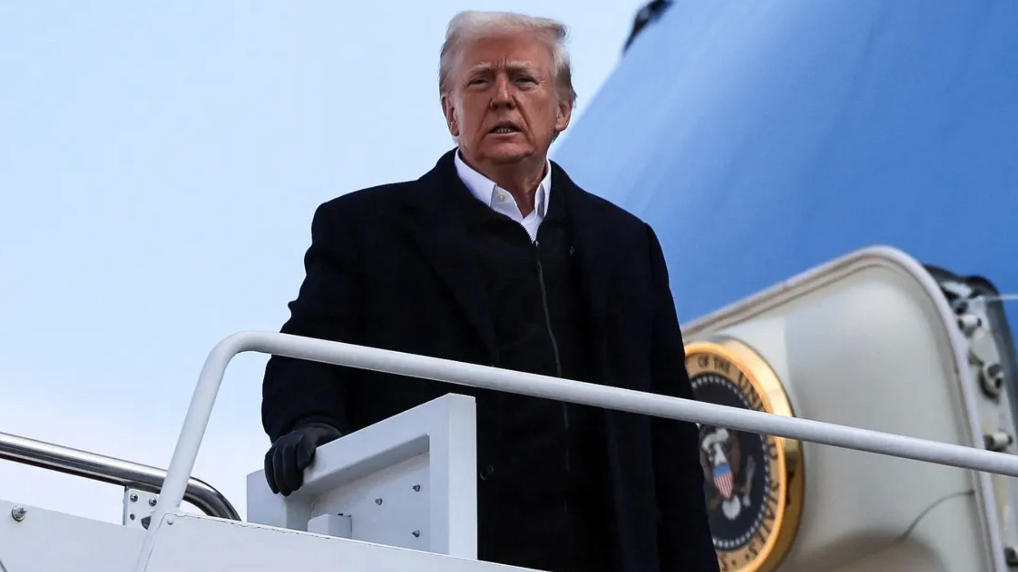

US President Donald Trump has extended the deadline for deciding on possible action against Iran from 10 days to up to 15 days. He made the announcement on Thursday while speaking to reporters aboard Air Force One.
“10-15 days, pretty much maximum," Trump said when asked about the timeframe for his decision.
He made it clear that the United States expects a deal. “We’re either going to get a deal or it’s going to be unfortunate for them,” he said.
Earlier the same day, Trump had warned that “bad things will happen” if Iran fails to reach an agreement with Washington. At the first meeting of his Board of Peace in Washington, DC, he said, “We may have to take it a step further, or we may not. Maybe we’re going to make a deal,” as quoted by CNN.
“You’re going to be finding out over the next probably 10 days, but this meeting today is proof with determined leadership, nothing is impossible,” he added.
Military Option Under Consideration
According to CNN, the US military is ready to carry out strikes on Iran as early as this weekend. However, Trump has not yet given final approval for military action.
The report said the president has privately reviewed arguments both supporting and opposing a strike. He has also spoken with advisers and international partners to decide the best course of action.
At the same time, Trump again urged Tehran to come to the negotiating table. “Now is the time for Iran to join us on a path that will complete what we’re doing. And if they join us, that will be great. If they don’t join us, that will be great too, but it will be a very different path. They cannot continue to threaten the stability of the entire region, and they must make a deal,” he said.
“If it doesn’t happen, it doesn’t happen. Bad things will happen if it doesn’t,” Trump added.
Rising Military Tensions
In recent weeks, Trump has moved aircraft carriers, warships and fighter jets into the region. This buildup has increased fears of another possible strike on Iran.
Last June, the United States and Israel carried out joint airstrikes on Iran’s nuclear facilities and selected military sites.
Meanwhile, US Secretary of State Marco Rubio is scheduled to meet Israeli Prime Minister Benjamin Netanyahu on February 28. According to Reuters, the two leaders will discuss Iran during their meeting.
Key US Demands
Washington is demanding that Tehran completely stop uranium enrichment. While uranium enrichment can be used for civilian nuclear energy, it can also produce material for nuclear weapons.
The United States and Israel are also pushing Iran to limit its long-range ballistic missile programme. They want Iran to stop supporting armed groups across the Middle East and to end the use of force against domestic protesters.
However, Iran has refused to negotiate beyond its nuclear programme. It has described limits on its missile system as a red line.
Iran’s Response and Regional Moves
Satellite images show that Iran has been repairing and strengthening its nuclear and missile sites in recent months. At the same time, US military bases across the Middle East have increased their preparedness.
Tehran has also carried out joint military exercises with Russia. In addition, it expanded naval drills in the Gulf of Oman. State media broadcast footage showing special forces deployed by helicopter and sea.
Trump first renewed threats of strikes in January, when Iranian authorities used deadly force to suppress large-scale protests.
As tensions rise, the next 10 to 15 days could prove critical for both Washington and Tehran.