

The conflict involving the United States, Israel and Iran has entered its second week. Airstrikes continue to hit the Iranian capital Tehran. Iran has also carried out retaliatory attacks across the Middle East.
Amid rising tensions, Iran’s Islamic Revolutionary Guard Corps (IRGC) announced the 27th wave of attacks under “Operation True Promise 4.” The force said the operation targeted American and Israeli positions. Iran described the attacks as a response to what it called “unprovoked US-Israeli aggression towards the Islamic Republic.”
Iran Uses New Solid-Fuel Missile Technology
The IRGC said its Aerospace Division used newly developed solid-fuel missiles in the latest strikes. The attacks reportedly targeted Israeli military sites in Haifa.
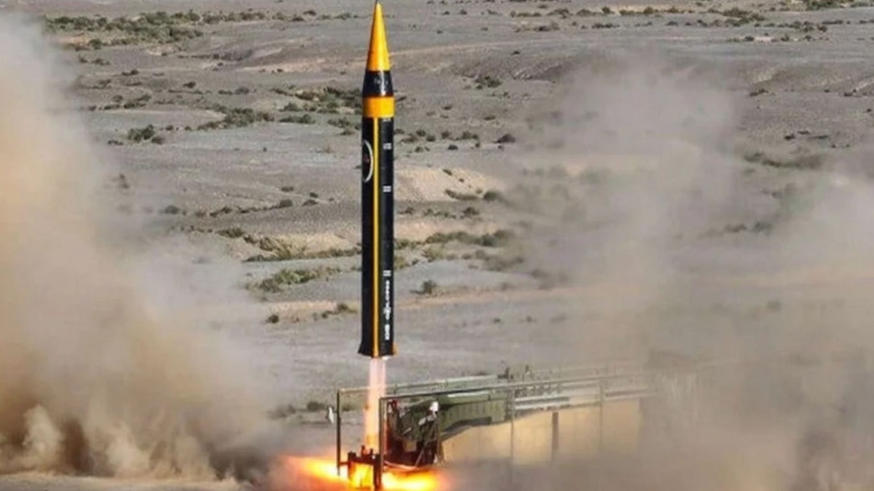
"In this strategic and multidimensional operation, Zionist military targets in [the occupied city of] Haifa were struck by the IRGC's Aerospace Division's new solid-fuel Kheibar-Shekan missiles, which possess terminal guidance capability up to the point of impact," the official dispatch stated.
The statement said the missiles can guide themselves until they hit the target.
What Are Solid-Fuel Missiles?
Solid-fuel missiles store their fuel inside the rocket. This design allows armies to launch them quickly.
Liquid-fuel missiles work differently. Operators must fill them with fuel before launch. That process takes time and preparation.
According to Reuters, solid fuel usually contains metallic powders such as aluminium mixed with an oxidiser like ammonium perchlorate. A rubber-like material binds the mixture inside a metal casing.
Why These Missiles Are Harder to Stop
Solid-fuel missiles offer several advantages. They can launch quickly because they do not require fueling before launch.
This speed reduces the chance that enemies detect the launch site. Many systems also launch from mobile platforms. Armies can move them between locations, which makes them harder to track.
These missiles also need less logistical support. They remain ready for long periods because the fuel stays inside the rocket. Operators can launch them within minutes, leaving air-defence systems little time to react.
Inside the Kheibar Shekan Missile
The missile used in the latest attack is the Kheibar Shekan missile, operated by the IRGC Aerospace Force.
The name “Kheibar Shekan” means “Castle Buster” or “Fortress Buster.” The missile is designed to destroy fortified targets.
Iranian media say the missile has a range of about 1,450 kilometres. This range allows Iran to strike Israel from western Iran.
The missile uses satellite guidance and a manoeuvrable warhead to improve accuracy. It measures about four metres in length and weighs roughly 1,500 kilograms.
Reports say it can reach speeds of about 19,500 km/h inside the atmosphere and around 9,800 km/h outside it. These speeds make interception difficult even for advanced defence systems.
The missile uses a single-stage solid-fuel motor called the Arond engine. Engineers integrated the engine into the fuel tank to reduce the missile’s size and improve stealth.
The system can launch from mobile platforms. Crews can prepare it for firing in less than 15 minutes. It carries a high-explosive warhead weighing between 550 and 600 kilograms.
Part of Iran’s Expanding Missile Arsenal
The Kheibar Shekan belongs to Iran’s Khorramshahr family of ballistic missiles. Iran introduced the first version in 2017 and later upgraded the system.
Early versions used liquid fuel. Newer models rely on solid fuel. This change makes them lighter, faster to deploy and easier to move.
Iran operates one of the largest missile programmes in the Middle East. Its arsenal includes short-range and medium-range ballistic missiles.
Short-range missiles usually travel 150 to 800 kilometres. They target nearby military bases.
Medium-range missiles such as the Shahab-3 missile, Emad missile, Ghadr-1 missile, Sejjil missile and the Kheibar Shekan can travel 1,500 to 2,000 kilometres, according to Al Jazeera. These weapons can reach Israel, US-linked bases in the Gulf and other regional targets.
Iran Also Deploys Drones
Iranian state media said the military also deployed unmanned aerial systems during the latest operation.
According to the IRGC statement, drone units "successfully targeted the location where American forces are stationed in 'Marina,' in the vicinity of the buildings of the 'Warner Brothers' company," during the 27th wave of Operation True Promise 4.
Authorities in Dubai confirmed that debris from an interceptor missile killed one person during the exchange.
At the same time, the IRGC Navy reportedly engaged facilities connected to the US Fifth Fleet in Bahrain. The incident suggests that the conflict is expanding across multiple fronts.
Hundreds of Missiles and Drones Fired
The IRGC said Operation True Promise 4 began after foreign strikes last week. Since then, Iran has launched hundreds of ballistic missiles and drones.
The attacks have targeted key locations such as Tel Aviv, Jerusalem and the technology hub of Be’er Sheva.
As the war intensifies, analysts warn that advanced missile systems could further widen the conflict across the Middle East.