
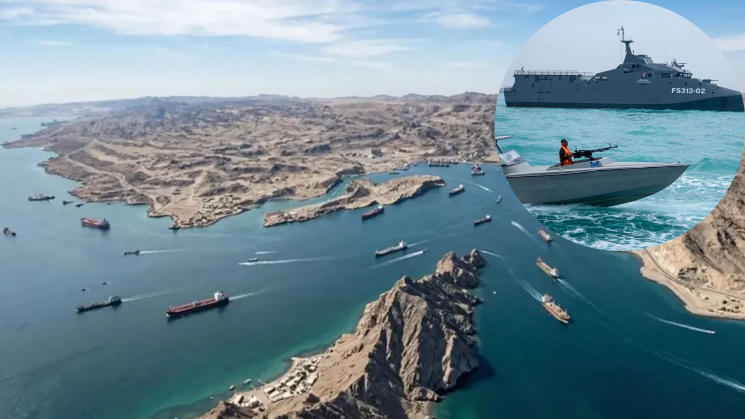

Iran sharply increased its warning on Sunday. It said it would respond strongly if US President Donald Trump carries out his 48-hour threat to attack Iran’s power grid. Iran warned that it could target energy and water systems across Gulf countries.
The Islamic Revolutionary Guard Corps (IRGC) signalled a wide and serious response. It said the Strait of Hormuz could be completely shut. It also warned companies linked to the US and countries hosting American military bases. This puts Saudi Arabia, Qatar, the UAE, Bahrain, and Kuwait at direct risk.
“The Strait of Hormuz will be completely closed and will not be opened until our destroyed power plants are rebuilt,” the Guards said in a statement.
Trump Threatens to Destroy Iran’s Power Plants
Meanwhile, Donald Trump issued a strong warning of his own. In a post on Truth Social, he asked Iran to ensure safe and free movement through the Strait of Hormuz. This route is very important for global oil shipments and has already faced disruptions due to rising tensions.
“If Iran doesn’t fully open, without threat, the Strait of Hormuz within 48 hours from this exact point in time, the United States of America will hit and obliterate their various power plants, starting with the biggest one first,” he said.
Iran Warns of Wider Retaliation
Iran made it clear that any attack would lead to a much broader response. Iranian military spokesman Ebrahim Zolfaqari said Iran would not limit its retaliation.
“If Iran’s fuel and energy infrastructure is attacked by the enemy, all energy infrastructure, as well as information technology…and water desalination facilities, belonging to the US and the regime in the region will be targeted pursuant to previous warnings,” Iranian military spokesman Ebrahim Zolfaqari said, according to state media.
This warning suggests that key systems like energy, technology, and water supply could all become targets.
Gulf Nations Face Water Supply Risks
Gulf countries rely heavily on desalination plants to get drinking water. These plants run on electricity. Bahrain and Qatar depend almost fully on this system. The UAE and Saudi Arabia also rely on it for a large share of their water needs.
Therefore, any attack on power systems could quickly affect water supply. This makes these countries highly vulnerable if the conflict spreads.
Fighting Intensifies Across the Region
The conflict has already turned violent. On Sunday, air raid sirens rang across Israel as Iranian missiles hit several locations. Reports said people were injured in Arad and Dimona. Later, Israel confirmed it carried out strikes on Tehran in response.
At the same time, the crisis in West Asia continues to grow. The war has now entered its fourth week. Iran has fired long-range ballistic missiles towards a US-British base in the Indian Ocean. It has also struck areas near Israel’s nuclear facility close to Dimona, showing its long-range capabilities.
In another development, fighting between Israel and Hezbollah has become more intense. Israeli forces are carrying out operations in southern Lebanon. Hezbollah has launched repeated rocket attacks into northern Israel. Casualties are rising fast. Reports say more than 1,000 people have died in Lebanon since early March.
Economic Impact and Global Concerns Rise
The conflict is also affecting the global economy. Oil prices have surged. Shipping routes are facing disruptions. Experts are warning that instability could increase further.
“President Trump’s threat has now placed a 48-hour ticking time bomb of elevated uncertainty over markets,” said IG market analyst Tony Sycamore.