
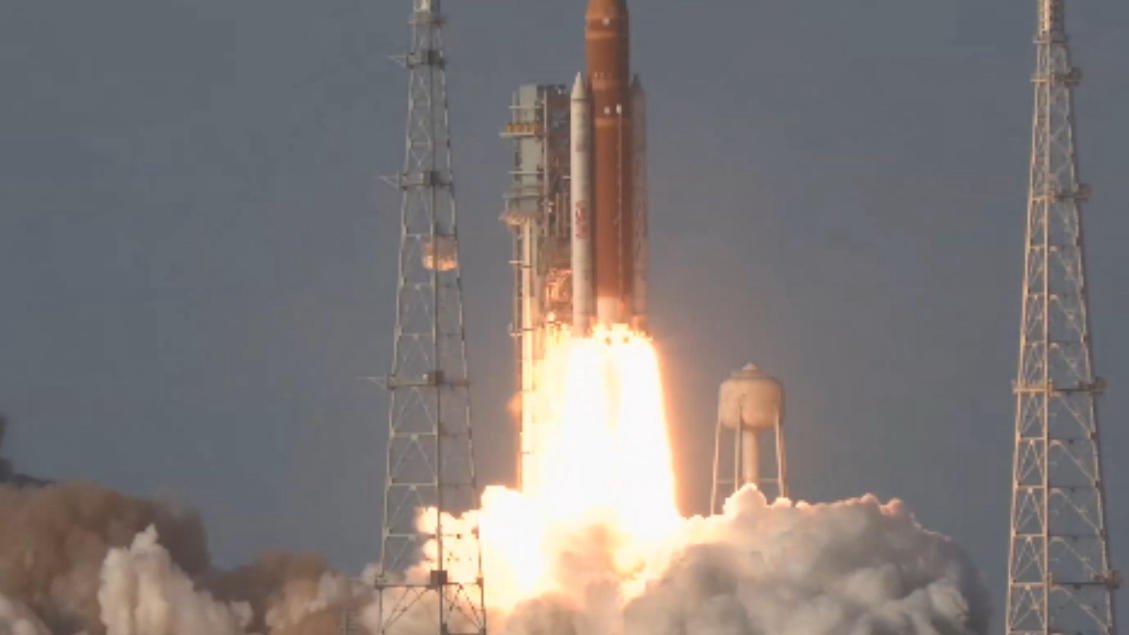

NASA launched Artemis II on Wednesday evening. The mission marks the first human journey toward the Moon in nearly 54 years. The spacecraft is now orbiting Earth. It will continue until Thursday. Then, engineers will carry out the translunar injection burn. This step will send the spacecraft on its 240,000-mile journey to the Moon.
Astronauts Begin Work in Space
Four astronauts are onboard the Orion capsule. They quickly started checking how the spacecraft performed during launch. The rocket reached a speed of 17,500 mph during ascent.
Mission control in Houston confirmed a key milestone. All four solar arrays deployed successfully. These panels will provide power throughout the mission.
Liftoff.
— NASA (@NASA) April 1, 2026
The Artemis II mission launched from @NASAKennedy at 6:35pm ET (2235 UTC), propelling four astronauts on a journey around the Moon.
Artemis II will pave the way for future Moon landings, as well as the next giant leap — astronauts on Mars. pic.twitter.com/ENQA4RTqAc
First Mission Beyond Earth Orbit Since 1972
This mission is historic. Humans have not travelled beyond low Earth orbit since Apollo 17. Commander Reid Wiseman highlighted the moment. He said, “The nation, and the world, has been waiting a long time to do this again.”
Crew Makes History
The crew includes three Americans and one Canadian. Christina Koch will become the first woman to travel into cislunar space. Victor Glover will become the first person of colour to do so.
Jeremy Hansen will make history as the first non-American on this journey.
Mission to Break Distance Record
The spacecraft will travel farther than any human mission before. By day six, the crew will move over 4,600 miles beyond the far side of the Moon. They will reach nearly 253,000 miles from Earth.
This will break the record set by Apollo 13.
Step Toward Future Moon Base
NASA sees Artemis II as a key step forward. The agency plans to build a Moon base by the end of the decade. Jared Isaacman leads this effort.
Astronauts will photograph the Moon’s south pole. They will capture images from 4,000 to 6,000 miles above the surface. This area is important for future landings.
Testing for Future Missions
Astronauts will test critical systems during the mission. These include life-support and onboard technology. The results will support future missions like Artemis IV, planned for 2028.
Life Inside the Capsule
Astronauts will live inside a small space. The Orion capsule measures about five metres in diameter. They will stay there until splashdown in the Pacific Ocean. Scientists will monitor their health. They will study the effects of radiation and microgravity.
Wiseman spoke about the challenge. “Like clicking a pen cap can annoy somebody over 10 days in a small capsule.”
He added, “We have got a great dialogue together, and we talk through those sorts of things, but there are definitely going to be things by day six, seven, eight, nine that we’re like, ‘Man, all right, I need a little space, and I can’t get any right now.’ But we are a good crew.”